Зміст
Bench or pouf – the short answer if you’re in a hurry
Banquet — is a “bench with discipline”: longer, more stable, often with a shelf/niche, ideal for a hallway, foot of the bed, dressing room.
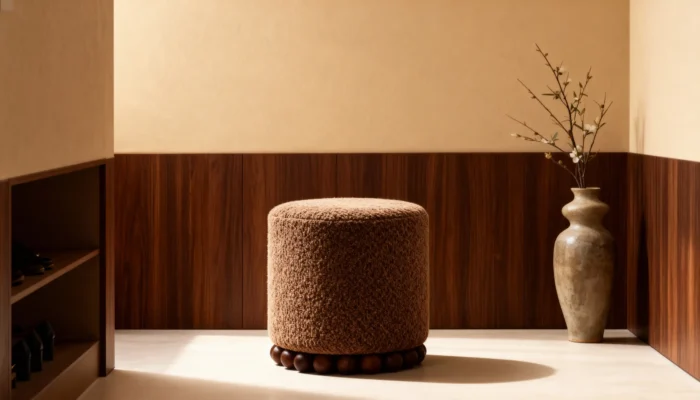
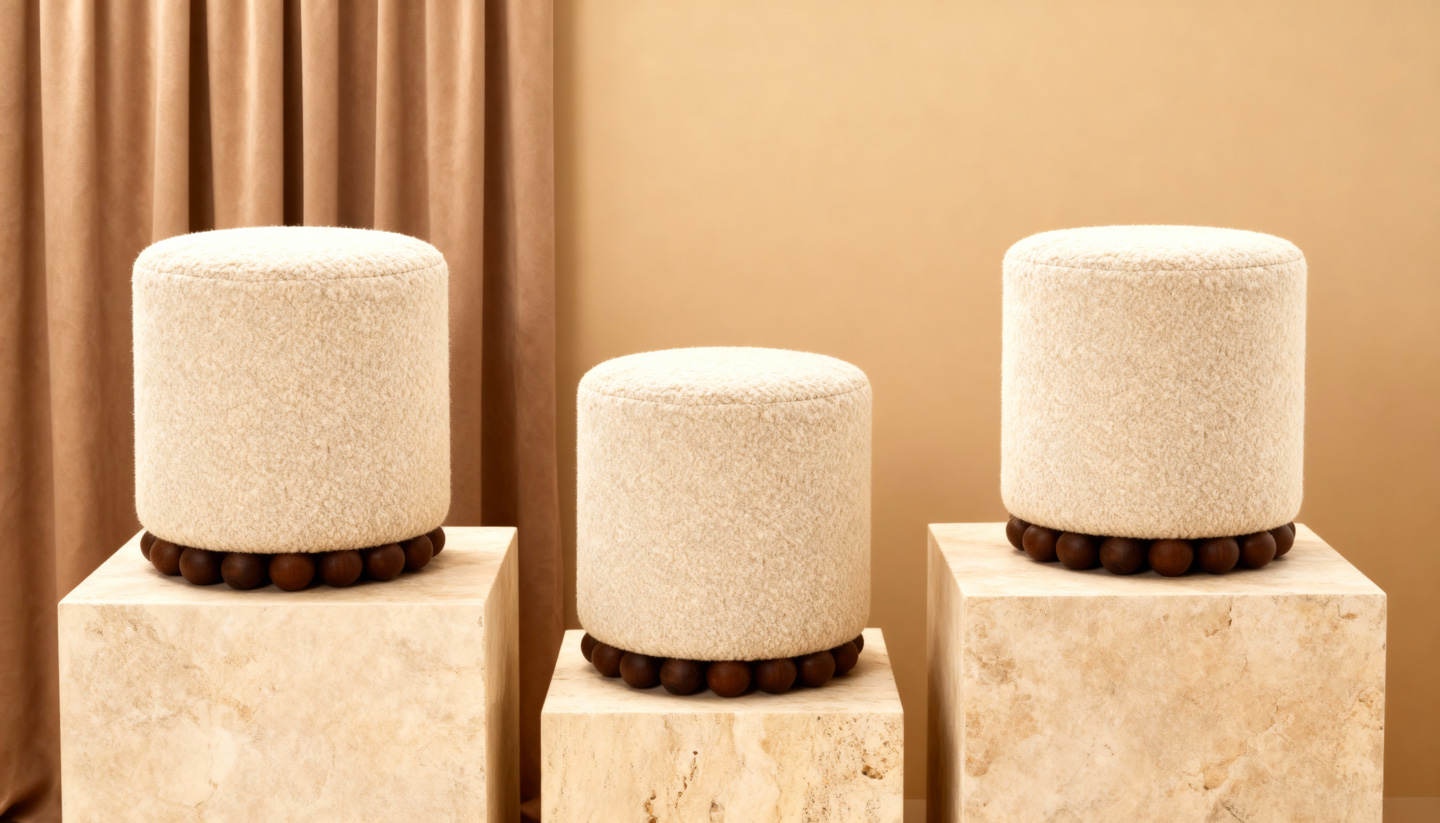
Pouf — is a “mobile module”: compact, easy to move, works as an extra seat, a footrest, a shape/color accent, sometimes with storage.
If you have a daily scenario of “put on/take off/put down bag/left” — a banquette usually wins. If you need flexibility of “slid/rearranged/added a seat for a guest” — a pouf.
What is a banquette in a modern interior?
Banquet Today, it is not a “retro bench,” but a compact comfort station. It solves three problems at once:
Landing without chaos. Sit for 20–30 seconds — but correctly: don’t balance on the edge of the bed, don’t lean against the wall, don’t lose your balance in the hallway.
Order in the little things. A bag, scarf, package, plaid, slippers — things get “temporary parking” instead of falling into random corners.
Style line. A banquette creates a sense of collectedness — especially in minimalism, modernism, and futuristic modernism.
Where is the strongest bench?
Hallway / corridor: a place for shoes, a place for a bag, a support for the daily start.
Foot of the bed: fold the blanket, sit down, change your shoes, “remove” the visual load from the bed.
Wardrobe: short changing sessions without searching for a chair.
What is a pouf and why is it “small but strategic”?
Pouf — is a furniture “scenario switch.” It is needed where you want freedom: today by the chair, tomorrow by the window, the day after tomorrow — as an additional place for a guest.
In bedrooms, a pouf often becomes that “small object” that raises the standard of living: sit down, tie your shoelaces, put on a blanket, slide it to the dressing table — and all this without unnecessary movements.. Kaizen
Poof works best when you know the script clearly.
Footrest: Elasticity and area are important.
Guest place: Loads and stability are important.
At the dressing table: critical height to avoid “breaking” the landing. Kaizen
Table: banquette vs pouf – how to choose without mistakes
| Parameter | Banquet | Pouf |
|---|---|---|
| Main role | Stable landing + order | Mobility + additional scenario |
| Where is the best? | Hallway, foot of the bed, dressing room | Bedroom, living room, reading area, near the mirror |
| Dimensions | More often longer (2 seats/long line) | More often compact (1 seat/module) |
| Storage | Shelf/niche/drawer – very appropriate | Can be “chest” or without storage |
| Visual effect | Makes the space “put together” | Adds softness/accent to the shape |
| If space is small | It’s good if it doesn’t block the aisles. | Very good: easy to rearrange |
| Typical error | Take too deep/massive | Take too soft/unstable |
What height is right: the key to real comfort
The rule is simple: The seat height should support your movement, not hinder it.
Hallway: It is comfortable when the knees do not “fall” down and the foot stands confidently on the floor.
Foot of the bed: It is convenient when the bench/pouf is approximately at the level of the bed or slightly lower – this makes it easy to get up.. Kaizen
At the dressing table: The height should match the height of the countertop – otherwise the shoulders will rise and the back will get tired.. Kaizen
Practical life hack: if you are in doubt between two heights, choose the one from which easier to get up. This is felt within the first 5 seconds of the test.
Materials and upholstery: how to make it “premium” and not be nervous about everyday life
Key answer: The upholstery should withstand your pace, not demand a different life from you.
For the hallway
wear-resistant fabrics with structure (small marks are less visible),
simple local cleaning,
a stable base so that the furniture does not “walk around”.
For the bedroom
tactilely pleasant velour/chenille/structured fabrics,
well-thought-out elasticity of the filler (so that it does not turn into a “bag”). Kaizen
Quote about the KAIZEN approach: “Comfort is not just softness. It is precise elasticity and correct geometry that save your movements every day and add a sense of control over space.”
Bench with or without storage: the honest logic of choice
Short: If you have small items that always “don’t have a home,” take them to storage.
When storage is definitely needed
narrow corridor without a cabinet,
lots of seasonal little things (hats/gloves/brushes),
family with children (more things than planned).
When is it better to go without storage?
if maximum lightness and minimalism are important,
if the bench is part of a pure composition (and the order is already decided by other modules).
How to “sew” a banquette and ottoman with the rest of the furniture to make the interior look more expensive
Best result It turns out that a bench/pouf is not a random purchase, but part of a system: light → seating → space for things → rhythm of movement.
In the living room, a pouf often logically continues the soft area: it provides additional comfort without overloading the composition.
If you think of space in “scenarios”, it’s worth looking at how KAIZEN approaches the central element of the seating area – the sofa: the logic of sizes, shapes and usage scenarios is well laid out there.. Kaizen
Internal quote-transition #1 (to the article about sofas)
Do you want the pouf and bench to work not “by themselves”, but as part of a single soft zone? See the logic of choosing a sofa for your scenarios — sofa in the living room: sofas Lviv. Kaizen
KAIZEN approach: why an individual format often wins over a “ready-made” one
The answer without pathos: In compact furniture, centimeters, fit, and details matter. They either add speed to your daily life or imperceptibly take up your resources.
What the KAIZEN approach gives in banquettes and poufs:
custom size for real passage and planning,
elasticity selection according to your scenario (fast landing vs relaxation),
selection of materials for your everyday life,
preliminary 3D visualizationso that bold decisions are controlled,
possibility of author’s printswhen you want a personal accent without chaos. Kaizen+1
Internal quote-transition #2 (to the article about the pouf in the bedroom)
If your focus is the bedroom and you want to choose the shape, height, and filling as accurately as possible, keep this guide for yourself: soft pouf in the bedroom — it details scenarios and “comfort for the future”. Kaizen
Typical mistakes that make a bench or pouf “not fit”
Quick answer: People often choose with their eyes, but they have to live with their bodies.
Incorrect height. It looks beautiful in the photo, but it’s inconvenient to get up every day.
Too soft for the hallway. A quick landing requires resilience, not “failure.”. Kaizen
Massive format in a narrow aisle. Minus the speed of movement, minus the sense of space.
Ignoring care. If the fabric is difficult to clean, it will become a source of constant microstress.
Casual style. The pouf/banquet should either support the main shapes (radii/lines) or be a controlled accent.
Pouf + armchair: a combination for reading, working and rebooting
In many interiors, the strongest pair is armchair + pouf: the chair maintains ergonomics, the pouf adds relaxation and a change of position. If you are also choosing a chair (especially for working from home), check the criteria for fit and back support – this directly affects productivity and well-being. Kaizen
Internal quote-transition #3 (to the article about chairs)
To avoid making mistakes with fit, dimensions, and back support, check out the guide. buy a chair in Kiev — there is a well-structured selection for home and office. Kaizen
Mini Pre-Purchase Checklist: 60 Seconds That Save Years
Where will (point + passage) stand?
What exactly is it for (putting on shoes / relaxing / guests / dressing table)?
What height is comfortable for standing up?
Is storage necessary?
What upholstery will hold up to your pace?
Should there be mobility (easy to move) – then poof.
FAQ
1) What is better for a hallway: a bench or an ottoman?
For everyday wear, it often wins. banquet: more stable, gives more order. Pouf – when you need maximum mobility or very little space.
2) Does an ottoman with storage make sense?
Yes, if you have small items without a “home.” But check the tightness of the fit: it should remain comfortable, not “empty.”
3) Which shape of pouf is more practical?
Round — softer in aisles and visually “breathes”; square/rectangular — disciplines space and often provides more functions.
4) Is a footstool at the foot of the bed about beauty or utility?
About both. It adds a “sit/fold/put down” scenario, and at the same time makes the bedroom more organized.
5) When should you make a custom-made banquette or pouf?
When centimeters (passage/niche) decide, a specific fit is needed, or you want the exact combination of materials and style for the interior.