Зміст
What are coffee tables today and why are they important?
Coffee tables have long ceased to be just a “place for the remote control.” They are the centers of gravity of the recreation area, organizers of small things, accent objects in the interior, and tools that influence your daily scenarios: how you read, work, communicate, and relax.
When you decide which buy a table, you actually choose how your space will work: will the living room be a perpetual mess, or will everything have its place; will you be able to comfortably place a laptop and a cup of coffee, or will you have to “juggle” things.
Studio KAIZEN looks at coffee tables as compact but very influential elements of the system: it small architects your comfort.
What task should your coffee table cover?
It’s worth starting not with shape or color, but with function. We answer right away:
Question: What do you really need a coffee table for?
Short answer: It must solve specific problems:
surface for coffee, books, appliances;
storage space (shelves, drawers, niches);
accent design element;
a mobile assistant that is easy to rearrange.
Next, let’s expand on the scenarios.
Most common usage scenarios
“Coffee + books + remote control”
A small coffee table with a shelf: a simple surface on top, magazines, books, and appliances on the bottom. For minimalists and lovers of order.“Home office in the living room”
A well-thought-out table with greater depth and a stable base where you can put a laptop, notepad, cup. Ergonomics are already at work here: height and stability are important, just like in a full-fledged desktop.“Guest evenings”
Low coffee table-transformer, which can be folded out or combined with additional modules when friends come over.“Minimum visual noise”
A glass coffee table or a model with thin metal supports – for the effect of visual lightness when the living room is small.“Children’s scenarios”
Rounded shapes, soft radii, no sharp corners. For families with children, this is not just a design issue, but a safety issue.
“A well-designed coffee table is not an object, but a script: it subtly dictates how you spend your time in your space.”
Which table to buy for your space: dimensions, proportions, distances
Question: What height and size should a coffee table be to make it comfortable to use?
Respond: Focus on the sofa and the dimensions of the room.
Basic guidelines
Height:
Coffee tables are usually made in the range of 35–50 cm.
Optimally, at the level of the sofa seat or 2–3 cm lower so that the hand naturally reaches the surface.Length:
1/2–2/3 of the length of the sofa. If the table is too long, it “eats” air, if it is too short, it is inconvenient to use.Distances:
40–45 cm from the sofa to the table is a comfortable passage for legs.
70–90 cm to the TV stand or other furniture in front – so you can walk freely.
Common mistakes
buy a table “by eye” without measurements – in real space it turns out to be either too small or bulky;
choosing a table that is too high for a low sofa – uncomfortable seating, the sofa loses its “lounge” feel;
Too heavy supports in a small room visually “cram” the interior.
At KAIZEN, we often make a simple 3D layout of a living room with a sofa, rug, and coffee table before production—this allows you to immediately see how the proportions work, even before you decide which table to buy.
Coffee table shapes: what geometry says
Question: What shape of coffee table is right for you – round, rectangular, oval or non-standard?
Respond: Shape directly affects the sense of movement, safety, and style.
Form comparison table
| Table shape | For which spaces | Pros | What to look out for |
|---|---|---|---|
| Rectangular | Medium and large | Maximum usable area, clear geometry | Can look bulky in small rooms |
| Square | Compact zones | Balance, convenient to put 2 chairs | It is important not to overdo it with the size. |
| Round | Small and family | Safe edges, soft plastic | Keep an eye on the diameter so it doesn’t “eat up” the space. |
| Oval | Long living rooms | Combines softness and direction of movement | Works well with long sofas |
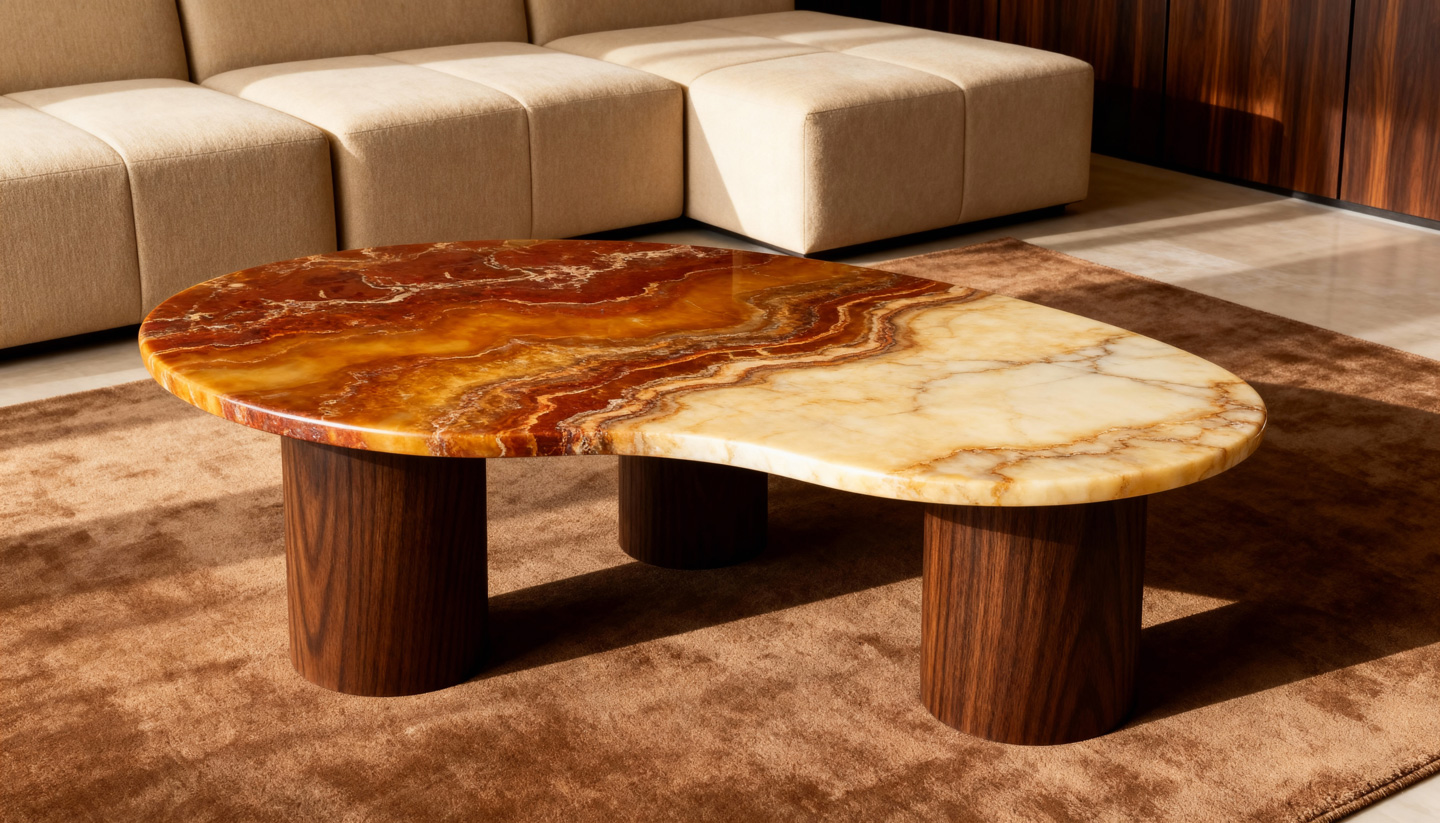
| Non-standard | Designer interiors | Strong accent, wow effect | Needs thoughtful space around |
In futuristic interiors, compositions of two or three tables of different heights work well: for example, a round low + oval higher. KAIZEN often uses this approach: the tables become a dynamic group that can be adapted to different scenarios.
Materials: from natural wood to futuristic composites
Question: What material should you choose for a coffee table so that it looks premium and lasts a long time?
Short answer: Look for balance: tactility, durability, style of your interior.
Basic materials
Natural wood (solid wood, veneer)
Warm, “living” material. Works well in modern minimalism, Scandi, eco-style.
LSI: wooden coffee table, solid wood coffee table.MDF with painting
Provides perfect geometry, the ability to create smooth radii, complex chamfers.
At KAIZEN, we often use matte or velvety finishes that are pleasant to the touch and visually “extinguish” glare.Glass coffee table
For visual lightness. Well suited for small rooms and interiors in the modern, loft, high-tech style. But requires regular care.Metal (supports, frame)
Stylish thin legs or graphic frame designs. Combine with wood or painted MDF to avoid making the interior “cold”.Composites, stone, porcelain stoneware
For those who put a lot of hot cups, jars, vases. Strong, scratch-resistant, but heavier.
At KAIZEN, materials are selected for specific scenarios: if the table is for a family with children, we focus on impact-resistant coatings; if it is a premium lounge, we can add stone, metal, complex textures, and even surface printing with an original print.
Style: coffee tables as an interior accent
Question: How to make coffee tables not look like random objects, but fit organically into the interior?
Respond: keep in touch with the style of the sofa, the rug, and the overall concept of the room.
Several landmarks
Minimalism
Laconic shapes, no unnecessary decor, neutral colors. One accent – for example, a smooth radius of the tabletop or an unusual asymmetrical support.Modern and neo-modern
Plasticity of forms, combination of different materials (metal + wood, stone + painted MDF), soft but expressive radii.
This is the direction where KAIZEN feels at home: futuristic coffee tables with smooth lines and technological details.Loft
Metal frame + wooden or stone countertop, open design. But it’s important not to make it too “heavy” in small rooms – then it’s worth working with thinner profiles.Eco-style
We leave the texture of the wood as “alive” as possible, adding calm natural shades.
The task of the KAIZEN brand is not to simply repeat the style, but to twist it towards the future: instead of banal shapes, slightly bolder geometries, interesting transitions, and the ability to customize colors and prints.
Functions: open shelves, drawers or clean surface
Question: Do you need shelves, drawers, niches, or is a simple countertop enough?
Respond: depends on whether you want to see things or hide them.
Open shelves
It’s good if you like beautiful magazines, books, and decorative objects. But they tend to accumulate visual noise more quickly.Closed drawers
For remotes, chargers, and small items that shouldn’t be “in plain sight.” From the outside, the table looks clean and calm.Combinations
The top is a clean surface, the bottom is a niche or one small drawer. For most modern interiors, this is the golden mean.
KAIZEN designs coffee tables as small storage systems: even one extra level of storage can save your living room from chaos.
When to choose a transforming coffee table or a set of tables
Question: In what cases should you buy a transforming table or a set of several coffee tables, rather than one large one?
Short answer: when a space needs to operate in multiple modes.
Transformers
can rise to the height of a dining or work table;
to expand, increasing the area;
change the geometry (sliding parts, additional segments).
This is a solution for small apartments, studios, and those who work in the living room.
Sets of 2–3 tables
Of different heights and diameters, one nesting under the other. You can move it apart when guests come, or arrange it compactly on weekdays.
In KAIZEN we often do modular coffee tables, which can work as a single object or as separate elements in different corners of the room. This is already an intelligent, adaptive space.
What the process looks like: from idea to finished KAIZEN coffee table
When you decide which buy a table, it is important to understand not only the result, but also the path to it.
What usually happens in KAIZEN
Brief
You talk about your space: living room dimensions, sofa, carpet, style, colors, life scenarios (children, working from home, evening gatherings).Concept and 3D visualization
We offer 1–2 options of shape, materials, colors, and, if necessary, variations of the table with a custom print. You can see how the table will look in your interior.Clarification of details
Height, depth, radii, support types, fittings, storage options. This is where the approach comes into play. kaizen: continuous improvement of small details.Production
Clear technology, geometry control, high-quality materials and premium finishes.Result
A coffee table that fits perfectly into your space and works with your lifestyle. Not universal, but yours.
FAQ: short answers to the main questions about coffee tables
1. What shape is the best coffee table to buy for a small living room?
Round or oval: soft shapes, safe edges, less risk of bumping. For very small rooms, glass coffee tables work well – they add visual lightness.
2. What is the optimal height of a coffee table?
Focus on the height of the sofa seat. Usually it is 40–45 cm. The table should be at the same level as the seat or slightly lower, then it will be convenient to place a cup or laptop.
3. Should I choose a glass table if I have children?
Yes, but only with tempered glass and a well-thought-out shape of the supports. If you want maximum safety, it is better to choose models with rounded wooden or MDF countertops and soft radii.
4. What desk should I buy if I work in the living room with a laptop?
Slightly larger than a standard coffee table, with more depth and a stable base. Or a transforming table that can be raised to a comfortable working height.
5. How does the KAIZEN coffee table differ from the mass market?
It is designed for your space and scenarios, goes through 3D visualization, can have custom sizes, materials, and even original prints. It is part of a holistic furniture system, not a random element.
How to make the final choice: a checklist before buying
Before deciding which buy a coffee table, go through a short checklist:
What is the basic scenario: coffee, work, guests, kids?
Is there enough space to walk around the table? (minimum 40 cm)
Does the height of the table correspond to the height of the sofa?
Does the table support the style of your living room: minimalism, modern, loft, eco?
Do you need additional storage (shelf, drawer)?
Do you like its appearance on a sensory level – imagine looking at it every day?
If the answers to at least these questions are clear, you are already half a step towards the right decision. Next is the matter of technology and design, which KAIZEN takes on.