Зміст
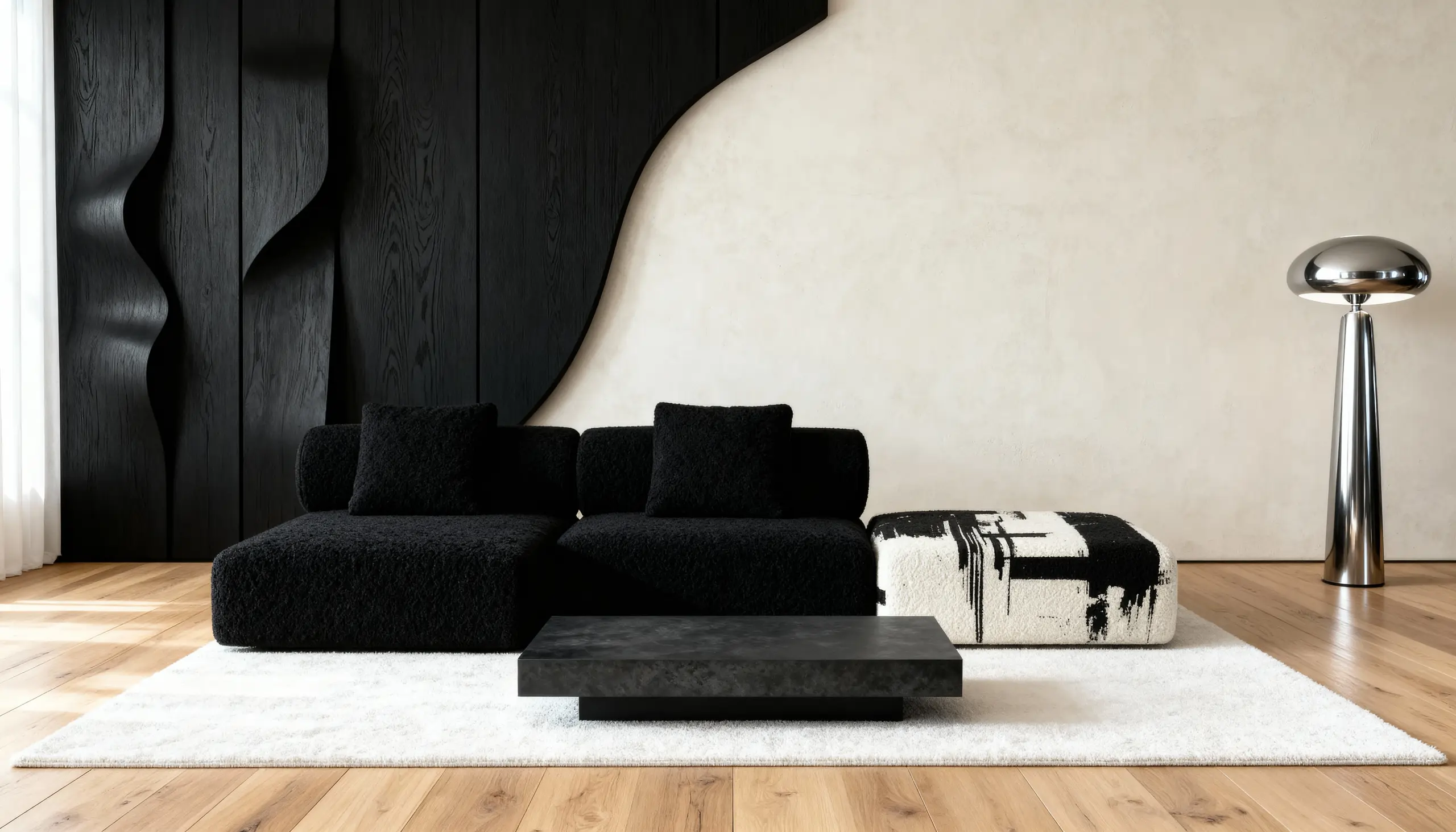
The light hasn’t had time to change its angle yet. It slides across the floor, breaks on the texture of the wood, and stops on black. Deep, matte, calm. Two modules stand side by side, without haste, without demonstration. They don’t try to please — they are already in their place. Behind them is a dark wall with the rhythm of waves, as if a motion has been recorded. Nearby is a white surface, the soft line of which balances the space. The contrast is not harsh. It holds.
In corporate interiors, sofas rarely exist on their own. They become part of a system – the same as identity, light, movement scenarios. That is why sofas in corporate style are logical to consider as an element of a broader concept, which is formed by sofas with print as a tool for working with space and brand. It’s not about decor. It’s about solutions that remain relevant for a long time and work without words.
Corporate identity does not start with a logo
Corporate style sofas are not upholstery with a corporate color. They are consistency. When the shape, proportion, and texture support the character of the company as clearly as the font in a presentation or the tone of voice in communication.
A common mistake is to start with the graphics. In reality, the logic is different:
SENSE → SPACE → FORM → MATERIAL → GRAPHICS
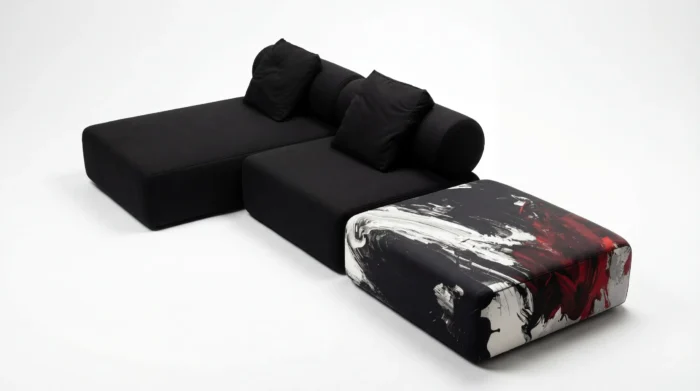
In the space with the photo, this is read without explanation. The low seating is not oppressive. The depth of the modules is inviting, but not overly relaxing. The black texture of the fabric absorbs noise, both visual and physical. The black and white print on the pouf works as an accent — not for show, but for rhythm.
This is how a corporate style is formed without a direct identity.
Form as a tool of discipline
The first paragraph is a short answer: the shape of a corporate-style sofa disciplines the space.
Straight lines, modularity, no random radii—it’s not about minimalism for minimalism’s sake. It’s about control. In a business environment, form shouldn’t be distracting.
In this interior:
- the backrest is low, but sufficient for support;
- no armrests – free movement;
- The modules are self-contained but read as a single unit.
This solution is suitable for office lounge areas, reception areas, waiting areas. That is why corporate-style sofas often intersect with logic sofas for offices, where softness is not important, but the balance between comfort and working mood.
Kaizen approach: improvement without noise
“Improvement doesn’t require revolution. It requires attention to detail.”
— Masaaki Imai, Kaizen: The Key to Japan’s Competitive Success
Corporate-style sofas are kaizen in furniture. Nothing superfluous. Nothing random. Every element has meaning.
Error → solution: when “expensive” looks empty
Error: Choose a sofa as a status object. Massive, with a high back, and a complex shape.
Decision: choose a sofa as a backdrop for interaction.
Corporate spaces live by scenarios:
- short conversation;
- waiting for a meeting;
- an informal pause between decisions.
The low black sofa in the photo does not dominate. It pauses. This is what distinguishes corporate-style sofas from home or demonstrative models.
Formula:
CORPORATE COMFORT = PEACE × PREDICTABILITY × SCENARIO
Material as part of identity
The fabric here is not just black. It is tactile, with a short pile that does not shine or “play” in the light. This is important. Corporate style does not tolerate random glare.
The material must perform several functions simultaneously:
- withstand the load;
- not to age visually;
- be a neutral base for accents.
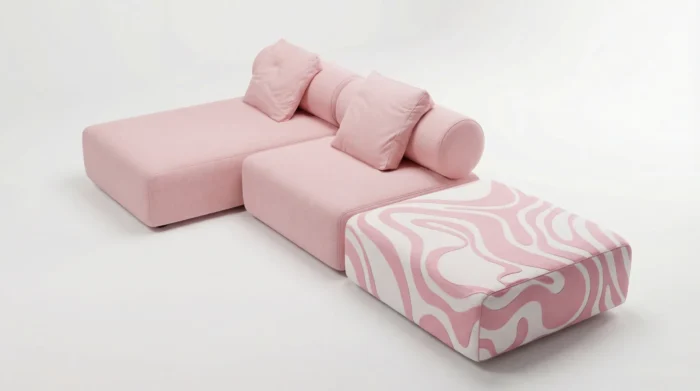
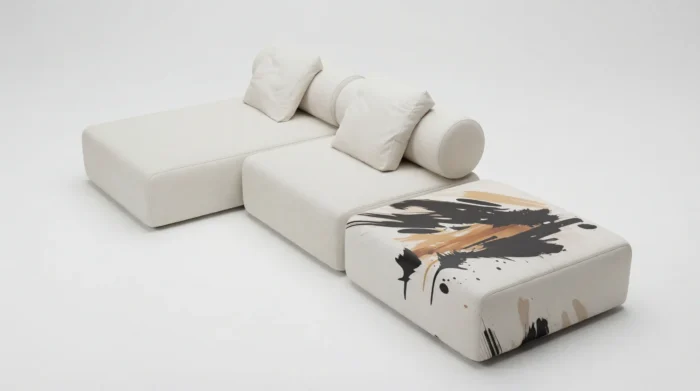
That’s why in corporate projects we often combine basic sofas in a corporate style with printed elements – poufs, pillows, modules. This is the same principle that works in sofas with print when graphics appear where they are really needed.
Space is more important than the object
The second key principle: a corporate-style sofa is designed from the space, not the other way around.
In this interior:
- a wall with a wave sets the movement;
- the white plane balances the darkness;
- the light is not accent, but diffused;
- objects do not compete with each other.
The sofa becomes part of the architecture. This is how they work corporate sofas, which do not distract attention, but support the structure of the space.
A brand without a logo is the norm
The first paragraph is short: in mature interiors, a logo is not required.
The brand is read through:
- level of restraint;
- quality of materials;
- accuracy of proportions;
- lack of excess.
This is especially important for companies that work with clients for long cycles. In such cases, corporate-style sofas become a tool of trust, not advertising. If identity is needed, it is introduced pointwise, as in solutions sofas in corporate style, where graphics are subordinate to form.
Table: corporate vs. household sofa
| Criterion | Corporate style | Household |
|---|---|---|
| Form | Discreet, modular | Expressive, emotional |
| Landing | Moderate | Deep |
| Material | Wear-resistant, matte | Soft, decorative |
| Role | Script support | Center of attention |
| Graphics | Spotty or absent | Decorative |
Usage scenarios
- Waiting before the meeting
- Informal conversation
- Short rest between tasks
In each of these scenarios, corporate-style sofas must perform equally well. That is why they are often combined with solutions for waiting sofas and sofas for visitors, where a sense of control and calm is key.
Final chord
The light shifted almost imperceptibly. What had been an accent in the morning had now become a background. The shadow from the low table stretched out and lay in a smooth strip on the carpet—without sharp edges, without drama. The black sofa had not lost its depth, the white accent had not become aggressive. The space had not begun to demand attention. It had remained stable.
This is the essence of corporate-style sofas. They don’t work on the first impression – they withstand the second, third, hundredth. They don’t age, because they don’t depend on trends. They don’t try to be relevant – that’s why they stay that way. They aren’t noticed right away, but without them the space falls apart.
The corporate sofa is a fulcrum. It doesn’t explain, it doesn’t sell, it doesn’t convince. It simply maintains a state: calm, collected, predictable. It’s the one where decisions are made, conversations are held, and pauses are made without tension.
And if we go back to the initial scene, it becomes clear: the choice did not happen at the moment of viewing the catalog or discussing the materials. It happened much earlier – when an understanding emerged of what the space should be like and what it should broadcast without a single word.