Зміст
Why are designer chairs and armchairs today “furniture for life,” and not just a place to sit?
The short answer: because we sit more than we think — and it is the chair that determines how the body feels, how attention works, and how the space looks as a whole.
Designer chairs are often bought “by eye”: shape, line, legs, texture. But in real life, the winner is the item that simultaneously:
supports the back without tension;
does not interfere with movement (and does not steal passages);
keeps the style for many years, not just one season;
gives a feeling of “composition” — in the kitchen, living room, office.
And the half-chairs are the next level. They seem to add “intelligence” to the chair: the armrests are short, not massive, but the body feels supported. The back is wider, the fit is more confident, and the mood is more premium.
In KAIZEN, such things are thought of as part of a scenario: how you eat breakfast, work with a laptop, have conversations, receive guests, take breaks between tasks. Furniture doesn’t just “stand” – it helps you live more precisely.
Semi-armchairs: what are they and how do they differ from a chair and armchair?
The short answer: a semi-chair is a chair with the feel of an armchair, but without the extra bulk.
The main idea of the half-chair
Back often broader and “embracing”.
Armrests short (sometimes it is an extension of the back), as if they wrap around the body.
Landing more stable than a classic chair, but lighter than a full-fledged armchair.
Visually Half-armchairs look more prestigious, especially in a dining room or near a kitchen island.
When semi-chairs are the best choice
when you sit at a desk for a long time (work/study/dinner);
when you want “softness” without a bulky chair;
when hand support is important (relieves shoulders);
when the table is the center of social life.
What role do designer chairs play in a space: an accent or a “background that holds the composition”?
The short answer is: both—it depends on how you project the mood of the room.
There are three healthy scenarios:
1) Chair as an accent
You choose a shape/texture/color that draws the eye. This works when the interior is restrained, but you want “impulse”. Half-armchairs are especially strong here: they look like a small sculpture, but functional.
2) The chair as a balance
When you have an active sofa, textured walls, prints, or complex lighting, a chair should “calm” the frame. Then geometry, proportions, and tactility are important, not screaming.
3) The chair as a system
The same seating arrangements in the dining area create a sense of order, like a well-configured interface. In KAIZEN, this logic is often complemented by 3D visualizations: you see the set “working” before the tree takes shape.
How to choose the right fit: simple tests that eliminate 80% of errors
Short answer: don’t check for “softness”, but support and geometry because they provide comfort after 20–40 minutes.
Quick check: what your body should feel like
feet firmly on the floor;
knees at approximately a 90° angle (plus or minus);
the lower back does not “sag”;
shoulders do not rise due to uncomfortable armrests;
you get up easily without “starting effort”.
Two practical examples from life
“Breakfast + laptop”: if you regularly work at the dining table, armchairs often benefit from chairs because the short armrests relieve shoulder fatigue and help maintain posture.
“Guests for 2–3 hours”: on a beautiful but uncomfortable chair, the evening ends early – people unconsciously want to change the location. Comfortable half-armchairs continue communication.
Materials and construction: what really affects the durability of a designer chair?
Short answer: not “fabric name”, but a combination frame, filler, connection nodes and upholstery durability.
Frame
Wood (solid wood/veneer): warm, lively, premium to the touch. Important — correct humidity, high-quality connections, protective coating.
Metal in construction: provides stability and slimmer silhouettes, but requires proper geometry so it doesn’t “walk” under weight.
Filler and softness
The right softness is when the seat doesn’t “fall over,” but it’s not a “board.” In KAIZEN, the logic is simple: softness should be controllable — like the suspension in a good car.
Upholstery
For everyday life, look for fabrics that:
keep their shape and do not “flak”;
easy to clean;
Tactilely pleasant, because contact with hands and skin is constant.
If chairs are the “rhythm” of your day, then the sofa sets the “tone” of the evening. When considering seating in the dining area, it is useful to compare the proportions with the soft zone at the same time: here is a guide on how to choose sofa in the living room so that comfort and style work as a single system.
Table: what to choose – a chair, a half-chair or an armchair?
Short answer: for the table and everyday scenarios, half-armchairs are most often the winner; for relaxation, an armchair; for maximum ease, a chair.
| Format | Landing sensation | Armrests | Visual “weight” | What is best for? | Who is suitable for? |
|---|---|---|---|---|---|
| Chair | assembled, mobile | usually not | easy | short meals, compact kitchens | minimalists, small spaces |
| Half-armchair | comfortable, stable | short/integrated | average | long dinners, desk work, guests | families, designers, people “at the laptop” |
| Chair | as relaxed as possible | full | above average | reading, lounge, relaxation area | those who value relaxation and “their own place” |
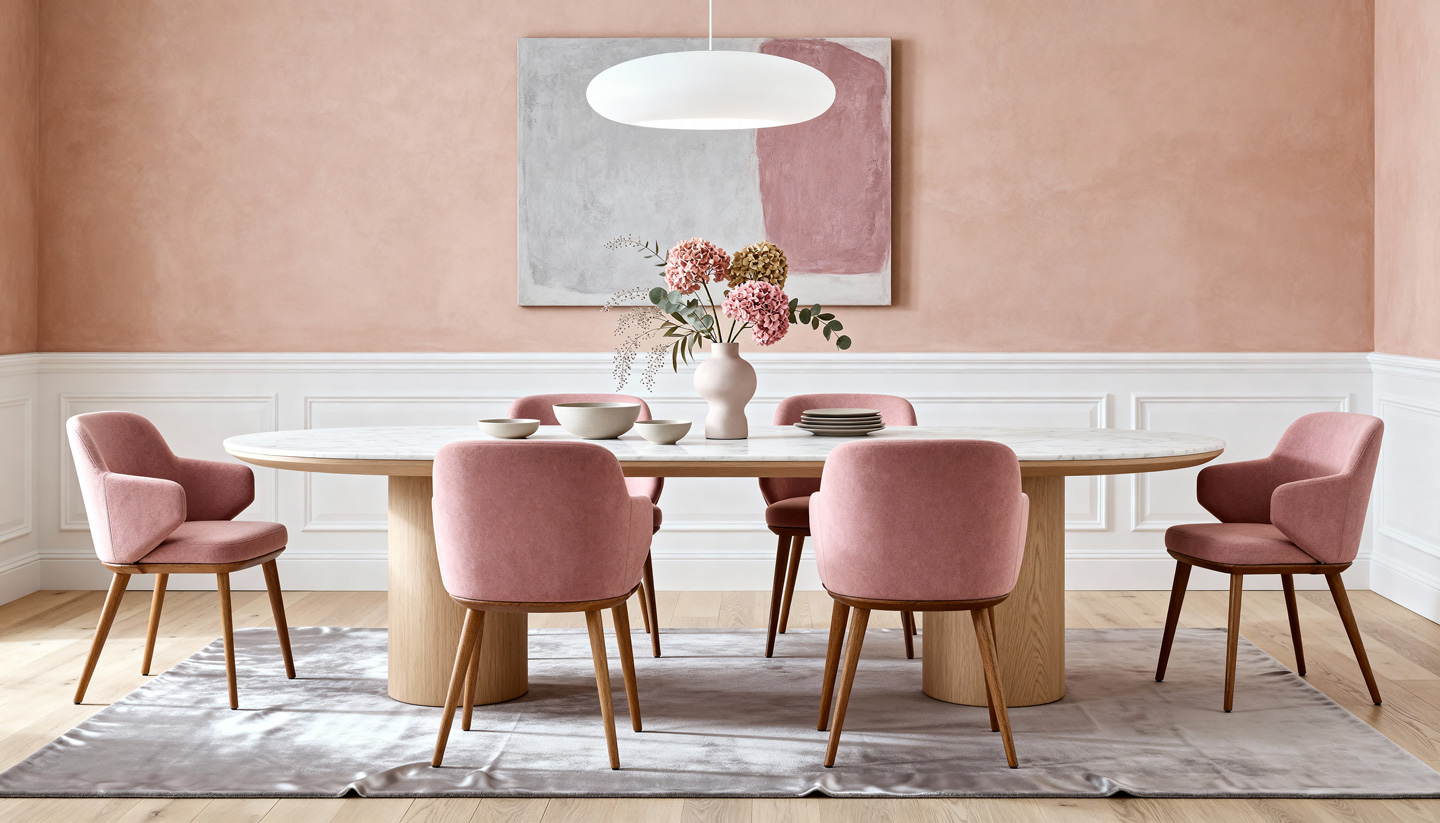
How to choose armchairs for a kitchen, island or dining table so as not to lose space?
Short answer: don’t count centimeters “by furniture”, but space for movement.
Minimum rules that really save lives
leave a comfortable passage so that a person can pass when someone is sitting;
the armrests of the chair should not rest against the tabletop (otherwise you will not slide the chair in properly);
in small kitchens, models with legs work better – they give visual lightness.
Mini-story from practice
Two equally beautiful options can give different results. In one, the half-chairs “hug” and create a club atmosphere. In the other, the same ones, but wider by a few centimeters, and the kitchen starts to feel cramped. That’s why KAIZEN often starts with 3D visualization: you see not a “model”, but the behavior of the space.
Designer chairs as a productivity tool: sounds strange, but it works
The short answer: ergonomics affect attention in the same way that light and silence do.
When your posture is incorrect, your brain wastes resources on discomfort. When your posture is correct, you stay focused longer, you “break down” less from fatigue, and you complete tasks more easily.
The half-chairs here are interesting because:
armrests relieve tension from the shoulders;
wider back gives a sense of control;
Softness supports, not “puts you to sleep.”
If you want to understand more deeply how sitting affects your back, rest, and even concentration, keep an extended guide: soft chair for the room — about ergonomics, scenarios, and typical interior placement mistakes.
Print, textures, non-standard solutions: how to add “futurism” and not overdo it
Short answer: focus on one strong idea — form or invoice or print.
KAIZEN loves bold decisions, but boldness is not chaos. Futurism looks premium when it:
emphasizes the geometry of space;
has logic (repeated in detail);
does not interfere with daily use.
Examples of “smart accent”
2 half-armchairs with an original print + other neutral ones — balance and “wow effect”.
one unusual texture (boucle/tweed/microvelour) + simple shape — a feeling of technological tactility.
monochrome + complex silhouette — sculpturalness without noise.
How to care for designer chairs and armchairs to keep them looking “like new” for a long time
Short answer: regularity + good habits are more important than “super tools.”
Wood / veneer
wipe with a dry or slightly damp soft cloth;
avoid aggressive chemicals;
Place coasters if there is a risk of hot cups near wooden elements.
Cloth
vacuum cleaner with a soft nozzle once a week (or at least once every two);
local spots – immediately, without “postponing”;
If you have children/animals, choose practical fabrics that are forgiving to life.
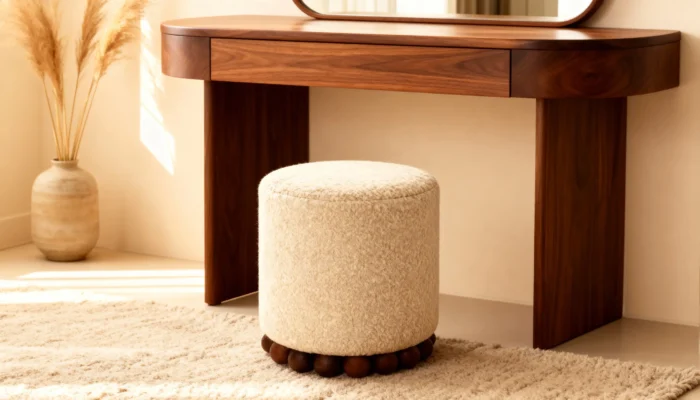
When you want to add softness and movement to your interior without overloading it, a “half-chair + pouf” pair works well. Here’s a detailed guide on how to choose the right accent: buy ottoman: round ottoman — about dimensions, height, materials, and placement.
One KAIZEN principle that makes a difference: not the “furniture”, but the script
The short answer is: we look at the chair as part of your day.
“A good designer chair doesn’t tie you to a posture — it gives you freedom of movement, supports your body, and gathers the space into one clear “yes, it’s comfortable to live here.”
Hence the kaizen approach: constantly polish parts — radii, fit, seams, joints, balance of softness — so that after a year of use the thing doesn’t get “tired” either physically or visually.
FAQ: short answers to the most frequently asked questions
1) What is better for the kitchen: designer chairs or half-chairs?
If you sit for a long time (dinner, working at a desk) – they are more likely to win half-chair. For maximum ease and small kitchens — chairs.
2) Will the armrests prevent you from sliding the half-chairs under the table?
They won’t if the armrest and tabletop height are chosen correctly. The key is to make sure the armrest doesn’t rest against the edge of the table.
3) Which upholstery is most practical for daily use?
Fabrics with easy-clean properties, dense textures, microvelour. Practicality is a combination of density, abrasion resistance and ease of local cleaning.
4) How do you know if the fit is “yours” if you buy to order?
Formulate a scenario (how much you sit, how you use the table), and then 3D visualization + geometry coordination: seat height, depth, backrest angle, armrest width.
5) Are half-armchairs only for premium interiors?
No. They are appropriate in minimalism, modernism, and eco-style – it’s a matter of proportions and materials. Often, it is the half-armchairs that “pull” the space to a sense of togetherness.
Conclusion: How to make a confident choice
If you need a simple guideline, keep the final algorithm:
determine the scenario (kitchen/living room/working at the desk);
choose the format (chair or semi-chair);
check the fit (geometry is more important than “soft/hard”);
check the dimensions with the aisles;
choose materials to suit your lifestyle;
capture one strong aesthetic idea (shape/texture/print).
KAIZEN designer chairs and armchairs are a way to make your space more precise: to support your energy, style, and forward movement – every day, without unnecessary compromises.