Зміст
Kitchen table – where to start choosing before buying a table?
A search for “buy a table” gives hundreds of options. But in fact, you need not just a piece of furniture, but a workstation for life: a place for breakfast, phone calls, children’s education and evening wine. Therefore, choosing a kitchen table does not begin with a catalog, but with an honest answer to yourself: how you actually use the kitchen.
Short:
-
Measure the space.
-
Determine how many people will be sitting at the table at any given time.
-
Choose the shape and type of construction (stationary or folding kitchen table).
-
Choose the countertop material to suit your pace of life, not just “to make it look good.”
Next, we will analyze each step.
What size and shape of kitchen table is right for your kitchen?
What is the minimum table size for comfortable seating?
There is a simple formula: one person at a table needs a width of 60 cm and a depth of 40 cm.
That is:
-
2 people on one side – ~120 cm of tabletop length.
-
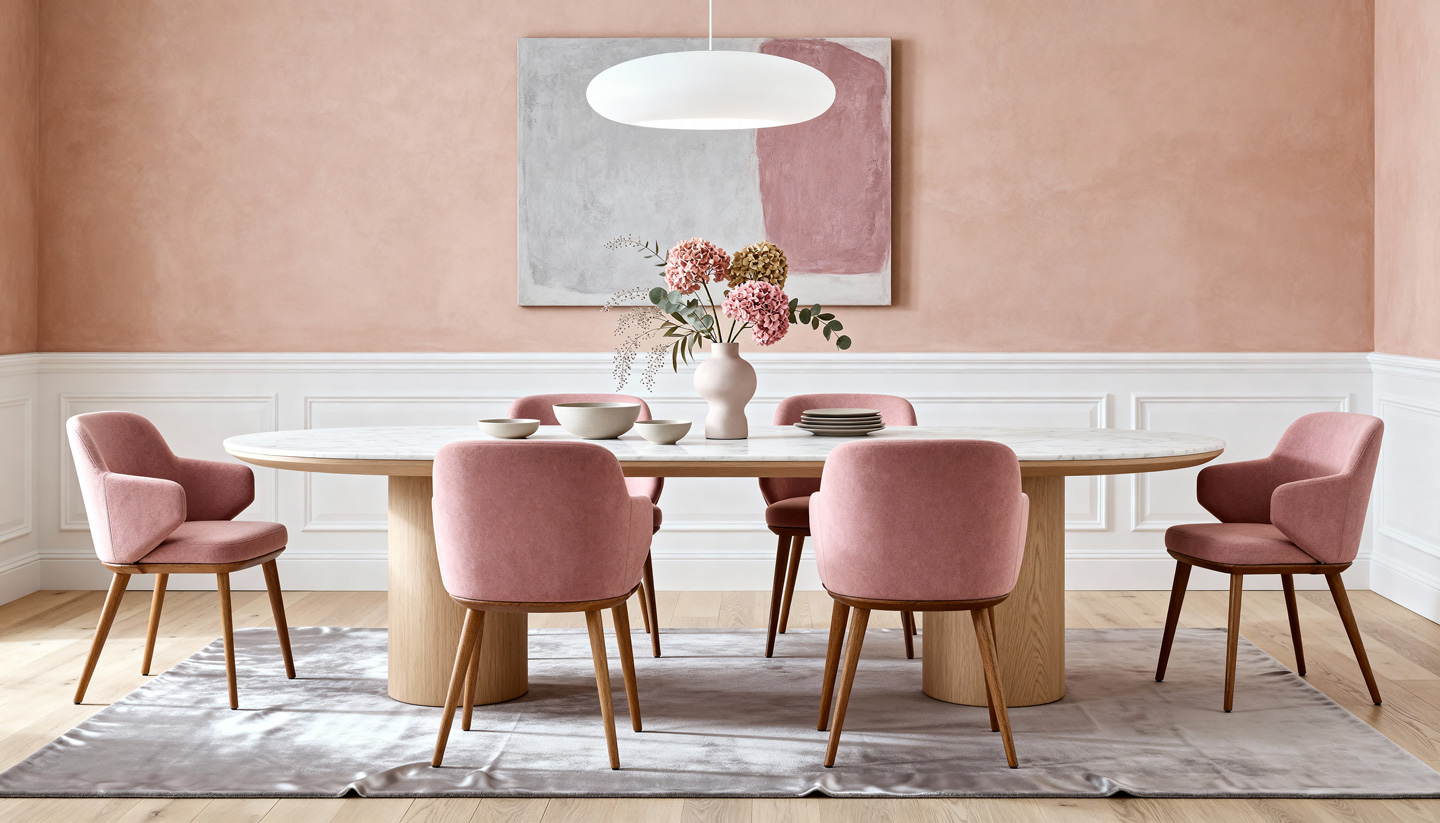
A table for 4 people is at least 120–130 cm (rectangle) or 90–100 cm (round table).
-
For 6 people – 140–160 cm, depending on the shape.
If your kitchen is small, don’t chase after a “giant.” A properly designed, compact kitchen table is better than a massive model that’s impossible to walk through.
Shape: when to choose a round table and when a rectangular one?
Round table in the kitchen suitable if:
-
the space is square or close to square;
-
you want more “live” communication – everyone can see each other;
-
Safety is important (fewer sharp corners – especially important with children).
Rectangular or oval kitchen table better if:
-
the kitchen is narrow, elongated;
-
the table will stand against the wall or in a corner;
-
A clear connection to the lines of the kitchen set is required.
At KAIZEN, we often design unconventional shapes—softly rounded rectangles, smooth asymmetries. This kitchen table adds a futuristic dynamic while still maintaining functionality.
Kitchen table materials: what is suitable for real life?
To buy a table without disappointments a year later, it is important to understand how different materials behave in reality – with hot dishes, children, coffee, knives, and daily use.
Comparison table of popular countertop materials
| Material | Pros | Cons | Who is it suitable for? |
|---|---|---|---|
| Solid wood | Warm, vibrant look, premium tactile feel | Sensitive to moisture and scratches, requires care | Those who appreciate naturalness and comfort |
| Veneer + board (MDF) | Price/quality balance, visually like a tree | Afraid of prolonged moisture at the seams | Practical users with regular maintenance |
| Painted MDF | Any color, smooth futuristic surface | Possible chipping upon impact | Lovers of minimalism and color accents |
| Stone / Quartz | Very durable, not afraid of temperatures | Weight, price, feeling of “cold” | Kitchen pro, active cooking |
| HPL laminate | Stain resistant, easy to care for | High-quality edge finishing is important | Families with children, intensive exploitation |
| Glass | Visual lightness, modern look | Fingerprints are visible, requires frequent cleaning | For modern and loft style interiors |
“The right kitchen table is not a compromise between beauty and practicality, but an exact fit into your life scenario. This is what the kaizen approach is all about: improving the details that you experience every day.”
At KAIZEN, we usually offer several material options in 3D visualization so you can see how the atmosphere changes: from warm wood to cold stone or futuristic painted MDF.
Stationary or folding kitchen table: which is better for you?
When is a folding table a must have?
A folding kitchen table is appropriate if:
-
In everyday life, there are 2–3 of you, but guests gather from time to time;
-
the kitchen is combined with the living room, and the area is transformed for parties or work sessions;
-
you don’t want to constantly “go around” a large table.
Typical scenarios:
-
Small kitchen in the apartment: on weekdays – a compact table by the window, on weekends – they moved it apart and invited friends.
-
Kitchen island: a folding module built into the island, which turns it into a full-fledged dining area.
When to choose a stationary desk?
A stationary kitchen table will benefit if:
-
you have a stable 4–6 people at the table;
-
the area allows you not to save every centimeter;
-
A monolithic, sculptural look is important (accent furniture that sets the character of the space).
At KAIZEN, we design both folding and stationary solutions, thinking through the ergonomics of the mechanisms so that unfolding is intuitive, without “dancing with iron.”
Design and style: how the kitchen table shapes the atmosphere of the kitchen
The table is the first object that catches your eye when you enter the kitchen. It can make or break the style.
What styles does the KAIZEN kitchen table work in?
-
Minimalism: clean planes, hidden structures, thin legs, smooth tabletop without unnecessary seams.
-
Modern: soft radii, combination of materials (wood + painted MDF, stone + metal), asymmetrical supports.
-
Eco-style: textured veneer, solid wood, natural shades, soft tactile surfaces.
-
Loft: massive metal supports, dark textured countertops, the effect of “industrial” strength.
We look at the kitchen table not as “another object,” but as the core of the composition. Hence the emphasis on visual lightness even in massive models: leg proportions, edge offsets, shadow joints, and rounding.
KAIZEN: how we design kitchen tables of the future
KAIZEN is not just about “buying a table from a manufacturer.” It’s about creating an interior that works for your goals.
What is embedded in the DNA of our tables:
-
3D visualization before manufacturing
You see your kitchen table in the future kitchen even before production: color, textures, proportions, even light reflections. -
Customization for your scenario
Height, dimensions, edges, radii, shape of legs, the possibility of printing a custom print on the tabletop or on inserts. This is not a series “like everyone else’s”, but a working tool to your rhythm. -
Kaizen approach to details
We constantly analyze where people hit their knees, where it is inconvenient to put a laptop, how the chair moves. Hence: correct tabletop offsets, thoughtful placement of supports, ergonomic seating. -
Technological capability
Folding mechanisms, protective coatings, stain-resistant materials – all this makes the table not just beautiful, but a long-term solution.
Life scenarios: which kitchen table is right for your family?
For those who work from home
The kitchen table becomes a temporary office. Important:
-
the depth of the tabletop is at least 80 cm so that the monitor or laptop does not “press” on the eyes;
-
wide enough to leave room for a plate on one side and a notebook on the other;
-
calm, not “flashy” coating that does not tire the eyes.
For families with children
Other priorities are at work here:
-
rounded corners (fewer injuries);
-
stain-resistant material (HPL, high-quality laminates, matte painted surfaces);
-
the ability to quickly wipe without fear of stains.
For those who rarely cook but love to host guests
Focus on transformation:
-
a kitchen table, which is compact in everyday use, but in 2 minutes turns into a full-fledged dining table;
-
designs that allow guests to sit without “cushion chairs” and comfortable supports that do not interfere with the legs.
How to buy a table at KAIZEN: from idea to implementation
To buy a table that you won’t have to “put up with” but want to use every day, we offer a transparent route.
1. Space and task analysis
You send a kitchen plan or measurements, photos, and briefly describe your scenario: how many people, whether you work at the table, how often you cook. We ask clarifying questions — this is the basis for a competent project.
2. Concept and 3D visualization
Next, the concept is formed:
-
the shape of the kitchen table;
-
materials and color;
-
type of supports and mechanism if a folding option is required.
In 3D, you see how the table “fits” into the space: where the aisles are, how it works with the set, lights, and floor.
3. Coordination of parts and materials
We discuss:
-
a coating so that the table can withstand your style of use;
-
edge options, rounding radii;
-
additional functions are possible – niches, integrated sockets, etc.
4. Production, quality control, installation
The same kaizen principles apply at the production stage: control of each node, tested mechanisms, final adjustment on site. As a result, you don’t just “buy a table”, but a completed interior element, ready for life.
FAQ: answers to frequently asked questions about the kitchen table
1. What height should a kitchen table be?
The standard height is 74–76 cm. If you have high chairs or a specific scenario (for example, you often work at a desk), the height can be adapted – at KAIZEN we often customize it for specific people.
2. Which table is best for a small kitchen?
A compact rectangular or round table with a diameter of 80–90 cm, often with a folding mechanism. Visual lightness is important: thin supports, light shades, minimal visual noise.
3. Should you be afraid of a wooden countertop in the kitchen?
No, if it is properly treated and you are ready for basic care: do not leave puddles of water, use coasters for hot dishes. Solid wood provides a unique comfort that no synthetic material can provide.
4. What to choose: a glass or frosted table?
A glass table adds visual lightness, but requires frequent cleaning. Matte (painted MDF, HPL) are more practical, they are less visible fingerprints. If the atmosphere of minimalism and cleanliness is important, matte solutions are often more comfortable for everyday life.
5. Can KAIZEN make a table to my non-standard size?
Yes. We work in the format of custom-made furniture: according to your dimensions, scenarios, style. Size, shape, color, even an original print – everything can be adapted within the limits of technical adequacy.