Зміст
Why the decision to buy chairs in the living room affects the whole scenario of life
The living room is more than a “room with a sofa”. This is your hub: here you recover after the day, meet guests, watch movies, work on a laptop, read, just “switch”.
When a person is looking for where to buy chairs in the living room, there is a desire to make space:
-
comfortable – to really want to occupy the chairs;
-
visually light – without feeling of tightness and accumulation;
-
stylish – so that each item maintains the atmosphere of the house;
-
“Smart” – adapted to the modern rhythm of life.
A white chair in this context is a strong tool:
-
It illuminates the space;
-
makes the room brighter;
-
Adds a feeling of purity, system, premium.
Kaizen works with the following tasks: to make the chairs for the living room not a random purchase, but part of a holistic system of furniture, thought out for your scripts and future use.
Where to start: 5 key solutions before buying chairs in the living room
To buy chairs in the living room without “burnout” and frustration, let’s walk through the logical checklist.
-
What is the area and shape of the room?
-
What role does the living room play in your life?
-
What style do you want to enhance?
-
Are you ready for a white chair – and in what format?
-
What flexibility do you need: fixed models or custom solutions?
1. Space analysis: dimensions, passages, “breathing” of the room
Before you buy chairs in the living room, you should literally “lay out” the room in zones.
Schematically draw (on paper or in any application):
-
where the sofa stands;
-
where the TV zone is planned;
-
where windows, doors, exit to the balcony;
-
main passages;
-
Possible points where chairs can stand.
Basic rules of proportions
-
Minimum passage between the chair and other furniture object: 70–80 cm.
-
If it is the main passage (to the kitchen, balcony, corridor): 90-100 cm.
-
Distance from chair to coffee table 40-50 cm (So that the hand easily took out a cup, but the knees did not rest).
-
If the chair stands in front of the TV area, the comfortable distance depends on the diagonal of the screen, but on average: 2.2–3 m.
A small living room
In compact spaces, the white chair wins due to visual lightness. Here are important:
-
slender, streamlined forms;
-
open legs (the space under the chair also “works” for a feeling of lightness);
-
No massive armrests that “eat” the area.
Spacious living room
In large rooms, chairs can be more massive, with a deep seat, wide armrests – a white chair does not overload the interior, but keeps a balance between volume and lightness.
2. Life Scenarios: How will you actually use the chairs
Before you buy chairs in the living room, ask yourself direct questions:
-
Are you reading or watching series anymore?
-
Do you work with a laptop in the living room?
-
Do guests come often and where do they usually sit down?
-
Do you have a habit of drinking coffee/tea in your chair?
-
Do you need a place where you can “curl in a ball” or lie down?
Depending on the answers, the choice of chair varies significantly.
Reading and rest chair
For the “reading” script are important:
-
the correct tilt of the back;
-
lumbar support;
-
sufficient depth, but not so much that the legs “hanging”;
-
Possibility to put a floor lamp and a coffee table nearby.
Laptop work chair
Here it is important:
-
more vertical back;
-
the height of the seat, which allows the feet to stand on the floor at an angle of about 90 °;
-
enough rigidity not to “fail” (the back should work, not suffer).
Armchair as a “place of power” in the living room
Many people subconsciously choose one place from which it is convenient to see the whole space – doors, window, screen, other people. A white chair at such a point can become your personal place for reflection, planning, reading, watching lectures.
In Kaizen, such scenarios are always spoken when designing: the chair is not just “+1 landing”, but part of your mode and way of thinking.
3. White chair and interior style: how to make it “come in”
A white chair is like a clean canvas: it is easy to integrate into almost any style, if you choose the right shape, materials and contrasts.
Minimalism
-
Forms – concise, almost sculptural.
-
Supports – hidden or as restrained as possible.
-
The fabric is smooth, tactile, without aggressive texture.
The white chair here emphasizes the architecture of the space and works as a calm but confident accent.
Modern
-
Floating lines, soft radii.
-
Material combination: white fabric + wood / metal.
-
Light color accents in decorative pillows are possible.
Scandinavian mood
-
Warm shades of white (milk, ivory, not “sterile” cold).
-
Combination with natural wood, flax, woolen blankets.
-
The white chair becomes part of a “living” texture story – without excessive shine.
Loft and Industrial Mixes
Against the background of concrete, dark brick and black metal, the white chair works on the contrast:
-
It softens the rigidity of materials;
-
sets a point of comfort in brutal space;
-
Allows you to leave the interior “adult” and stylish, but not cold.
4. White chair vs dark and colored chairs: what gives each option
Comparative table
| Parameter | White chair in the living room | Dark / colored chair |
|---|---|---|
| Visual weight | light, “dissolving” in space | heavier, clearly denotes the volume |
| Influence on space | Expands, illuminates, makes airy | Grounds, adds depth |
| Cooperation with light | enhances natural and artificial light | More work on contrast |
| Care | The choice of fabric is important | Easier to mask minor stains |
| Stylistic presentation | Minimalism, Art Nouveau, Skandy, High-Tech | loft, classic, art deco, eclecticism |
| Accentuation | Accent through shape and light | Accent through color, print, texture |
If you want to keep calm walls and floors without overloading the interior with bright colors, a white chair is a logical way: active design, interesting shape, but the range remains restrained.
5. Materials for white armchairs: practicality against fear of “marking”
Many people refuse a white chair precisely because of fear of care. But the question is not in color, but in fabric and technology.
Cloth
work best:
-
dense mats;
-
microfiber;
-
Aqua-Klin / Easy Clean / Stain Resistant fabric.
Benefits:
-
Pleasant tactility;
-
sufficient density;
-
Easy to clean – most stains do not have time to “enter” the structure of the fibers.
Skin / eco-leather
The white leather or eco-leather chair looks as premium as possible:
-
easy to wipe;
-
clear silhouette;
-
Goes well into high-tech, modern, minimalism.
Systemic care is required:
-
special cleaning agents;
-
air conditioners to maintain elasticity;
-
Protection from direct sunlight to avoid burnout.
Technological fabrics of the future
Kaizen relies on materials that allow you to not be afraid of white:
-
The liquid “rolls” from the surface without absorbing;
-
abrasion resistance is increased;
-
The color remains stable even with active use.
Ergonomics: something to look at when you sit in a chair
The chair for the living room should be not only beautiful but also ergonomic. Especially if you plan to sit in it for hours.
Critical parameters:
-
Seat height: The feet are completely on the floor, knees at about 90-100 °.
-
Depth of seat: Between the back of the knee and the edge of the seat – ~ 3-5 cm.
-
Low back support: The back repeats the natural curve of the spine.
-
The angle of the backrest: For rest – a little more than 90 °, but without the effect of “lying down” (unless it is specifically designed).
In Kaizen, ergonomics are not abstract – these parameters can be adjusted with a custom order: change the height, depth, density of the filler.
Location of chairs in the living room: schemes that work
When you have decided to buy chairs in the living room, it is important to think about not only “what”, but also “where exactly”.
Scenario 1: Sofa + 2 chairs opposite
Classics for spacious living rooms:
-
sofa – the main landing;
-
two chairs – opposite or at an angle to the coffee table;
-
A white chair can be either a pair or a “lighter” contrast to a more massive sofa.
Scenario 2: One Sofa + One White Accent Chair
Suitable for small rooms:
-
sofa – along the wall;
-
white chair – at an angle of 45 ° to the sofa and table;
-
Next to it is a floor lamp and a small table.
This creates an “island” of personal comfort and adds compositional depth.
Scenario 3: Window Chair
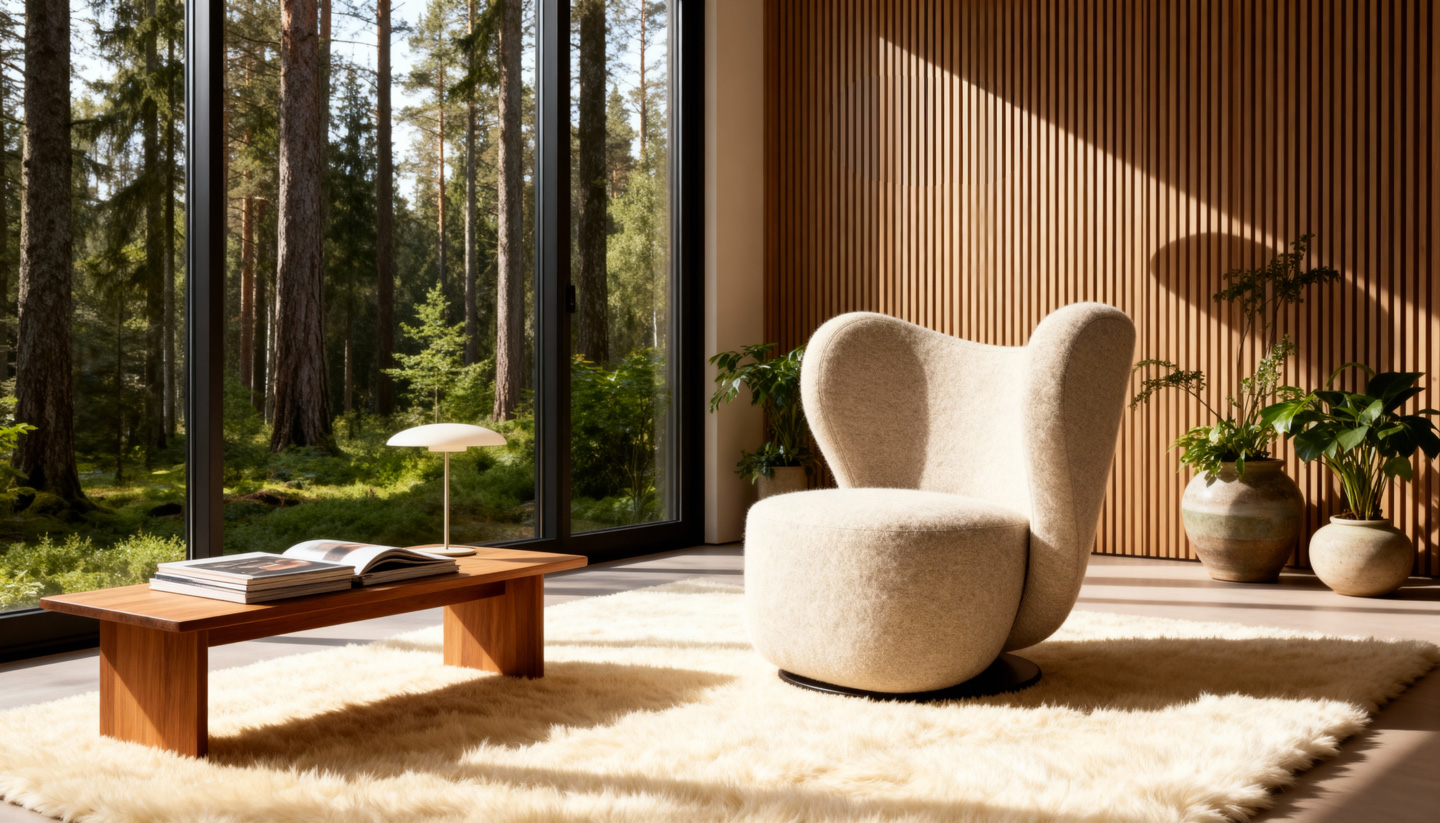
If you have a good view, put a white chair by the window – a strong move:
-
Daylight emphasizes the shape;
-
This is a logical place to read and quiet evenings;
-
White does not attract attention, but works with a panorama.
Kaizen: Armchair as part of intellectual space
Kaizen looks at the chair as an instrument that reminds you every day: your space works for you, not the other way around.
How does Kaizen’s approach differ from “just buying chairs in a store”?
-
3D-visualization: You see your white chair in the living room before production – in combination with real dimensions, colors of walls, floors, light.
-
Customization: change in shape, size, height, type of support, fabric combination.
-
Possibility of author’s prints: A white chair can remain a pure minimalist object or get a subtle graphic accent related to your story or brand.
-
Kaizen approach: Continuous improvement of parts – from seams to filler, from ergonomics to care scenarios.
As a result, you do not get “furniture as a commodity”, but a tool that works in the system of your space: home, work, development.
Typical mistakes when choosing chairs in the living room (and how to avoid them)
-
Focusing on photos from Pinterest or Instagram only
Excluding the real size of the room, height, habits – the result is often disappointing. -
Too big chair in a small living room
Beautiful volume on the render, but in reality – the effect of “room with one chair”. -
Ignoring white chair care
Choice of random cheap white fabric → Unseen stains → Disappointment and fear of white color for a long time. -
Random location
The chair is placed where the place was “vacated” without thinking about the review, light and scripts. -
Armchair that does not support interior style
For example, a heavy “classic” next to a minimalist sofa and high-tech lighting.
White chair care: a systematic approach, not “constant stress”
To keep the white chair in the living room white not only the first month:
-
Choose technological fabrics marked Easy Clean / Stain Resistant.
-
Regularly remove dust – a soft nozzle of the vacuum cleaner, a delicate mode.
-
Respond to stains immediately, without delay “for later”.
-
Use recommended products for a specific type of tissue / skin.
-
Think about the contact area: pillows, blankets, replaceable covers.
At Kaizen, these points are thought out in advance: you can choose materials and solutions that reduce the number of “surprises” in care.
How to order chairs for the living room and not change your mind in a year: a step-by-step plan
-
Record usage scenarios
What is more important to you: reading, working, watching movies, receiving guests? -
Measure the space
Dimensions of the room, aisles, distances to the sofa and TV zone. -
Determine the style and role of the chairs
Accent or background, white chair as a key element or part of a group. -
Discuss ergonomics
Your height, the feeling of what is “convenient for you personally.” -
Ask for a visualization
A 3D image with your sofa, walls and floor colors is much more honest than a nice picture from the catalog. -
Agree materials and care
It is better to immediately invest in quality fabric than to regret the savings later.
FAQ: Frequently asked questions about white chairs in the living room
1. Is it worth choosing a white chair if we have a small living room?
Yes, it is often in small spaces that a white chair gives the maximum effect: it visually facilitates the interior, does not “cut” the space with a dark spot and helps to make the room brighter. The main thing is to choose a form without excessive massiveness.
2. How practical is the white chair if there are children / animals?
Everything is decided by the material. Modern technological fabrics and proper care make the white chair no less practical than any other. In many cases, stains from quality fabric are easier to remove than from cheap dark.
3. How many chairs to put in the living room – one or two?
For small rooms, one accent white chair is often enough. For spacious living rooms – optimally two to create a balanced composition with a sofa and a coffee table.
4. Do the chairs and sofa have the same color and style?
Not necessarily. The modern approach is a combination: a white chair can complement a dark sofa, emphasize the shape or create contrast. It is more important that the logic is preserved in the proportions, materials and general concept.
5. Is it possible to make a white chair brighter without losing minimalism?
yes. This can be implemented through the shape (futuristic silhouette), delicate contrasting seams, author’s print, individual accent elements. Kaizen offers customization options, where the white chair remains concise, but has its own unique “note”.
6. What is the difference between just “buying chairs in the living room” and ordering them from Kaizen?
In Kaizen, you get not just a ready-made model, but a solution for your space: 3D visualization, the ability to adapt dimensions, ergonomics, materials and parts. This is furniture that is designed for your way of life and vision of the interior of the future.