Зміст
What is a coffee / coffee table and why is the living room “empty” without it?
Coffee tables and coffee tables are not just a “place for the remote”. This is a small center of gravity of the living room, around which people gather, a daily script moves: morning coffee, a laptop for fast work, a book, a glass of wine in the evening.
In fact, the coffee table performs three roles simultaneously:
functional – surface for drinks, gadgets, books, decor.
compositional – connects a sofa, armchairs, carpet in one logical zone.
emotional – sets the mood: from minimalist peace to futuristic drive.
When there is no table, the sofa area looks unfinished. When the table is chosen unsuccessfully – it interferes, “cuts” the passages, gathers chaos. The task of this article is to help you choose a coffee table or coffee table so that it works for your space and lifestyle.
How to choose the size of a coffee table relative to the sofa?
Let’s start with the most practical – proportions. Incorrectly chosen size is the most common mistake.
What is the optimal height of the coffee table?
The basic rule is simple:
Table height ≈ Sofa seat height or 2-3 cm below.
So it will be convenient for you to put a cup without stretching and without bending over. For most sofas, this is a range of approximately 40–47 cm.
If the sofa is low and you often work at a table with a laptop, you can consider Transformer models with the lifting mechanism of a table-top.
What is the length of the coffee table relative to the sofa?
Landmark:
60-80% of the length of the sofa.
For example, if the sofa is 240 cm wide, the comfortable length of the table is 140-180 cm. This is how the balance is preserved: the table does not look tiny, but does not block movement.
distances for comfortable passages
Another critical point is the retreat:
Between the table and the sofa: 35–45 cm (conveniently sit down and reach for the tabletop).
Between the table and the TV cabinet / wall: At least 60-70 cm for passage.
If the space is small, it is better to choose Compact round or oval table, not a rectangle with acute angles.
Forms and styles: which table will support your interior?
Coffee tables are a small stage where you can safely experiment with style. It is easy to add an accent here without overloading the entire interior.
What shape to choose: round, oval, rectangular or non-standard?
Rectangular table
Classics for straight sofas and corner models.
Works well in style interiors Loft, minimalism, modernism.
Convenient to place laptop, books, decor.
Round table
Ideal for compact rooms and families with children – no sharp corners.
Visually softens the space, adds a feeling of “flow” and movement.
It goes well with corner sofas and armchairs, forming a soft circle of communication.
Oval table
Compromise between rectangular and round.
Suitable for narrow living rooms: the length is, but the corners are smoothed.
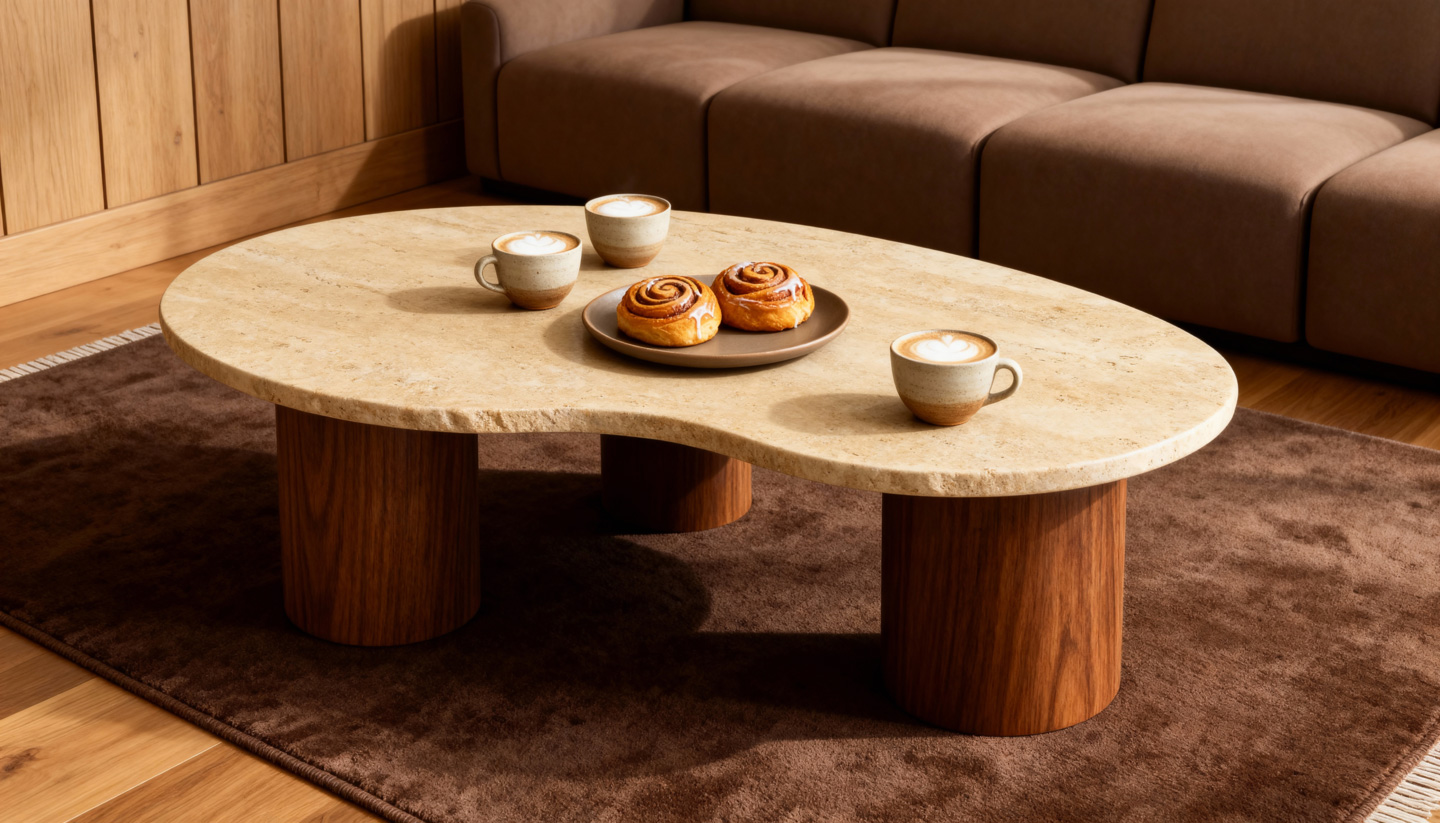
Non-standard shapes (asymmetry, broken geometry, “clouds”)
This is already a territory Futuristic interiors and premium design.
work well as Accent furnitureif the rest of the situation is restrained.
Coffee table style: adjust or contrast?
If the interior is neutral, Stylish coffee table It can become the main visual accent: bright color, unusual shape, textured table top.
In saturated interiors, on the contrary, it is better to choose Minimalist table, which does not conflict with other objects.
Kaizen often works with the reception of “quiet background – a bold accent”. For example, a calm sofa in natural shades and Futuristic coffee table With non-standard geometry and author’s print on the tabletop.
Coffee table materials: how to choose something that will withstand your rhythm of life?
Material is about both aesthetics and practicality. Here is a comparative table of popular options.
Comparison of materials for coffee / coffee tables
| Material | Pros | Cons | Which interiors are suitable for |
|---|---|---|---|
| solid wood | Heat, status, durability | Sensitivity to moisture, the need for care | Scandi, Eco-style, Art Nouveau, Timeless Classic |
| MDF / veneer | Flexibility in shapes, availability, different textures | Less “living” than an array, the quality of the coating is important | Minimalism, modern interiors, color solutions |
| Metal | Strength, visual lightness, industrial | may be cold to the touch, scratches are visible | Loft, high-tech, futuristic interiors |
| Glass | Lightness, transparency, visual unloading | need regular care, safety issues | Modern, minimalist, small living rooms |
| Stone / Porcelain | Status, unique texture, resistance to heating | Weight, difficulty of movement | Premium, art spaces, interiors with an emphasis on textures |
| composites, HPLs, etc | Resistance to scratches, moisture, kitchen scenarios | A quality manufacturer is important | Family interiors, tables with active use |
LSI examples to consider:
glass coffee table for a small living room;
solid wood coffee table;
table with metal legs and a table top with MDF;
Stone or porcelain table as an accent.
Functionality: What should a modern coffee table be able to do?
Modern coffee tables and coffee tables – It’s not just a surface. It Space organization tool.
Table with shelves and drawers
Suitable if:
You have many magazines, books, consoles, gadgets;
You want to hide “visual noise”.
The shelf under the table allows you to keep useful things together, but not in sight. Closed drawers are another level of order.
Transformer table
Solutions appreciated in studios and compact apartments:
the table top rises to the height of the desktop;
you can fully work with a laptop or have dinner;
Part of the volume is often used as a storage place.
If you work from home and like to sometimes “move” with a laptop to the living room – Sofa + table-transformer become a flexible workspace.
Mobile tables on wheels or light extra models
Easily change the configuration of the space.
Suitable for scripts, when the living room often “switches” between home cinema, games, reception.
Kaizen Coffee and Coffee Tables: The Interior of the Future, Not Just the Sofa Table
The Kaizen brand considers the coffee/coffee table as Small but strategic core of the interior.
Key Principles:
Futuristic design: clean lines, bold shapes, a feeling of moving forward.
3D-visualization before manufacture: You can see exactly how the table works with your sofa, carpet, lighting.
Customization: size, height, color, materials and even Printing of author’s prints on the tabletop – Under the character and lifestyle of the owner.
Kaizen approach: Attention to detail – radii, edges, stability of a design, ergonomics of movement around a table.
In the Kaizen approach, a coffee table is not a trifle of the interior, but a focus point that works daily for your comfort, performance and aesthetics of space.
Example:
The owner of the creative studio wants a living room that simultaneously receives guests and inspires ideas. Kaizen is designing Custom Coffee Table: asymmetrical shape, combined tabletop (painted MDF + inlay with an author’s print), built-in “pocket” for magazines and tablet. In 3D-visualization you can see how the table merges with the sofa, lighting, textiles – the owner chooses the option that resonates the most, and only then starts production.
How to integrate a coffee table into different areas of the house?
Coffee and coffee tables are associated primarily with the living room, but the scripts are wider.
Living room
Classics: One central table in front of the sofa.
Dynamic option: Two or three small tables of different heights that can be pushed apart and grouped are a trend of modern interiors.
Emphasis: A table of contrasting color or with a non-standard shape as a “point of eye attraction”.
Bedroom
Instead of a classic bedside table often works Compact coffee table:
more space for decoration, books, lamps;
more interesting geometry than a standard cabinet;
Adds lightness.
work corner / home office
Here the coffee table can:
to work as Additional surface for the layout of materials, models, fabric samples;
Be a place for informal meetings when you do not want to “put” guests at the desk.
Frequent mistakes when choosing a coffee table
Too small a table on the couch
Looks “toy”, does not work compositionally.Acute corners in families with children
Safer – round / oval or models with softly rounded edges.Too dark table in already dark room
The room visually “fails”. In such cases, it is better Table with glass, light table top or metal frame.Lack of space to pass
The perfect table doesn’t work if people stumble over it every day. Always check the distances.a form that conflicts with the interior
For example, a very aggressive geometry in a calm, “air” room – everything looks overloaded.
How to take care of coffee tables and coffee tables?
Care depends on the material, but there are general rules.
For wooden and veneered surfaces
Use a soft dry or slightly damp cloth.
Avoid prolonged contact with water, hot dishes – stands are a must.
Once a period – special wood products to maintain a protective layer.
For MDF with coloring
Soft fabric, without abrasives.
Do not put heavy, sharp objects without substrates to avoid chips.
If it is a KAIZEN table top with a premium coating, the manufacturer usually gives recommendations for a specific system of varnishes / paints.
For glass
Glass products without aggressive impurities.
Monitor the load – do not sit on the table, do not put excess weight in the center.
For stone / porcelain
Soft products without strong acids.
once in a while – updating protective impregnations (if provided by the type of material).
FAQ: coffee tables and coffee tables FAQ
1. What is the size of the coffee table to be universal?
Universal formula:
height – at the level of the seat of the sofa or slightly below;
length – 60-80% of the length of the sofa;
The distance to the sofa is 35-45 cm.
These parameters give comfort and movement without a sense of tightness.
2. Is a coffee table in a small living room appropriate?
yes just to choose Compact table:
round or oval, so as not to “cut” passages;
with glass or light table top for visual lightness;
If possible – with extra storage space to reduce the number of other small furniture.
3. What shape of the table is safer for children?
the safest— Round and oval models, as well as tables with softly rounded radii of the edges. In Kaizen, the radii are thought out taking into account real scenarios: children’s running, active games, frequent movements.
4. Should I make a coffee table to order?
If you have a non-standard space, a special sofa, specific wishes for materials or heights – yes to order makes sense. The advantage of Kaizen is that:
you see at first 3D-visualization It is in your interior;
You can adjust the dimensions, colors, textures, prints;
You get a table that fits exactly into your life script, not just “almost fit”.
5. What is a table-transformer and in which cases it is needed?
The transformer table is a coffee / coffee table, the table top of which rises or expands. It is needed when:
you work with a laptop in the living room;
often have dinner at the couch;
Want to combine several functions (coffee, work, storage) in one subject.
This is the best solution for studio apartments and a dynamic lifestyle.
Coffee tables and coffee tables are a small format of furniture with a great influence on the feeling of space. With the right size, shape, materials and well-thought-out functionality, they transform the living room from just a “room with a sofa” to intellectual zone of life and development.
The Kaizen approach helps to make this step consciously: from an idea and a 3D concept to a real subject that works daily for your comfort, efficiency and style.