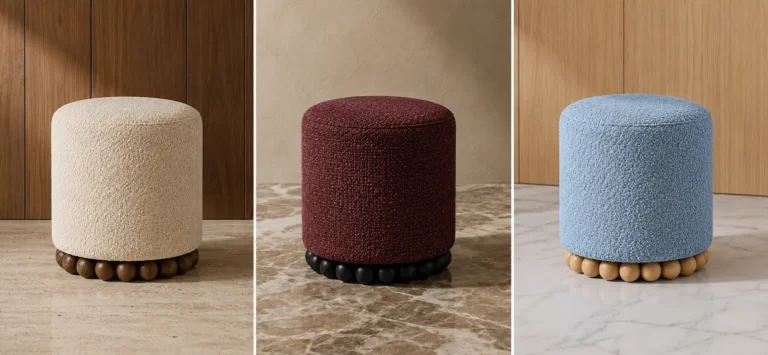
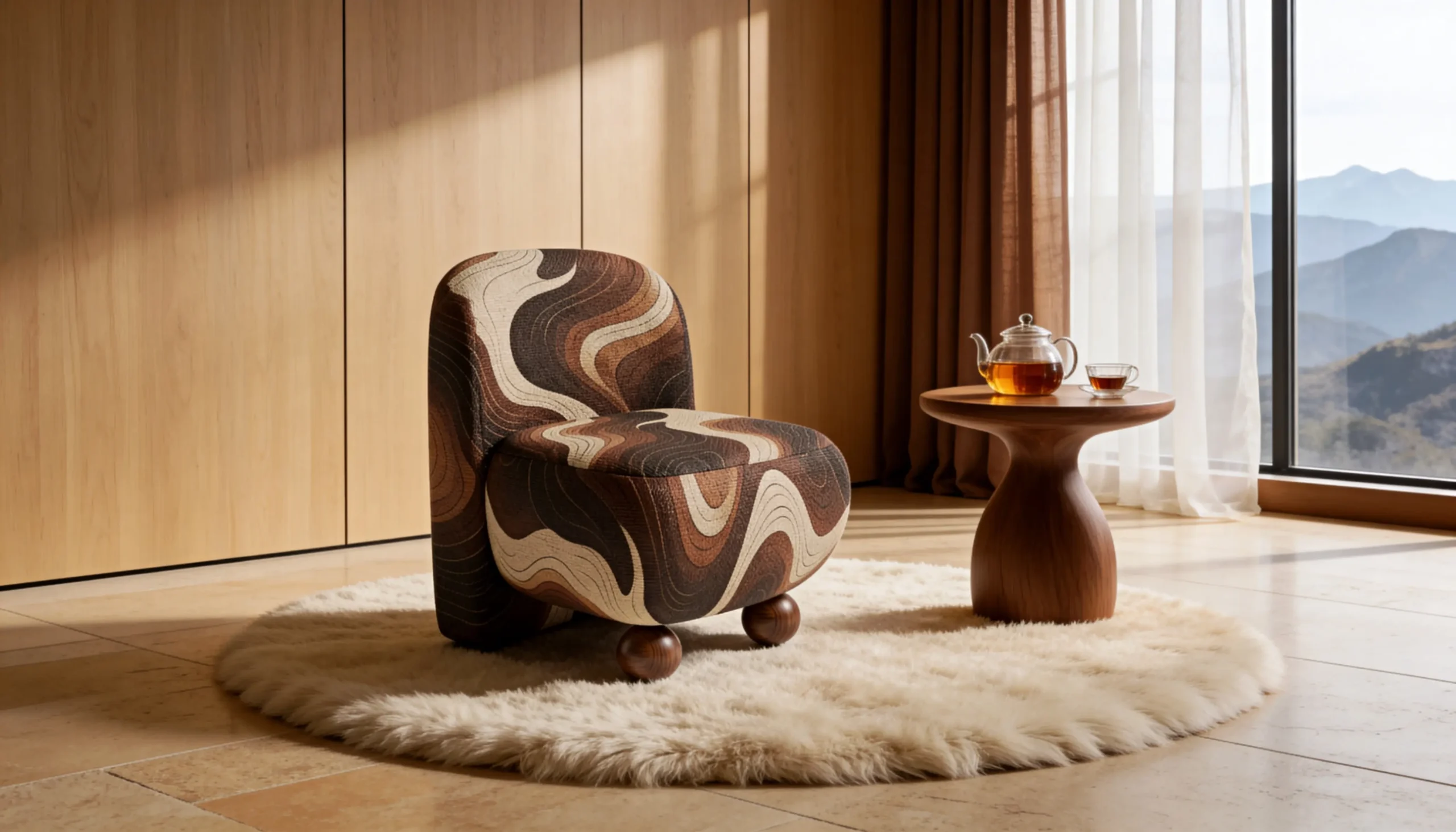
The light enters the room slowly. It glides over the warm wooden surfaces, falls on the soft pile of the carpet, clings to the glass of the teapot, where the amber tea already holds its own small temperature of the day. Behind the thin curtain, distant mountains breathe, and in the center of this calm frame stands an object that does not try to be a background. It does not ask permission for attention. It simply takes it – gently, confidently, beautifully.
It is at such moments that one simple thing becomes noticeable: an interior never consists only of walls, light and functions. It consists of solutions. And each solution either dissolves in the space or sets the tone for it. The gaze glides from the rounded back to the plastic volume of the seat, from the natural palette to the lively rhythm of the print, and the question that arises in the head is not “will it fit?”, but something completely different — “what character do I want to feel here every day?”.
Most people are used to the idea that furniture should be “safe”: neutral, unobtrusive, unobtrusive, and uncontroversial. The problem is that this caution makes so many spaces look the same. They work. They’re neat. They’re right. But they have little to no momentum left to remember.
It is this idea that we have developed in Instagram posts about a designer chair: the form can remain constant, but the character of the object can change radically. And this is the very precise logic of KAIZEN: not to multiply things unnecessarily, but to create a basis that can transform, adapt, and work for different moods, interiors, and life scenarios.
When a piece of furniture is truly thought out, it ceases to be just a “seating place.” It becomes a language. Through it, the space begins to speak of boldness or calm, of rhythm or silence, of tactility or graphics, of the brand or the private character of the home. That is why this chair is not reduced to form as such. Its true strength is in the system: one base, dozens of visual moods, many roles and no chance.
When the interior ceases to be neutral
There are spaces that are not memorable, even if everything in them is done qualitatively. Good lighting, successful planning, the right materials, a restrained palette – everything seems to be in place. But the impression is not created. The reason is often not that the interior is “missing something”, but that it does not have a distinct center of gravity.
A designer chair solves this problem not with loudness, but with concentration. It gathers the space around itself. In a warm living scenario, where wooden panels, a soft light carpet and a low table create an intimate atmosphere, a chair with a wavy print works as an emotional accent. Its plasticity seems to pick up the movement of light in the room, and the natural range does not argue with the interior, but deepens it.
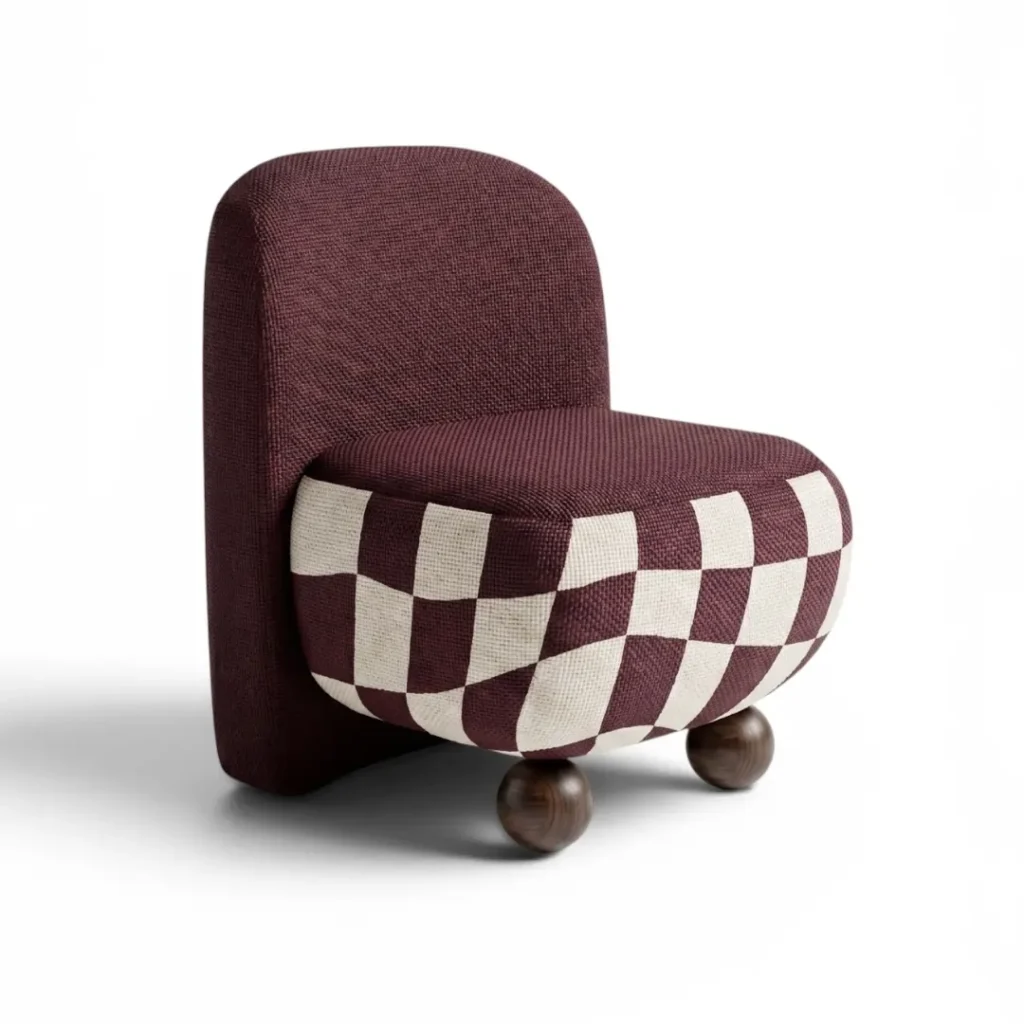
In a more restrained version — burgundy, with a graphic checkered accent on the front of the seat — the object becomes more collected, more intelligent, a little more architectural. There is less softness of mood here, but more discipline of form. Such a solution is easy to imagine in a private office, a laconic living room, a showroom space or a waiting area, where theatricality is not needed, but expressive neatness.
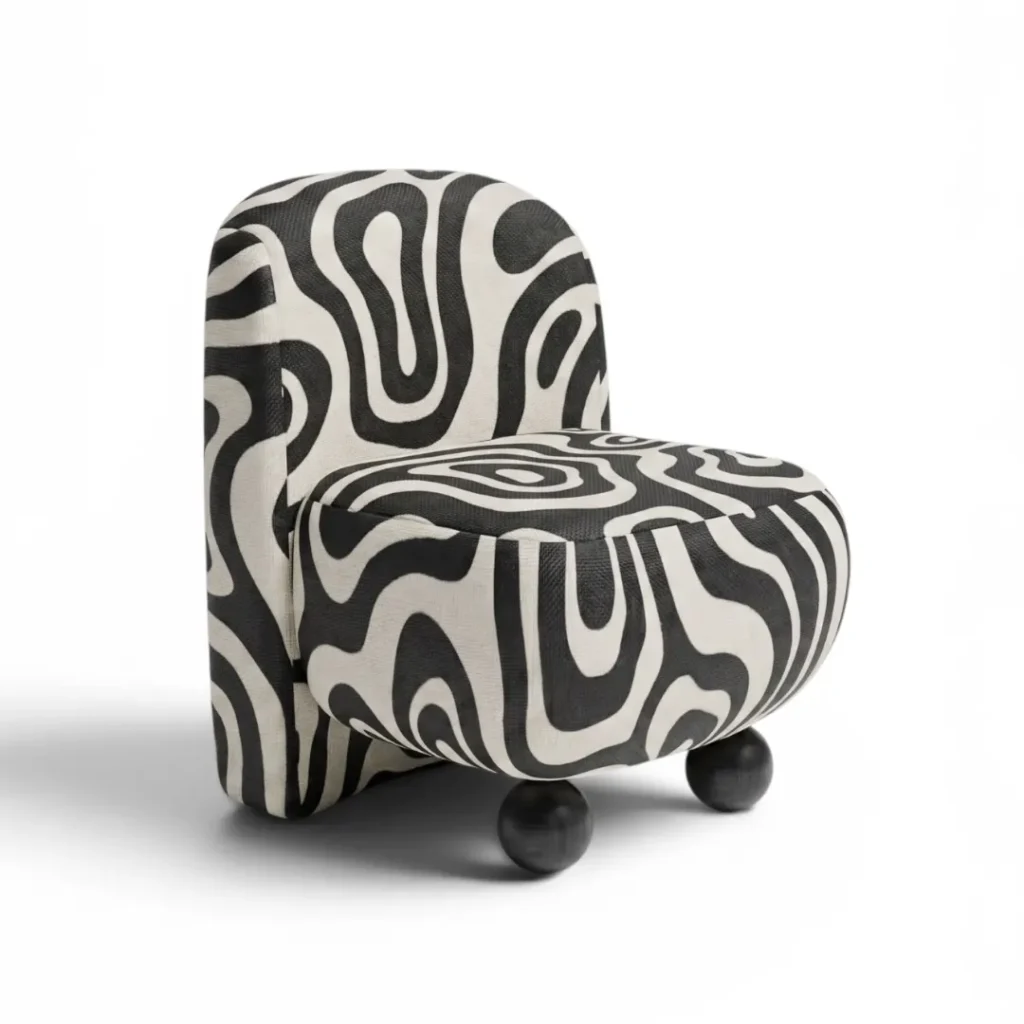
And the monochrome black and white solution works as a visual gesture. It is bold, even a little hypnotic. Such a chair does not just fit into a modern interior – it raises its degree. In the right environment, this option can become almost a gallery object: not flashy, but very noticeable.
It is important to understand here: we are not talking about decor for the sake of decor. We are talking about attention management. If the interior is a script, then accent furniture is a nodal stage. They help the space not to be faceless. Sometimes one strong object is enough for a room to stop “existing properly” and start living.
Text formula:
CHARACTER OF SPACE = SHAPE × FABRIC × PRINT × LIGHT × CONTEXT
That’s why the same chair can look intimate, bold, calm, or expressive. Not because its design changes, but because the language of the surface and its interaction with the environment changes.
One form, dozens of characters
A strong object always has a recognizable basis. This chair has such a basis: compact, rounded, soft geometry; a monolithic backrest that smoothly holds the silhouette; a voluminous seat with expressive plasticity; visual support on spherical legs that add a bit of play and objectivity to the image. This is a form that does not need unnecessary words. It is read quickly, but does not get boring, because it is not tied to a short-term trend.
However, the real interest begins when this form meets textiles. It is the textiles that make it multi-voiced. One chair can be warm and “earthy” if you use wavy natural tones. It can become almost a fashion object in burgundy fabric with contrasting geometry. Or it can move into the plane of modern graphics if you put a black and white abstract print on it.
This is the main idea of the post: furniture can be more than just a functional object. It can set the mood of a space, convey character, evoke emotions, and become the main accent of an interior. And this thesis is not a beautiful advertising sentence – it has a completely applied meaning for working with a project.
Here’s what it looks like at the solution level:
| Chair version | Impression | Where it works best | What character does it convey? |
|---|---|---|---|
| Wavy print in natural shades | Warmth, plasticity, calm emotionality | Living room, lounge area, private relaxation | Soft, lively, sensual |
| Burgundy fabric with checkered accent | Concentration, rhythm, intelligent courage | Office, boutique office, showroom | Confident, urban, structured |
| Black and white abstract print | Graphics, contrast, art mood | Modern interior, reception, creative space | Bright, expressive, distinct |
This table clearly shows that it’s not just about “upholstery options.” It actually changes the type of emotion an object brings to a space. And that’s a whole different level of working with furniture.
At KAIZEN, we are close to the approach where an object does not impose one scenario on the interior forever. On the contrary, it gives the designer or owner of the space freedom. You can start with a restrained solution, and then move on to a bolder one. You can create a series for a commercial object. You can adapt the chair to the visual language of the brand. You can find an option that reflects you – without banal neutrality and without artificial extravagance.
And that is why the phrase “one form, dozens of characters” is not a poetic exaggeration, but an accurate description of the product.
Comfort that runs deeper than first impression
Emotion is important, but furniture must withstand contact with the body, not just the gaze. In a good object, beauty does not hide the design, but grows out of it. If a chair looks expressive, but is uncomfortable to sit in, it very quickly ceases to be a design decision and becomes simply a photogenic object. Therefore, comfort here is not an addition, but the basis.
The technical logic of the chair is built honestly and professionally:
- frame – furniture plywood, which maintains shape, geometry and stability;
- seat base – furniture straps, which provide the necessary elasticity;
- filling – two types of PPUthat work together to balance softness and support;
- fabrics to choose from — velor, matting, chenille, boucle;
- both plain options and designer prints on fabric are available.
These characteristics are important not to “mark the technical block”, but to understand why the chair feels exactly the way it should. Furniture belts take away excess stiffness. Two types of PPU help to achieve the correct load distribution: the body does not fall, but does not sit on a hard surface. And the shape of the backrest, although laconic, gives a feeling of composure and calm support.
Text formula for comfort:
COMFORT = FRAME + ELASTIC BASE + TWO TYPES OF PU + CORRECT FIT
The chair doesn’t try to be too “relaxed” like some low lounge models, where you sink nicely but it’s hard to get back up. And at the same time, it doesn’t go into a dry verticality. It’s a very good balance between a piece for relaxation and a piece for lively daily use.
Here it is appropriate to recall one of the strongest ideas of the kaizen approach. As Masaaki Imai wrote, “kaizen is continuous improvement”. In furniture, this does not mean endless complication, but careful tuning of details: depth, elasticity, tactility, seams, fit, proportions. In other words, everything that is not always visible at first glance, but which determines the real value of the object after months and years of use.
The comfort in such a chair is not screaming. It is not sold with loud promises. It simply manifests itself in the fact that the object is something you want to use again and again – in the morning with coffee, in the afternoon with a laptop, in the evening with tea, in a private pause or during a short conversation. And this is the type of comfort that we consider the most honest.
Fabric as a language of mood
The shape gives the chair its body, but the fabric gives it a voice. That’s why choosing a material is never a matter of “like/dislike.” It’s about choosing the tone with which the object will enter your space.
Velour makes the image deeper and more plastic. It emphasizes light well, adds softness to the color, creates a feeling of a little more sensuality. Mat, on the contrary, gives texture and structure. It is suitable for those interiors where tactile honesty and restrained modernity are important. Chenille sounds softer, richer, a little more delicate; it is a good option for spaces where you need to combine comfort and visual density. Boucle adds a feeling of coziness, relevant softness and very fashionable volume.
But fabric is not everything here. Print changes the logic of perception at a higher level. It can:
- strengthen the plasticity of the form;
- visually “revive” a monolithic silhouette;
- give rhythm to a calm interior;
- to become a brand code in the commercial space;
- collect the color palette of the room into one point;
- to transform the chair from a furniture role into an accent art object.
That’s why the post says that a chair can be expressive, hypnotic, bold, or reflect you — depending on the fabric, print, and your vibe. This is not just an apt statement, but a very practical truth about a modern furniture solution.
Before / after
To:
The interior looks correct, but too neat. It has no center of gravity. Everything seems to “fit,” but nothing is memorable.
After:
A designer chair with the right fabric and print appears. The space immediately gains rhythm, mood, and a distinct focus. Other things start to work more precisely, because the interior finally has character.
This is important for both private and commercial interiors. In a hotel, salon, studio, office, waiting area or creative office, furniture items often also perform a communication function: they indicate what brand or lifestyle a person is dealing with. That is why customization is not a whim, but a tool.
If you need to choose a fabric or print for a specific interior, architectural concept or brand, this is exactly the case when it makes sense to write in Direct and discuss the decision substantively, not at the level of general wishes.
The mistake of “safe” furniture: why interiors become the same
“Safe” furniture seems like a logical choice. Neutral hue, familiar silhouette, minimal risk, minimal chance of “getting tired.” But this is where the biggest trap lies. When every item is chosen based on the principle of “not too much,” the space is assembled without internal tension. It does not conflict — and at the same time, it says nothing.
Design doesn’t have to be loud. But it does have to be meaningful. Sometimes the strongest solution isn’t just another quiet thing, but one object with a clear character that takes on the role of an emotional center. An armchair is precisely the format where such boldness is safe: it’s noticeable enough to set the tone, and local enough not to overwhelm the space.
Error → solution
Error: Choose a chair only to match the color of the walls.
Decision: Choose a chair based on the emotion the space should evoke.
Error: be afraid of print so as not to “get bored.”
Decision: look for a print that works with the shape and supports the interior scenario.
Error: consider furniture only as a function.
Decision: to see furniture as a tool of mood, identity, and composition.
Error: thinking that expressive things only suit large spaces.
Decision: Remember that a compact, well-thought-out accent often works best in small areas.
Error: buying “something universal” and then not liking the result for years.
Decision: Choose an object that immediately resonates both visually and tactilely.
In most cases, the problem is not that people are afraid of bold furniture. They are afraid of making mistakes. And that’s normal. That’s why the role of a studio or manufacturer is not only to produce, but also to translate the design language into a specific solution. To explain why this fabric works here. To show how this or that print will change the mood. To help understand when to stay in a restrained range, and when to give the space the necessary impetus.
True boldness in design isn’t chaos. It’s precision.
Usage scenarios: home, business, brand
When a person wants buy a chair, she actually often chooses not a model, but a scenario. Where will it stand? Who will use it? What is the rhythm of this space? What is more important: visual accent, soft everyday fit, brand character, wow effect or versatility?
This is the strength of this model: it easily transitions from a private scenario to a commercial one.
1. Private living room
Here, the chair becomes a place for personal pause. It can stand next to a low table, a floor lamp, a bookcase, by a panoramic window or in a composition with a sofa. In this case, soft organic prints or complex monochromatic fabrics work especially well, supporting the atmosphere of relaxation.
2. Bedroom or private master space
The chair acts as a quiet island – for reading, talking to yourself, a short morning ritual. Tactility is important here: boucle, velor, chenille can provide just that sensual level of comfort that too “clean” interiors often lack.
3. Office or home work environment
This scenario requires a balance of character and composure. That’s why the burgundy version with a geometric accent reads very well: it doesn’t “relax” the interior too much, but adds individuality to it.
4. HoReCa and boutique spaces
Hotel rooms, lounges, salons, galleries, showrooms — wherever comfort and a recognizable image are important, an armchair can become an element of identity. Especially if you use original prints or materials that support the brand’s style.
5. Office and corporate interiors
For KAIZEN, this is a particularly important direction. A modern office is no longer limited to tables and chairs. Reception, “soft format” meeting rooms, waiting areas, rooms for informal meetings require furniture that works to impress the company. This is where a designer chair can take on the role of an object that speaks about the brand without a single word.
In collaboration with designers and corporate clients, this model is especially valuable because of its adaptability. You can:
- choose a specific fabric for the project;
- match the color with the interior palette;
- use the author’s print;
- create a series with the same shape but different character;
- integrate the chair into a wider furniture system of the space.
All of this makes the object not just beautiful, but also manageable in the project.
How to buy a chair that will last a long time
Buying furniture often breaks down at one point: a person chooses with their eyes, but does not translate the choice into a system of criteria. In order not to make a mistake, it is worth taking a short route from emotion to decision.
How to choose your chair: 5 steps
- Define the usage scenario.
Is this a place for daily relaxation? An accent in the living room? A chair for the waiting area? An item in a commercial interior? The scenario greatly influences the choice of fabric, density and character of the print. - Set the mood, not just the color.
Not “I want beige” or “I want dark,” but “I want peace,” “I want rhythm,” “I want graphics,” “I want a soft accent.” The mood more accurately leads to the right decision. - Assess the context of the space.
What is already in the interior: wood, metal, stone, smooth textures, complex textiles, calm architecture, great light, contrast? The chair should either support this context or consciously become its counterpoint. - Think about tactility.
Appearance is only half the experience. If a chair is going to be used every day, the fabric should be pleasing not only to the eye but also to the touch. - Don’t be afraid to ask for help.
A good furniture solution is rarely born from a random “this is beautiful.” It appears when form, material, and the purpose of the space converge at one point.
Honestly, the solution buy a chair becomes successful not when the object simply “stands in a corner”, but when it begins to hold the atmosphere. This is felt very quickly. The space becomes more collected. A person uses this area more often. The same feeling of completeness appears in the room, which is not always possible to explain, but is easy to recognize.
And if we return to the logic of KAIZEN, it is not a random effect that works here, but a studio approach: minimalism, comfort, customization, attention to detail, and the understanding that furniture should not just fill the space, but improve the way we live or interact with space.
In the end, everything returns to that quiet room again, where the light touches the wood, the tea keeps you warm, and outside the window stands the distant peace of the mountains. In the center remains an armchair — not random, not “safe,” not faceless. An object that has taken upon itself the courage to be tangible. Not loud for the sake of effect, but alive for the sake of meaning.
And if you like the idea that furniture can convey character, not just function, it’s worth revisiting this Instagram post about the chair and seeing how a brief emotion unfolds into a holistic design solution.
And if you want to choose your own version — discreet, bold, hypnotic, plain or with a designer print — the easiest next step is obvious: write in Direct and discuss the space, the task, and the character you want to experience in your interior every day.