Зміст
RITMO designer pouf: when a small shape rules a large space
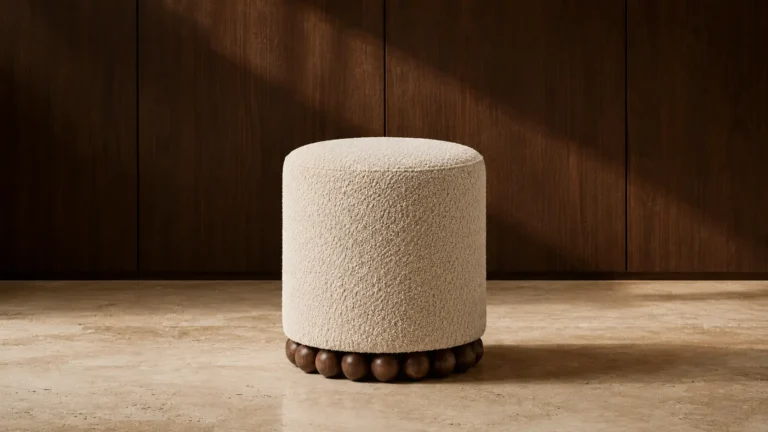
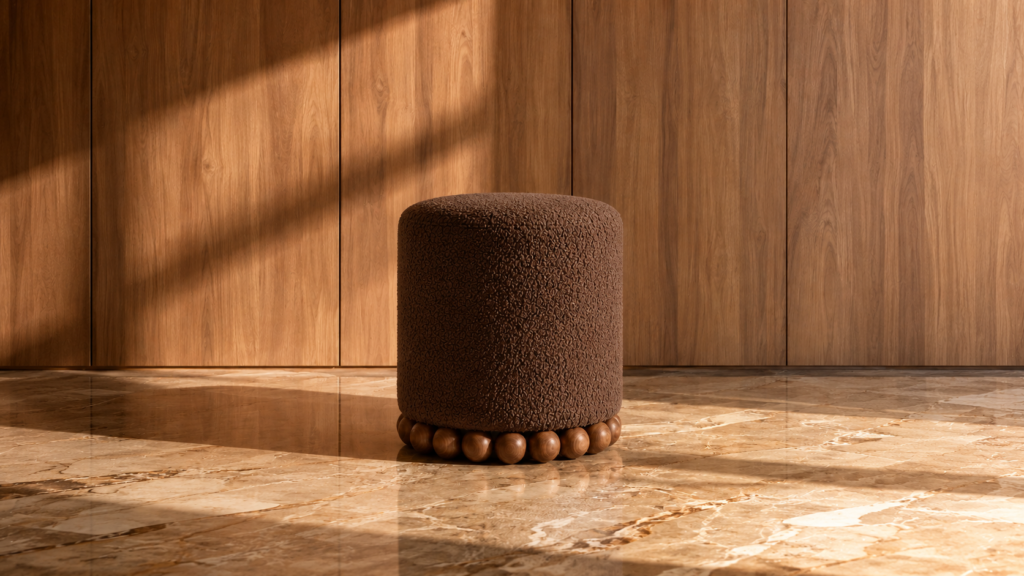
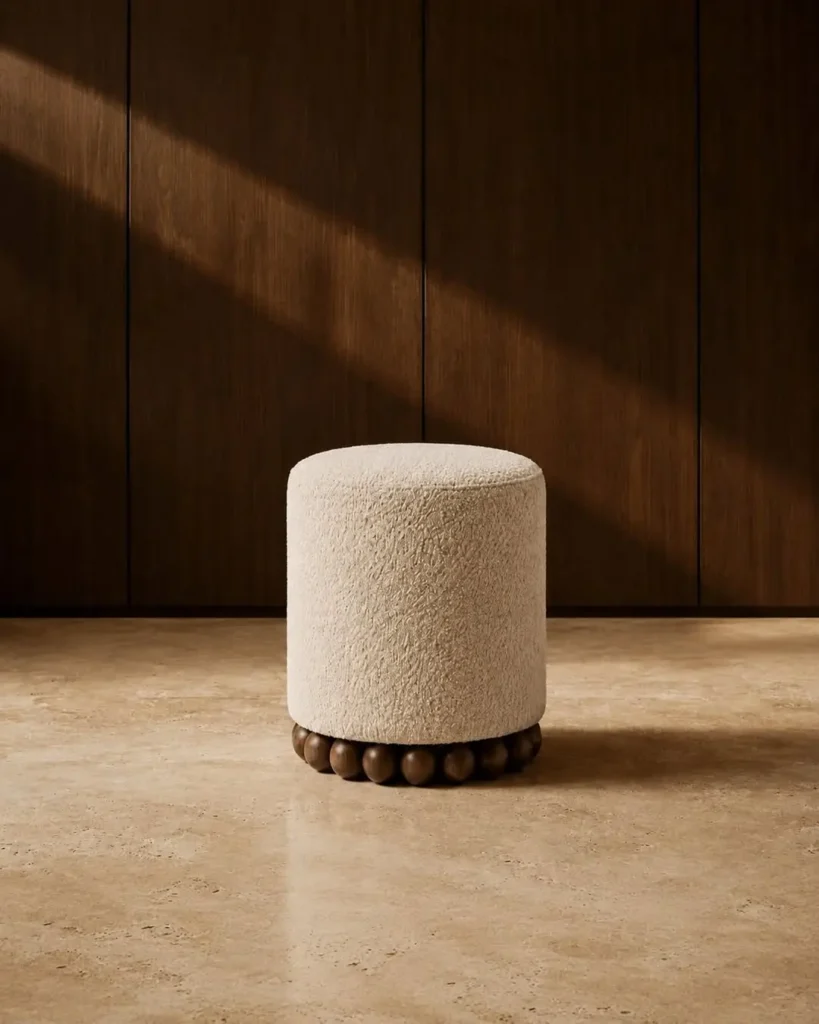
The light falls obliquely, as if someone had opened an invisible door and let the warm movement of the day into the room. The wooden planes on the wall hold the silence, the marble floor reflects it with soft shimmers, and in the middle of this peace stands a small cylinder – dense, textured, with a rounded wooden base, similar to a rhythmic beat.
He doesn’t try to be the main character. And that’s why the gaze returns to him again.
In space, there are things that occupy space. And there are things that set a direction. The RITMO pouf belongs to the second type. Its size — 400 x 400 x 450 mm — does not claim to be monumental, but the form works precisely: compact volume, soft texture, natural wood, choice of fabric, color that changes the character of the room.
This is the moment when the interior seems to stop for a second before choosing: to leave the space flat and predictable or to add an accent that will make it move. RITMO chooses movement. Not loud, not decorative for the sake of decor, but internal – through proportion, material and tactility.
That’s how it works. designer pouf: it doesn’t just cover the seating function. It pulls together the composition, emphasizes style, adds softness to hard surfaces, and creates a sense of completion. In a short Instagram post, KAIZEN RITMO is called an accent that sets the rhythm of the space — and this is an apt phrase, because its power is not in size, but in the pace it adds to the interior: designer pouf RITMO works as a detail around which the space begins to sound different.
RITMO shape: why a cylinder works softer than a square
In furniture, form always speaks first. Even before a person touches a fabric, sits down, rearranges an object or chooses a color, they read the silhouette. In RITMO, this silhouette is as clean as possible: a cylinder without unnecessary lines, without aggressive angles, without decorative noise.
The cylindrical shape has an important advantage – it does not create a conflict in space. A square pouf often adapts to the geometry of the room: to the sofa, to the carpet, to the wall, to the line of the passage. And a round or cylindrical shape is a softer part of the composition. It does not argue with straight planes, but balances them.
In a space with wood panels, marble, straight verticals and a clear light pattern, RITMO works as a counterbalance. Around are planes. In the center is volume. Around are hard materials. In the center is softness. Around are lines. In the center is roundness.
This is the design logic: not to add another similar shape, but to introduce an element that changes the feel of the room.
RHYTHM OF SPACE = FORM × TEXTURE × LIGHT × DETAIL
This formula is simple, but it explains why a small pouf can have a big impact. Remove texture and you’re left with just volume. Remove light and you’ll lose depth. Remove the wooden base and the shape will become too neutral. Remove proportion and the object will lose precision.
RITMO is balanced. Its height of 450 mm makes it a natural fit: it is not a low decorative pouf that exists only as an object for a magazine, nor a massive bench that requires a separate area. It is a compact object for real use: to sit on, to place next to an armchair, to add to a bedside, to use in a hallway, to place in a lounge area or a hotel room.
A decorative base of rounded wooden elements adds a second rhythm. The upper volume is calm, almost monolithic. The lower row is dynamic, tactile, lively. Because of this, the pouf does not look like an ordinary soft cylinder. It acquires character.
And it is this detail that distinguishes a designer object from a simple furniture unit. Design begins where function takes on intonation.
Materials: boucle, chenille, matting, velor – different character of one object
The RITMO pouf can be ordered in various fabrics: boucle, chenille, matting, velor. This is not just a list of options. For such a compact item, fabric actually becomes the language.
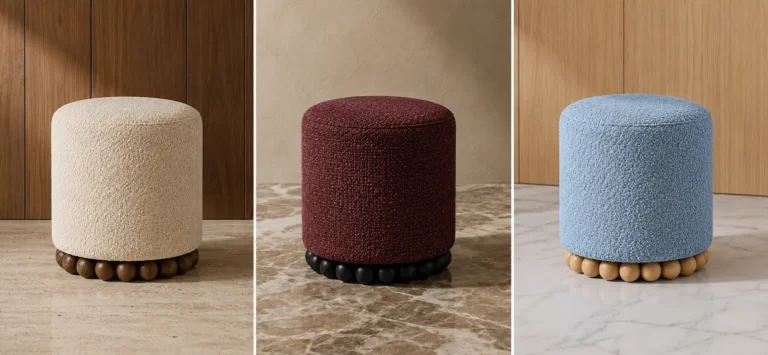
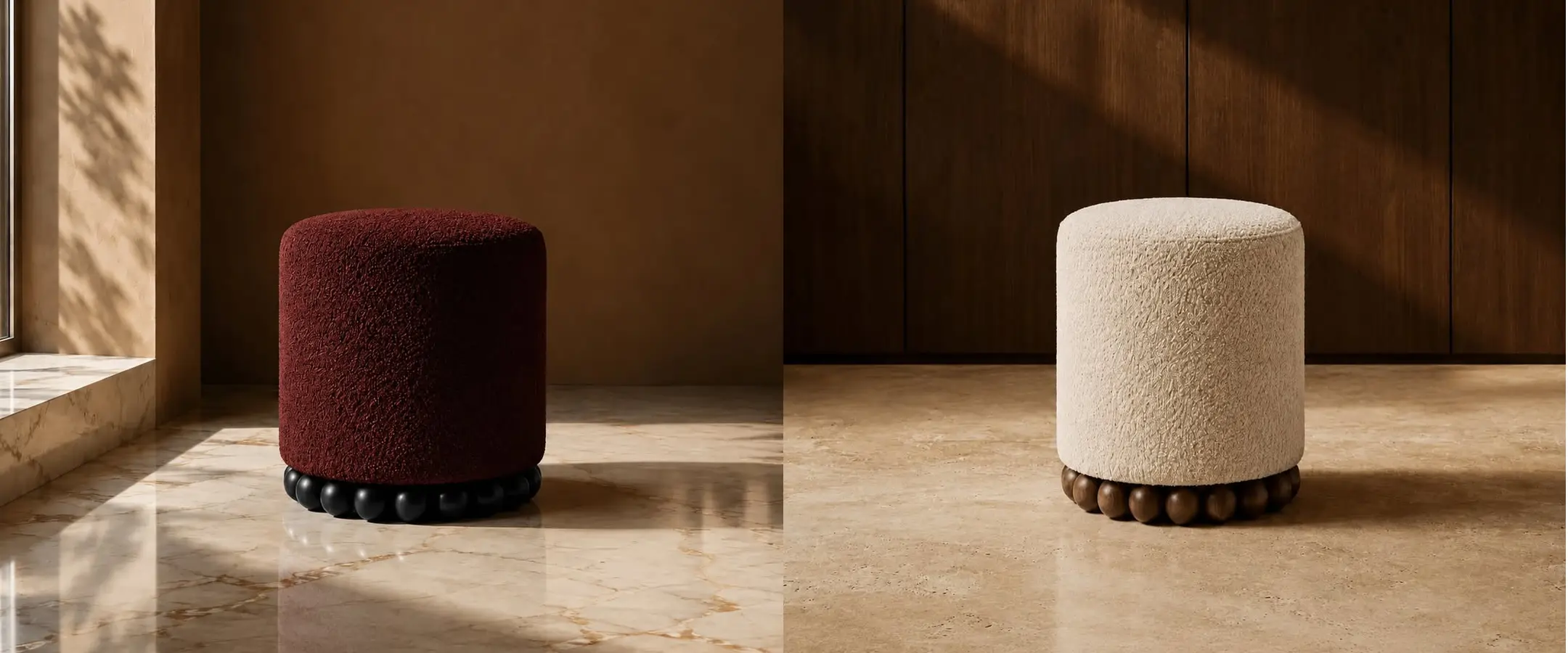
Boucle gives volume and a sense of hand-made texture. It works well in modern interiors, where there are many flat surfaces, natural wood, stone, glass or microcement. Its uneven surface does not look random – it adds warmth to the object. In a brown shade, boucle becomes almost architectural: the soft volume seems to absorb light and make it thicker. In light – it creates a feeling of purity and peace. In green – it brings the interior closer to the natural palette. In burgundy – it adds intimacy and depth.
Chenille works differently. It is softer visually, more restrained in texture, but very pleasant in everyday use. This is an option for those who want not so much an accent texture as a delicate softness.
A mat gives a more structured, collected impression. It is well suited for interiors where practicality and calm geometry are important. Such an ottoman can look more concise, even a little architectural.
Velour adds depth to the colour. It changes depending on the light, so RITMO in velour can be more emotional, more evening, more expressive. For lounge areas, hotels, showrooms or intimate living spaces, it is a strong option.
| Material | Visual effect | When appropriate | Feeling in the interior |
|---|---|---|---|
| Boucle | Volumetric texture, soft plastic | Modern living spaces, lounge areas, showrooms | Warmth, tactility, design accent |
| Chenille | Soft surface, delicate texture | Bedrooms, living rooms, recreation areas | Peace, comfort, coziness |
| Basket | Structure, restrained graphics | Hallways, offices, commercial spaces | Practicality, conciseness, order |
| Velour | Depth of color, light shine | Boutique interiors, hotels, lounges | Expressiveness, intimacy, emotion |
In KAIZEN it is important that the fabric is not selected in isolation from the space. The same pouf can be quiet or noticeable, warm or graphic, home or hotel. That is why pouf from the manufacturer has the advantage: you can not be limited to a random ready-made option, but customize the item to a specific interior, task and scenario.
Fabric is not just about color. It’s about how an object behaves in light, how it looks next to wood, how it contrasts with stone, how it feels in the hand, and how well it fits into the daily rhythm.
Wooden base: a small detail that changes the whole look
RITMO’s legs are made of natural wood – beech. There are 5 options for leg shades, and this option is more important than it seems at first glance.
Many poufs have a hidden base or simple technical legs. They perform a function, but do not contribute to the image. With RITMO, it is the opposite: the base is not hidden. It becomes a decorative rhythm. The rounded wooden elements create a visual beat, as if the lower part of the object has its own melody.
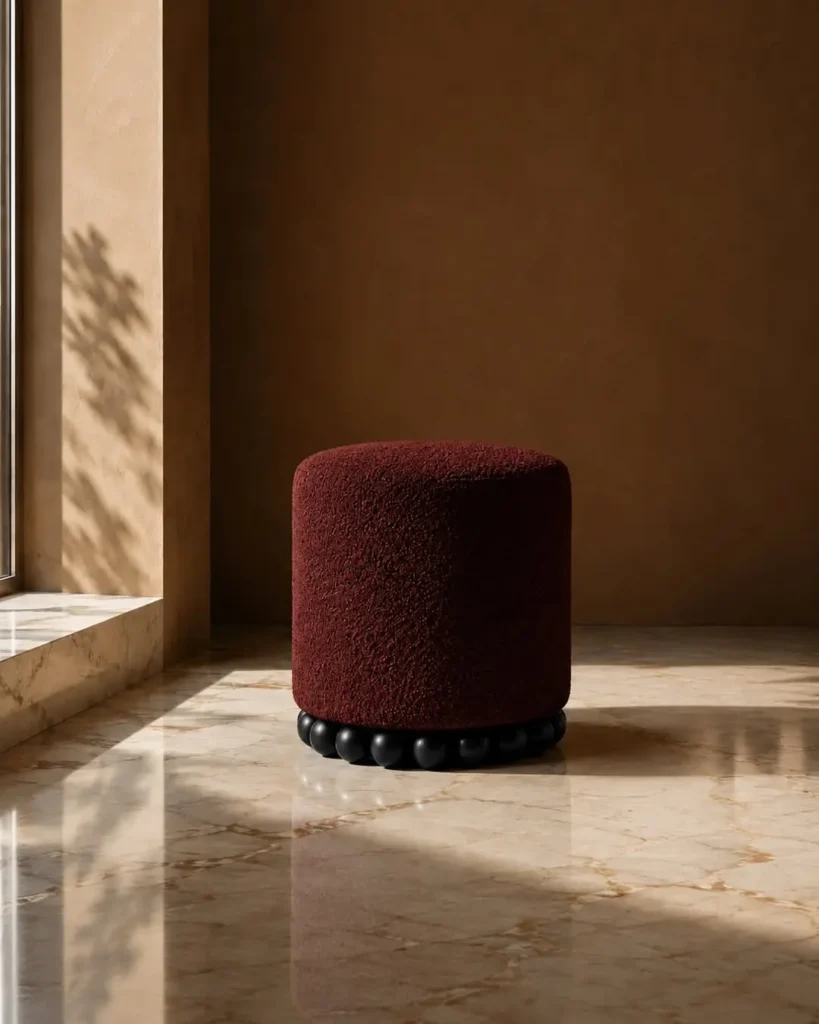
This solution works especially well next to natural materials. Wooden panels, parquet, veneer, stone with warm veins, textiles in natural shades – all this supports the basis of RITMO. But it works no less interestingly in contrast: for example, burgundy fabric with a dark base creates a more expressive, almost graphic character.
It’s important not to overdo it here. If the interior already has a lot of active details, the base can be made closer to the color of the fabric or floor. If the space is calm, the legs can become an accent.
Error → solution
Error: Choose a pouf based solely on the color of the fabric.
Decision: immediately take into account the shade of the wooden base, the floor, wall panels, nearby furniture and the overall temperature balance of the interior.
Error: put a compact pouf as a random addition.
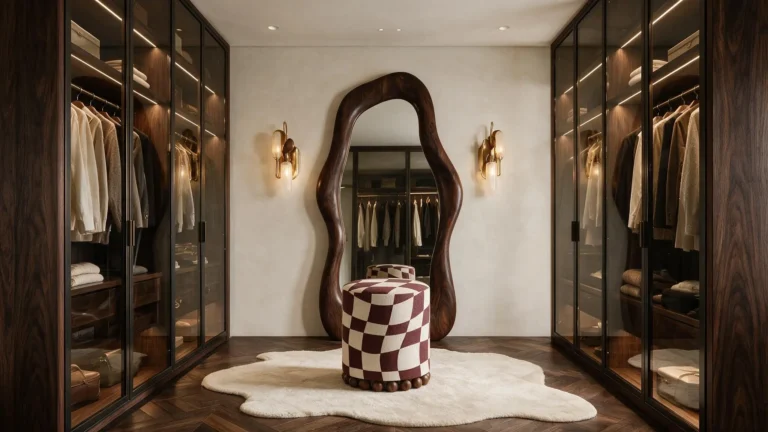
Decision: think of it as a rhythmic detail that supports the composition: next to an armchair, paired with a sofa, in a waiting area, near a mirror, or next to a bed.
Error: be afraid of an accent color.
Decision: Use a rich shade in a small space. A pouf is a safe format for deep green, burgundy, chocolate, or milky colors because it adds character but doesn’t overwhelm the space.
This is the power of small furniture. They allow an interior to change without renovation, without a complete replacement of the set, without major decisions. One item can shift the mood of a room.
The Kaizen philosophy describes this approach well: “Big changes are born from small, continuous improvements.” In furniture design, this means that a space doesn’t have to be radically transformed. Sometimes, just the right accent, the right texture, a different shade of wood, a new rhythm by the sofa is enough.
Color as a scenario: brown, light, green, burgundy
RITMO shows how differently one shape can behave in color.
The brown version sounds warm and solid. It feels good next to wooden surfaces, warm-toned marble, beige walls, brass details, coffee and caramel palettes. Such a designer pouf does not scream, but adds density to the interior. It seems to say: space has weight, material has temperature, detail has meaning.
The light version works softer. It is suitable for minimalist rooms where volume is needed without a dark accent. A milky or cream pouf can become part of a calm composition: next to a light sofa, next to a wooden coffee table, in a bedroom with natural textiles or in a waiting area where it is important to maintain a sense of space.
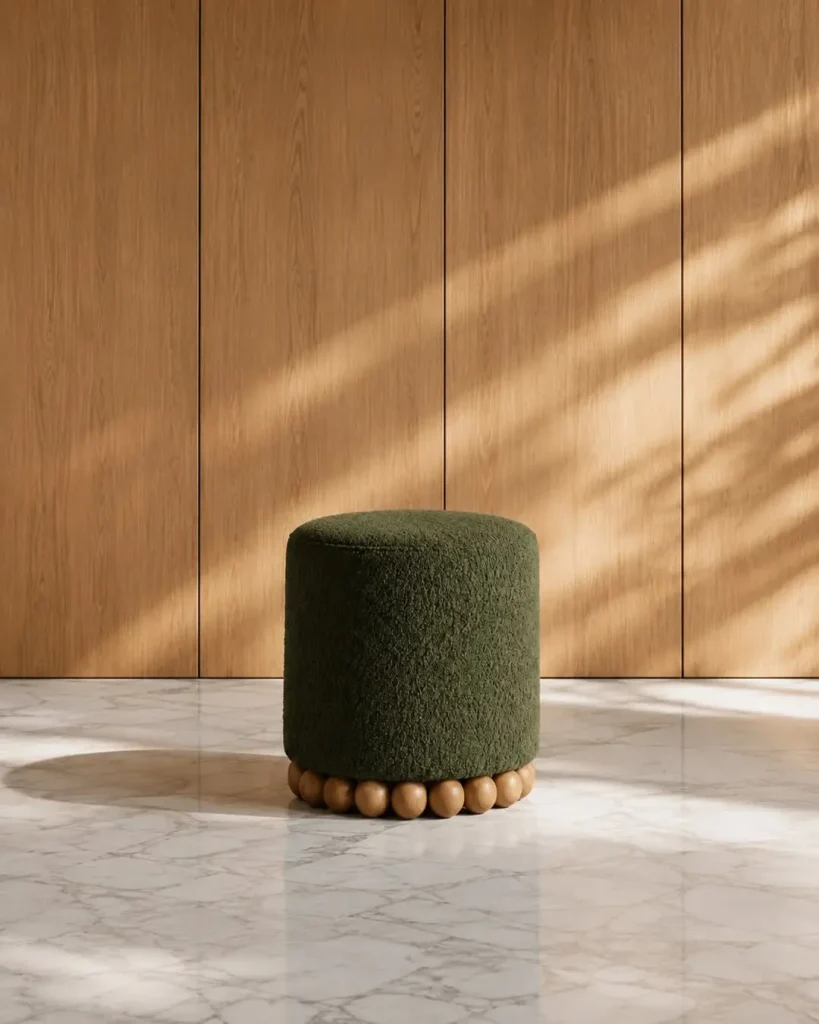
RITMO green gives a natural mood. It is not a decorative green for the sake of a trend, but a deep, restrained shade that goes well with wood, white stone, warm light and neutral walls. It can become the very living point that enlivens the interior without being too bright.
The burgundy version is the most intimate. It has more drama. Next to the window, the shadow, the warm stone and the dark base, it looks like an interior item with character. Not necessarily a classic one. On the contrary, in a modern minimalist space, a burgundy pouf can become a point of depth.
Before / after
To: the room has the right materials, but it looks flat, too calm, without a visual pause.
After: RITMO appears – and the space gains a tactile center, soft volume, color accent, and a completed composition.
The color in the pouf does not take up much space, so you can work with it more boldly than with a sofa or a large armchair. If a burgundy sofa is already a big decision, then a burgundy pouf is a controlled accent. If a green wall changes the entire room, then a green RITMO only sets a natural direction.
That’s why compact furniture often becomes a tool for designers. They give freedom: to test color, enhance an area, support materials, add texture, without destroying the overall concept.
Where to use the RITMO pouf: from apartment to commercial space
A pouf seems like a simple object until you start counting the scenarios. In fact, it is one of the most flexible interior elements. It is easy to move, easy to combine with other furniture, easy to adapt to different areas.
RITMO can work as:
- additional seating in the living room;
- soft accent near an armchair or sofa;
- a stool by the bed or dressing table;
- compact seating in the hallway;
- an element of a lounge area in an office, showroom or hotel;
- A designer detail for a photo zone, salon, boutique or studio.
For residential interiors, RITMO is valuable because it does not require much space. The diameter of 400 mm allows it to be integrated even into a small room. But the height of 450 mm maintains practicality: it is comfortable to sit on, not just to look at.
For commercial spaces, the pouf has a different role. It helps create an atmosphere where the customer is not just waiting, but feels the attention to detail. In a showroom, it can support the brand image. In a hotel, it can make a room less standard. In an office, it can add informality to a negotiation or waiting area. In a salon, it can create a soft point of contact between a person and the space.
For designers, RITMO is interesting as an adaptive module. You can choose the fabric, color, shade of the legs, and customize the item for a specific project. This is especially important when you need not random furniture from a catalog, but an exact detail for a finished concept.
5 scenarios where RITMO works best:
- Near the sofa — as an additional place or accent volume that breaks the linearity of a large soft group.
- In the bedroom — as a compact bench by the bed, mirror or window.
- In the hallway — as a convenient item for small daily actions: putting on shoes, putting on a bag, creating a first impression.
- In the lounge area — as an element of informal comfort for offices, studios, salons, and hotels.
- In the showroom or photo zone — as an object that adds texture, color, and design completeness to the frame.
In this context, the phrase “To order — write to Direct” sounds not like a simple commercial insert, but as a logical next step. Because such an item is better discussed through a specific space: what color is already there, what floor, what wood, what fabric on the sofa, whether a calm accent or a expressive detail is needed.
Pouf from the manufacturer: why it is important for an accurate interior
A ready-made pouf from a store can solve a basic problem. But if the interior is well thought out, if there is a palette, materials, lighting, design concept, or brand environment, a random object often looks alien.
Format advantage pouf from the manufacturer in that the solution can be adapted. In the case of RITMO, this means choosing the fabric, the shade, the wooden base, the overall character. There is no need to adjust the interior to what is in stock. You can create an object that naturally fits into the space.
For KAIZEN, this is fundamental. The studio approach is not limited to “making furniture.” It starts with the question: what role should the object play in the interior? Be quiet? Emphasize the brand? Add warmth? Become a photogenic accent? Work daily in a high-traffic area? Support the palette of the design project?
That is why the same RITMO can be different.
In a private apartment, it can be soft, light, almost invisible – but necessary.
In a restaurant or lounge area, it’s darker, denser, and more atmospheric.
In the showroom – accent, recognizable, one that works on visual memory.
In the office – discreet, practical, with fabric that withstands the daily rhythm well.
Not only aesthetics are important here, but also production logic. A good pouf should be stable, comfortable, proportional, neatly upholstered, and correctly assembled. If the shape is small, mistakes are even more visible. An uneven seam, an unsuccessful radius, a weak base, an incorrect height — all this immediately violates the feeling of quality.
There is no room for negligence in compact objects. That is why the manufacturer must think as both a designer and a technologist.
RITMO operates on three levels:
1. Visual level — shape, color, texture, rhythm of the wooden base.
2. Tactile level — fabric, softness, fit, feel of the material.
3. Spatial level — where the object stands, which emphasizes how it interacts with the light and neighboring furniture.
When these three levels coincide, the pouf ceases to be a trifle. It becomes part of the design.
How to choose RITMO for your space
Choosing a pouf seems simple: if you like the color, go for it. But for a strong result, it’s better to focus not on the color, but on the task. Then the object is not just “beautiful,” but appropriate.
It’s worth starting with the role. RITMO can be a quiet support or an accent. If the room already has an active sofa, carpet or painting, it’s better to make the pouf more restrained. If the space is built on neutral materials, you can allow a deeper color or a more expressive texture.
The second step is the material. Boucle gives designer tactility. Velour gives depth of color. Mat gives practical structure. Chenille gives soft comfort. The choice of fabric depends not only on taste, but also on the usage scenario.
The third step is the wooden base. It can support the floor, echo the furniture or create contrast. Five leg shade options allow you to more precisely introduce RITMO into the interior.
The fourth step is light. Daylight makes the texture more active. Warm evening light makes it deeper. Dark fabrics in low light become intimate, light ones retain their lightness. If the pouf is placed near a window, it will change throughout the day. If it is in the back of the room, artificial lighting will become more important.
The fifth step is neighboring objects. The pouf does not exist by itself. It always enters into a dialogue with a sofa, an armchair, a table, a wall, a floor, curtains, wood, stone, metal. And the more precise this dialogue, the more expensive the space looks.
Mini-selection formula:
THE PERFECT POUF = USE SCENARIO + FABRIC + COLOR + BASIS + LIGHT
In the publication KAIZEN RITMO is presented briefly: accent, size, natural wood, 5 leg options, fabrics to choose from, ordering via Direct. But behind this brief form is a complete design process – from proportion to material, from first impression to daily use. That is why the pouf from the manufacturer RITMO should be perceived not as an additional item, but as a tool for customizing the space.
For a consultation, it is enough to describe where the pouf is planned to be placed: living room, bedroom, hallway, office, showroom or commercial area. Then you can choose the fabric, color, shade of the wooden base and the nature of the accent. Direct in this case is the fastest way from an idea to a specific solution.
RITMO as the final touch of the interior
The light moves across the wood again. The shadow grows longer, the marble changes hue, the space seems to shift from one state to another. The small volume remains in place, but it is precisely because of it that the room no longer feels empty. It has a pause. It has texture. It has rhythm.
The RITMO designer pouf is not about unnecessary decor. It’s about precision. About the moment when a compact form can gather wood, stone, light, color, and tactility around itself. About furniture that doesn’t block space, but helps it resonate.
Its strength lies in its small form with a thoughtful character:
size 400 x 400 x 450 mm, natural beech wood, 5 leg shade options, fabrics to choose from — boucle, chenille, matting, velor.
But the main thing is not the characteristics themselves. The main thing is how these characteristics are combined into a solution for a specific interior.
RITMO can be a warm brown accent against a wooden wall. It can be light and almost airy in a minimalist space. It can become a green natural centerpiece in a calm room. It can enter the burgundy depth of an evening interior with a dark base.
And each time it will be the same subject — but with a different mood.
The pouf, which sets the rhythm of the space, does not complete the interior with a period. It puts a comma. After it, you want to continue: choose the fabric, specify the shade of the wood, try it on in the room, discuss the details, write in Direct Kaizen and find the right RITMO option that won’t just sit next to the furniture, but will start working together with the space.