Mornings in the dressing room are rarely completely calm. The door opens, the fabrics move, the hangers touch each other, the mirror catches the light, and the first pair of shoes already appear on the floor. The look is not yet composed. The decision is not yet made. The space lives in a brief, almost creative chaos.
In this chaos, a point of support is needed.
Not a closet. Not a shelf. Not another organizer. But a soft object on which you can sit, put things down, stop for a few seconds and continue moving again. This is how a bench appears in the dressing room: not as a decorative detail, but as a participant in a daily ritual.
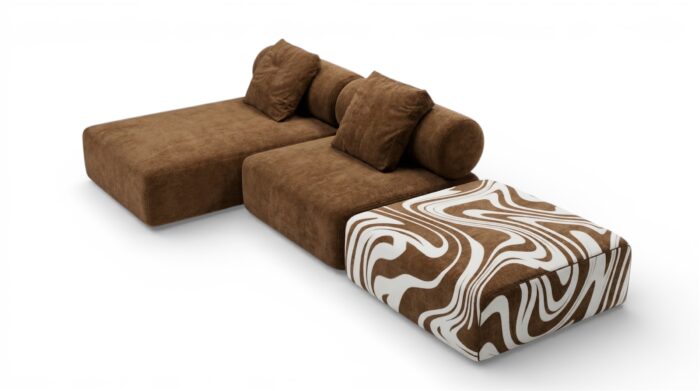
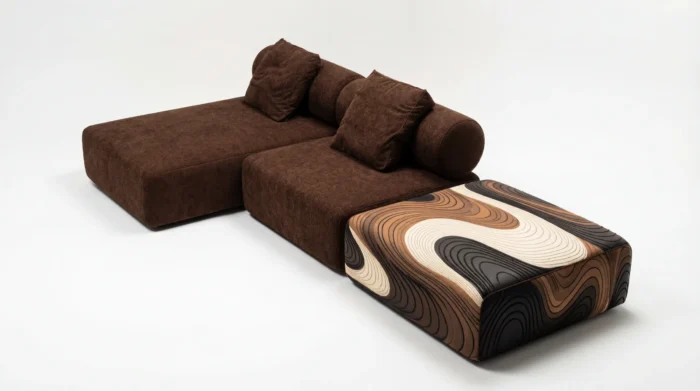
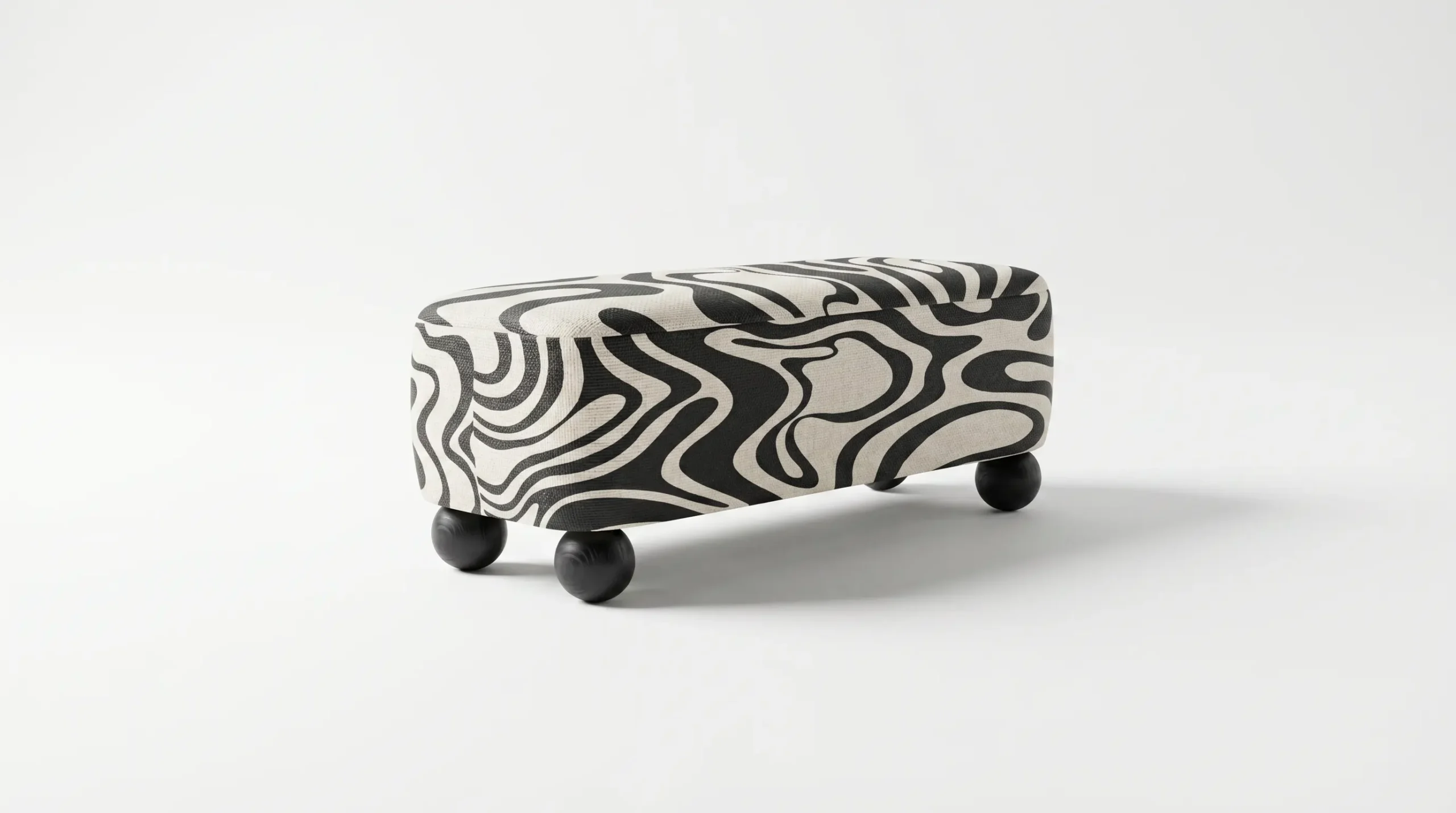
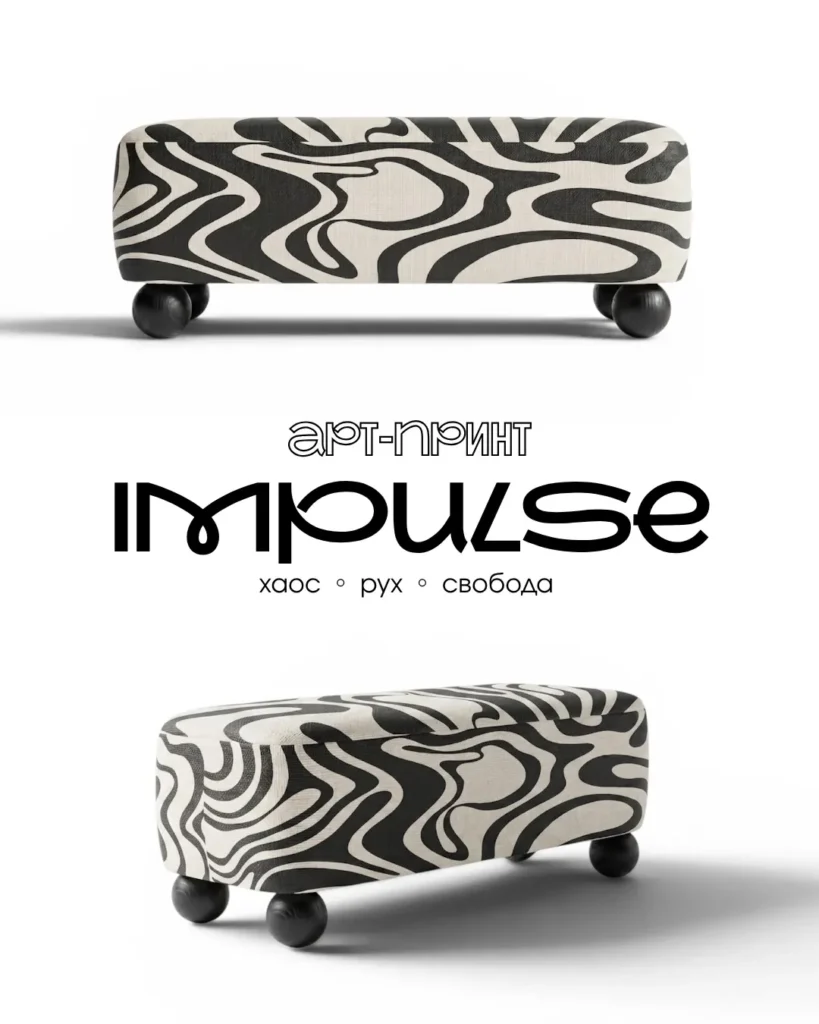
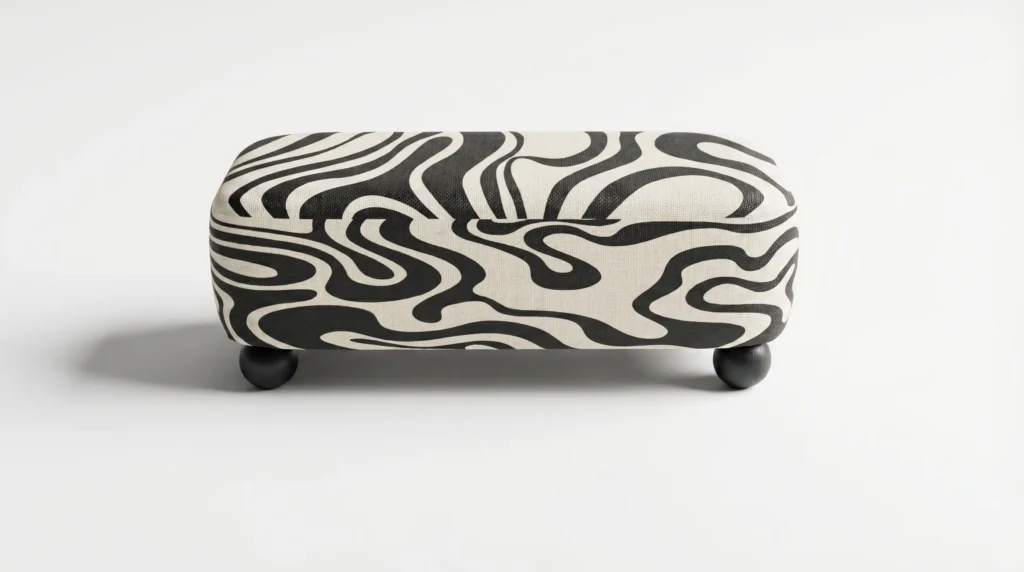
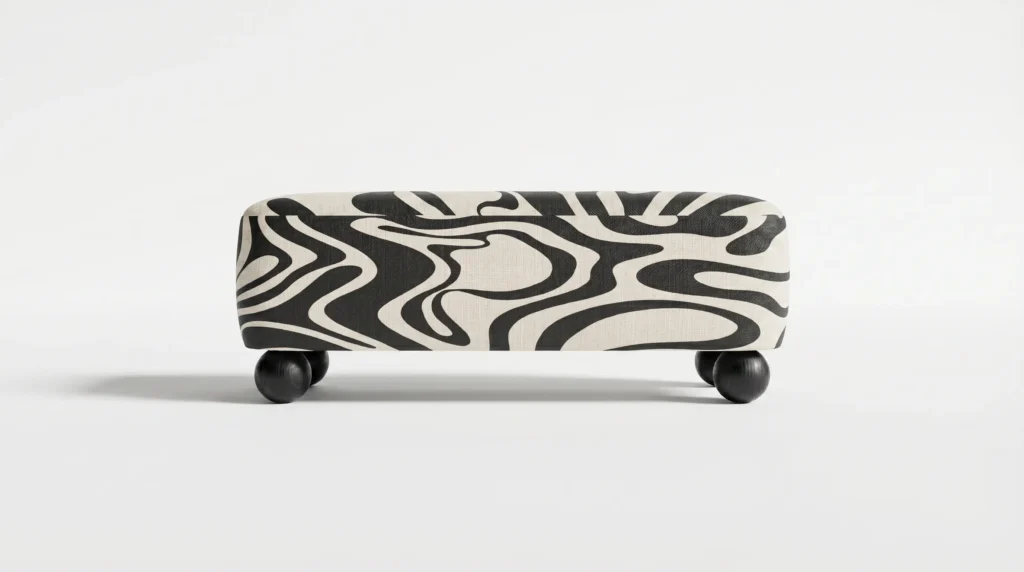
Ritmo Impulse banquette created for such a scenario. Its black and white print does not look calm or predictable. The lines bend, diverge, contract, pass through rounded corners and create the impression of constant movement. Black spherical legs hold the composition from below, and the soft elongated body gives the body a simple and clear support.
The model’s slogan is chaos, movement, freedom. And for a dressing room, this sounds very accurate. Because a dressing room is not just a place for storage. It is a space of choice. A place where a person gathers themselves anew every morning.
Impulse: a dressing room bench where chaos becomes style
A dressing room often starts out as a technical space: cabinets, shelves, drawers, lighting, a mirror. Everything should be convenient, logical, and functional. But if you leave only function, the space quickly becomes cold. There is order in it, but there is no sense of personal script.
That’s why dressing room bench It matters more than it seems. It adds a human dimension to the room. There’s a place to sit. There’s a pause between choosing a dress, shoes, jacket, bag. There’s an object that doesn’t store things, but supports the process of choosing.
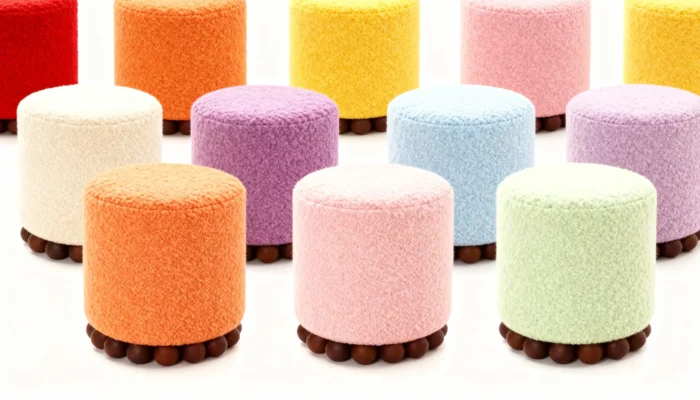
The entire collection Ritmo banquettes with art prints is built around the idea that one form can have different characters. Euphoria gives lightness, Hedonist – warm pleasure, Hypnosis – magnetism, Igniter – expressive impulse. And Impulse works with the theme of movement. It does not calm the dressing room, but makes it alive.
Here, chaos does not mean disorder. It is the chaos of creative choice. When things have not yet formed into an image, but there is already energy. When a person tries on not only clothes, but also their mood. When a mirror becomes not just a functional object, but part of a small personal scene.
| Slogan word | As manifested in Impulse | What gives the dressing room |
|---|---|---|
| Chaos | uneven graphic lines and active print | living, non-sterile energy |
| Movement | wavy shapes pass through the body | sense of dynamics |
| Freedom | the banquet does not dictate one scenario | flexibility in daily use |
That’s why Ritmo Impulse is not just a stool next to a closet. It’s a piece that transforms a walk-in closet from a storage space to a space of personal style.
Why a dressing room needs a soft fulcrum
A dressing room is a room of short actions. People don’t sit here for hours, but often sit down for a few seconds. Put on their shoes. Fasten their belt. Put down their bag. Arrange their clothes before choosing. Stop in front of the mirror. It is these short actions that determine how comfortable the space really is.
Without a bench, a dressing room often works incompletely. A person puts things on shelves, on the floor, on the edge of a dresser, or holds more in their hands than necessary. The space seems functional, but moving around in it is uncomfortable. There is unnecessary clutter.
Dressing room bench solves this not with a complex structure, but with its very presence. It creates a place for pause. And pause in the dressing room is part of the order.
Impulse Formula:
A WARDROBE WITH CHARACTER = FUNCTION × MOVEMENT × FREEDOM OF CHOICE
The function provides convenience.
Movement gives life.
Freedom of choice gives a sense of personal space.
Ritmo Impulse fits this formula well. Its soft shape doesn’t look office or technical. The black and white print adds a fashion mood to the wardrobe. The ball-shaped legs don’t overload the object, but create a feeling of light play. The bench doesn’t look like a randomly placed bench. It looks like part of the image.
And this is important. Because a dressing room is one of the few rooms where the furniture works not for guests, but primarily for the person who uses it every day.
Custom-made banquette: when the dressing room has its own rhythm
Dressing rooms are very different. One has a narrow passage between the cabinets. Another has a central island. The third has a large mirror, near which a seating area is needed. Somewhere the bench should be by the window, somewhere – against the wall, somewhere – in the center of the dressing space.
That’s why custom banquette for a dressing room, it is often more logical than a random ready-made model. It is not only the color and print that are important. The size, proportion, scenario, distance to the cabinets, the width of the aisle, the landing height, the visual role in the room are important.
Ritmo has a basic design with several widths: 800, 1000 or 1200 mm, a depth of 400 mm and a height of 430 mm. This is a practical range for a dressing room. The compact version can become a soft spot near the mirror. The medium version is a convenient item between cabinets or against the wall. The longer version is a strong accent in a spacious dressing room or fashion zone.
But customizing is not just about size. It’s also about character. Impulse is for those who don’t want a “faceless” walk-in closet. Its black-and-white print doesn’t hide, it sets the pace. It works well with mirrors, black handles, light-colored fronts, wood, metal, lighting, and graphic details.
Custom banquette In this case, it becomes a tool for fine-tuning the space. Not just “so that there is somewhere to sit,” but so that an object appears in the dressing room that supports your rhythm.
As Charles Eames said:
“The details are not the details. They make the design.”
This is especially noticeable in a dressing room. The distance to the mirror, the size of the bench, the texture of the fabric, the print, the legs, the lighting – all affect how the space works on a daily basis.
Impulse art print: black and white movement without unnecessary decor
Impulse is built on the contrast of black and light. But unlike Hypnosis, where the print has a magnetic, almost hypnotic rhythm, here the lines seem freer. They move wider, change direction, creating a sense of a wave, a flow, a quick gesture.
This print is not about symmetry. And it is not about calm repetition. It is about the energy of choice. That is why it is so well suited for a dressing room. Clothes, textures, mirrors, light, human movement – none of this is static. Impulse picks up this dynamic and translates it into a piece of furniture.
The black and white palette has another advantage: it goes well with various wardrobe systems. If the facades are light, the bench creates a contrast. If the interior has black handles, frames or lamps, it gathers these details into one graphic story. If the space is built on wood, the print gives it a more modern fashion character.
Impulse goes well with:
- large mirrors;
- black or graphite cabinet handles;
- light facades;
- natural wood;
- lighting in niches;
- metal rails;
- stone or microcement floor;
- monochrome textiles;
- open fashion rails.
This is not a decorative print in the classic sense. It does not “decorate” the dressing room. It adds movement to it. Because of this dressing room bench Impulse looks appropriate where clothes, accessories, and people are constantly in the process of change.
How to place Ritmo Impulse in a dressing room
The right place for a bench depends on the route. In a dressing room, it is important not just to find a free area. You need to understand where a person actually stops. Where they take things. Where they look in the mirror. Where they put on their shoes. Where they put their clothes away while trying them on.
Dressing room bench should support this route, not interfere with it. If you put it in the aisle, it will quickly become annoying. If you put it too far from the mirror, it will lose some of its meaning. If you hide it in a corner, its print will not work.
5 Impulse placement scenarios
- Near the large mirror
The strongest scenario for a dressing room. The bench becomes part of the fitting area: sit down, look around, change shoes, evaluate the look. - Between two cabinet units
If the aisle is wide enough, Impulse can create a soft spot in the center of the route and break up the technical linearity of the cabinets. - Near the island with accessories
In a spacious dressing room, a bench can work next to a place where jewelry, bags, or small items are stored. - Under a free wall
If the dressing room has one calm plane, a black and white print will become a strong accent without unnecessary decor. - In the open dressing area of the bedroom
If the dressing room is not closed off by a separate room, Impulse can mark the boundary between the sleeping area and the image selection area.
It’s important to strike a balance here. Impulse should be noticeable, but not obstruct movement. Its purpose is to provide freedom, not create a new obstacle.
Choice mistakes: when a dressing room bench doesn’t work
A dressing room is a space where mistakes quickly become noticeable. If a bench is too big, it obstructs the passage. If it is too small, it looks random. If it is too neutral, it loses its role. If it is too active in a cluttered space, it creates noise.
Impulse has a strong character, so it requires careful decision-making.
Error → solution
Error: choose a banquet without taking into account the aisles.
Decision: First determine the person’s route, and then select the size.
Error: Place the banquette far from the mirror or fitting area.
Decision: place it where the image selection actually takes place.
Error: make the dressing room completely technical.
Decision: add a soft object with character to bring the space to life.
Error: be afraid of an active black and white print.
Decision: support it with black details: handles, lamps, frames or rails.
Error: order a banquet only “by size”.
Decision: also think about the script, print, fabric, light, and the emotion of the space.
That’s why custom banquette for a dressing room should solve not only the issue of dimensions. It should correspond to the lifestyle. Someone wants complete order and peace. Someone wants movement, freedom, experiment. Impulse was created for the second scenario.
How to combine Impulse with materials, light and details
The black and white Impulse print has a strong graphic, but it doesn’t require a complex surrounding palette. On the contrary, it works best in interiors where the base is fairly clean. Light facades, wood, stone, black accents, mirrors and warm lighting – this is enough to make the banquette look complete.
| Wardrobe element | How it works with Impulse | Effect |
| Large mirror | reflects the print and enhances movement | fashion scene |
| Light facades | provide a calm background | pure contrast |
| Black pens | support print and legs | graphic integrity |
| Wooden panels | add heat | balance to monochrome |
| Shelf lighting | reveals the texture of the fabric | depth |
| Stone floor | makes the image more collected | premiumness without pathos |
If the dressing room is very bright, Impulse will be the main accent. If it already has black details, the bench will support them and make the composition more complete. If the space is warm and wooden, a black and white print will add a more modern energy.
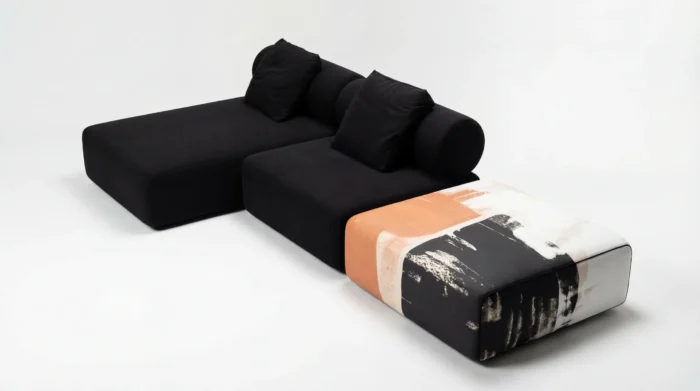
Compared to Igniter, Impulse is less like a sharp brushstroke and more like an organic flow. Igniter sets the space in motion through expression. Impulse through the rhythm of movement. This is an important difference for a dressing room: it requires not only energy, but also the freedom to change the script every day.
When to choose Ritmo Impulse
Impulse is not for those looking for the most relaxed banquette. It is designed for people who value vibrant graphics, contrast, movement and a sense of personal style. It works especially well in dressing rooms, where furniture should not only be practical, but also part of the daily mood.
Choose Ritmo Impulse if:
-
- you need a dressing room bench with a distinctive character;
- you want to add a black and white graphic accent to the space;
- the dressing room has a mirror, light facades or black details;
- you need a custom-made banquette for a specific size and scenario;
- the space should support movement, fitting and image selection;
- you don’t like completely neutral furniture;
- I want to make the dressing area more personal and bold.
At KAIZEN, the choice of such a model does not begin with the phrase “I need a bench.” It is more correct to formulate the task: I need a fulcrum in the dressing room that will be comfortable, soft, graphic, and not look like a random item from a catalog.
Ritmo Impulse meets this exact task.
Final chord: freedom begins with a point of support
In the beginning, there was a dressing room in motion. Things, a mirror, light, choices, the brief chaos of the morning. In such a space, it’s easy to think that all you need is order. But sometimes you need something else – a soft spot that allows this chaos to become beautiful.
Ritmo Impulse banquette works exactly like this. It doesn’t remove movement from the dressing room. It organizes it. It provides a place for pause, supports the fitting scenario, adds graphic rhythm and turns the dressing area into a space of freedom.
As dressing room bench, Impulse solves a practical task: sit down, put on shoes, put things away, stop in front of the mirror. How custom banquette, it allows you to more precisely adjust the size, print, and role of the item to a specific interior. And as a design accent, it adds something that is difficult to buy separately: character.
To choose Ritmo Impulse for your dressing room, you can start with a photo of the space, dimensions, palette and a brief description of the scenario. KAIZEN will help you understand what size will be comfortable, where to place the banquette and how to make its black and white rhythm work not as a random decor, but as an extension of your movement.
Because freedom in the interior is not the absence of structure. It is a structure that does not prevent you from being yourself.