Gray is not always about cold. In the right texture, it can be soft, deep, and almost meditative. It doesn’t demand attention, it doesn’t argue with the architecture, it doesn’t try to be the loudest detail in the room. Its strength is in its silence.
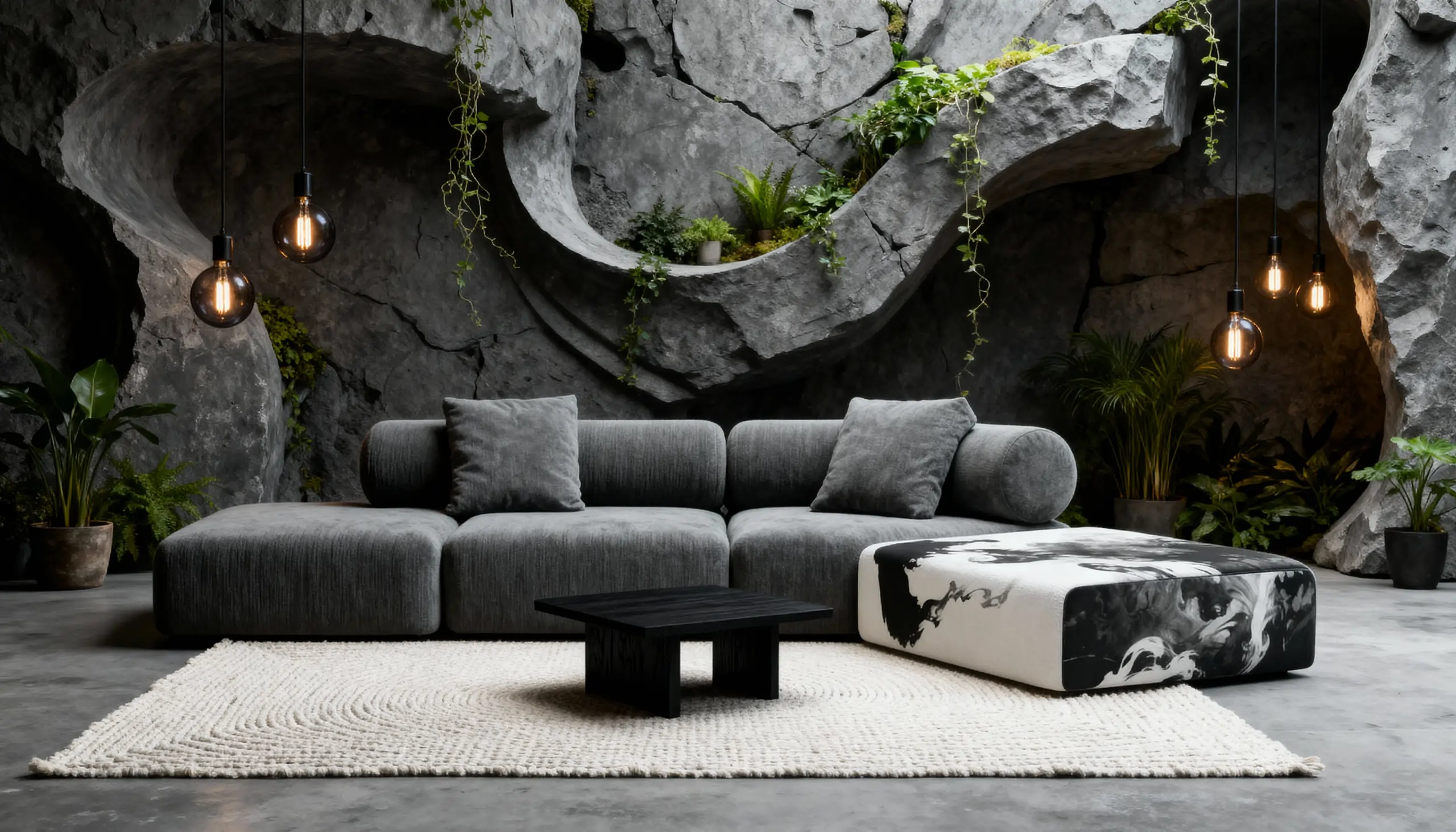
Exotiq Grey Japan fog works in exactly this way. The grey modules create a discreet lounge area, the cylindrical backrest creates a calm horizontal line, and the cushions add softness without being overly decorative. There is no random effect in this composition. There is a mist, a pause, depth and a sense of space that does not need excessive explanation.
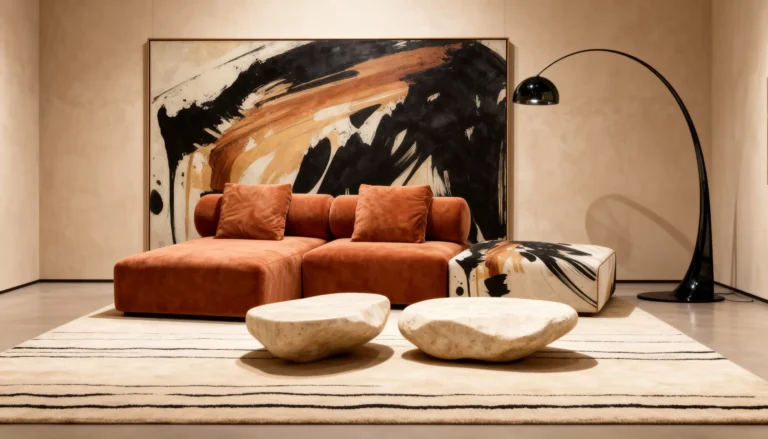
The accent module with a black and white print resembles a blurred ink brushstroke. It does not look like a bright decor. On the contrary, it creates the impression of fog, smoke, water, clouds or Japanese graphics, where the important thing is not the number of details, but the pause between them.
Exotiq Gray Japan fog is it gray sofa for interiors where peace is needed, not neutral emptiness. It can be adapted as custom-made sofa: according to the size of the space, the landing scenario, the fabric, the print and the level of visual restraint.
Grey Japan fog: gray minimalism without cold emptiness
It’s easy to make a grey sofa too technical. If the shape is rigid, the fabric flat and the space around it cold, it quickly becomes a faceless object. Grey Japan fog works differently. Here, the grey has texture, depth and softness.
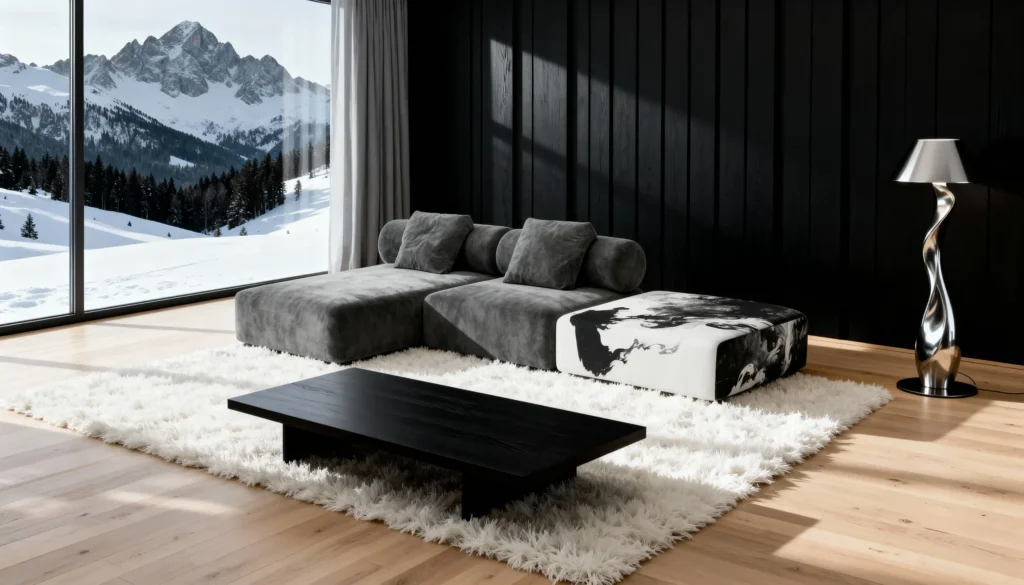
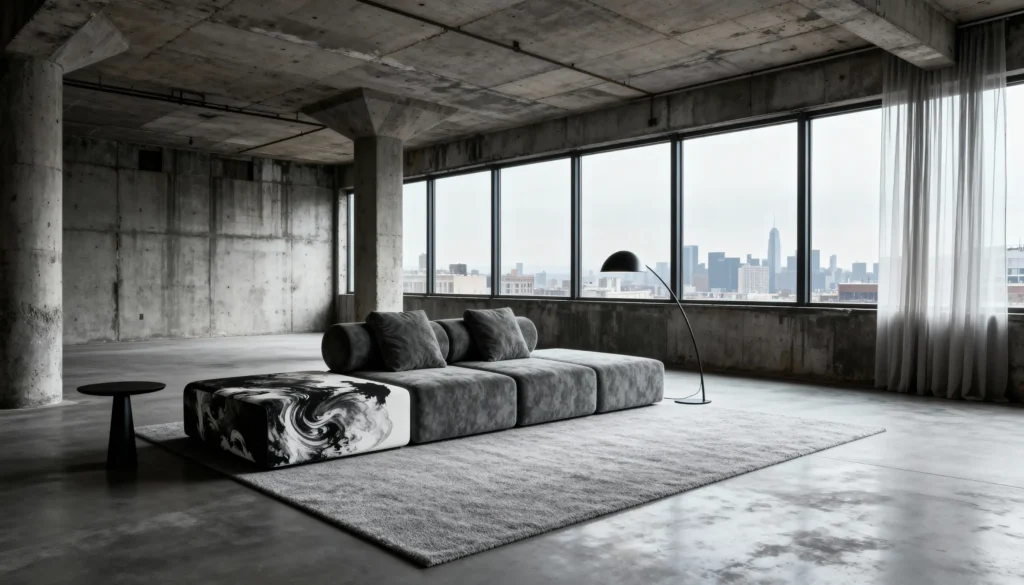
In a mountain interior, it resonates with the snowy landscape, black panels, and white carpet. In a concrete space, it maintains industrial restraint, but softens it with a lounge-like seating. In a stone interior, it becomes part of a natural palette, where gray doesn’t look artificial, because there’s a rock texture, greenery, and warm local light nearby.
The name Japan fog is accurate in its mood. It is not a literal stylization of a Japanese interior. There is no direct copying here. There is a principle: less excess, more pause; less color noise, more material; less decorativeness, more feeling.
In the main article about Exotiq modular sofa with cylindrical backrest The entire Exotiq system is revealed through modules, colors, fabrics and art prints. Grey Japan fog is its most restrained scenario: gray, foggy, calm and very precise.
A gray sofa as the centerpiece of a calm living room
Request gray sofa often seems practical. Gray is easy to combine with black, white, wood, concrete, stone, glass and metal. But the real value of gray is not only in its versatility. It can create a mood: restrained, mature, visually clean.
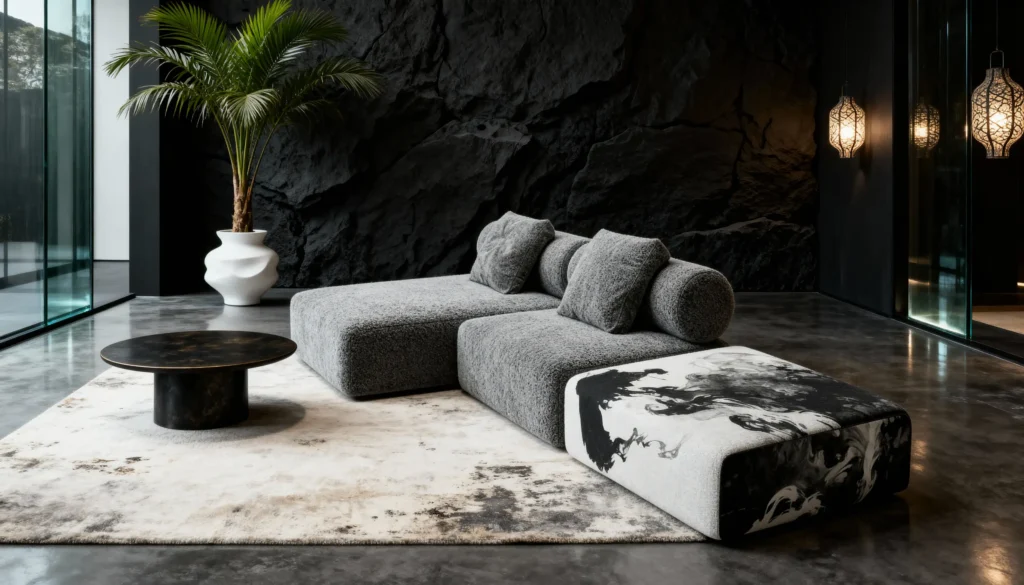
Grey Japan fog doesn’t try to be a background, although it easily fits into different spaces. It works as a quiet center. It doesn’t need to be reinforced with bright pillows or unnecessary decor. The right composition is enough: gray modules, white or gray carpet, dark table, calm wall, natural light, one art module.
Textual formula of the composition:
GRAY CALM = TEXTURE × PAUSE × FOG PRINT × CLEAN SPACE
That’s why Grey Japan fog works well in interiors where balance is not important. It doesn’t overwhelm the room, but it doesn’t disappear either. It holds space through form, scale and the feel of the material.
Custom-made sofa: when restraint needs to be fine-tuned
Gray minimalism looks simple only at first glance. In fact, it requires precision. One bad shade can make a space cold. The wrong fabric can make it flat. Too active a print can make it noisy. Too weak an accent can make it inconspicuous.
That is why Grey Japan fog should be considered as custom-made sofa, and not just like a ready-made gray sofa. It is important to customize everything: the number of modules, the depth of fit, the shade of gray, the texture of the fabric, the placement of the printed block, the balance between the monochromatic base and the art accent.
| What is configurable? | Why is this needed? | How does it affect the interior? |
|---|---|---|
| Number of modules | adaptation to the room area | the sofa does not look too small or massive |
| Shade of gray | balance with wood, concrete, stone or black panels | the space becomes warmer or more restrained |
| Fabric texture | tactility and depth of color | gray doesn’t look flat |
| Art module location | focal point of the composition | the print works as an accent, not a random insert |
| Planting depth | vacation scenario | the sofa becomes a lounge area or a more collected seating area |
| Backrest and pillows | comfort and silhouette | the shape remains soft but clear |
In this approach, customization is not just about choosing a fabric from a catalog. It’s about making a sofa precise for a specific space.
Cylindrical backrest: soft lines in a minimalist form
Grey Japan fog has a calm silhouette, but it doesn’t look dry. One of the reasons is the cylindrical backrest. It softens the modular geometry, makes the sofa more flexible and adds to its recognisability.
In the grey fabric, this shape reads particularly delicately. It does not create a sharp outline, as it might in black. Instead, it works as a soft horizontal: calm, low, tactile. The backrest supports the body, but does not turn into a heavy wall behind the sofa.
In a mountain interior, such a backrest echoes the horizon line outside the window. In a concrete space, it softens the harsh architecture. In a stone interior, it creates a contrast between the natural roughness of the rock and the soft shape of the sofa.
This is important for minimalism. If you remove excess decor, the form begins to work more strongly. Every line becomes noticeable. And the cylindrical Exotiq back is not a detail for the sake of effect, but part of the architecture of the object.
Foggy art print: graphics without sharp contrast
The Grey Japan fog accent module does not have a clear geometry. It does not have a checkerboard pattern, sharp optics or a wide contrasting stroke. Its language is different: blur, transition, halftone, fog.
The black and white print works as an abstract fragment. It adds visual depth to the sofa, but does not disturb the peace. In a space with mountains, it echoes the snow, shadows and rocks. In a concrete interior – with the urban haze outside the window. In a stone space – with the natural spots, cracks and irregularities of the rock.
This is not a print that immediately “screams”. It opens up more slowly. Up close, you can see the texture, the lines, the black and gray transitions. From a distance, it reads like a hazy spot that completes the composition.
PRINT = PAUSE + TRANSITION + DEPTH
In Grey Japan fog, the print doesn’t decorate the sofa. It adds to its status. That’s why the composition doesn’t just look gray, but atmospheric.
Japanese restraint without direct copying
In this composition, the Japanese theme is not expressed through obvious symbols. There are no lanterns, hieroglyphs, screens or literal decor. Japan fog works through feeling: pause, simplicity, asymmetry, naturalness, attention to texture.
It’s close to the logic of wabi-sabi, but without the decorative stylization. The unevenness of the stone, the soft fabric, the muted gray color, the misty print, the large window, the silence between objects – all this creates a space where not many details are needed.
Grey Japan fog goes well with materials that have their own surface: wood, stone, concrete, black panels, matte metal, wool or textured carpet. Next to them, a gray sofa does not look empty. It becomes part of a calm material composition.
That’s why it’s better not to overload this sofa with small decor. It doesn’t need dozens of items, but a few precise ones: a low table, a rug, a light, a plant, a stone, a window or a blank wall.
Where Grey Japan fog works best
Grey Japan fog is suitable for interiors where silence is important. Not emptiness, but silence: when the space is collected, but not oppressive; when the furniture is noticeable, but not screaming; when the sofa works not as a decorative spot, but as a soft center.
In a mountain house, this composition looks natural. Gray textiles echo the rocks, snow, shadows and black wooden panels. A white carpet adds lightness, and a black table structures the lounge area.
In an urban loft space, Grey Japan fog supports concrete, glass, and panoramic windows. It doesn’t try to make the interior “homey” in the usual sense, but adds softness and a human scale.
In a space with stone and greenery, the sofa acts as a bridge between natural roughness and comfort. The gray fabric doesn’t clash with the stone, and the art module adds movement without color noise.
Best use cases
- minimalist living room with black or gray accents;
- mountain house with panoramic views;
- loft with concrete, glass and open space;
- a space with stone, plants and subdued lighting;
- lounge area for slow relaxation;
- showroom or salon, where a discreet premium is required;
- a private office or quiet room.
Compared with Black and white Illusion, Grey Japan fog is softer and less dramatic. In the background Caramel Vertigo it is cooler and more restrained. If you need a warmer lounge depth, you should look towards Brown Tiramisu Swirls.
How not to go wrong with gray minimalism
A grey interior can look expensive and calm, but it can become cold if there is not enough texture, light and soft transitions. Grey Japan fog works best when there is not just “grey” around, but materials with depth.
Error → solution
Error: Choose a gray sofa just because it is universal.
Decision: look at the texture, the hue, and how it works with light.
Error: make the entire interior the same gray.
Decision: add black, white, wood, stone, greenery or warm local light.
Error: be afraid of print in a minimalist space.
Decision: use a foggy art module that adds depth but doesn’t create noise.
Error: buy a standard sofa without taking into account the scale of the room.
Decision: Choose a custom sofa to customize the modules, fit, fabric, and accent placement.
Error: overload a gray sofa with decorative pillows and small details.
Decision: leaving the space cleaner and letting the shape, fabric, and print do the work.
How to choose Grey Japan fog for your interior
Grey Japan fog is a good choice when the interior needs a restrained strength. This is not a sofa for a bright color accent. Its role is different: to create a calm zone that withstands attention, but does not exhaust the eye.
5 steps of selection
- Evaluate the materials of the space.
A gray sofa works best next to stone, wood, concrete, black panels, glass, and textured rugs. - Determine the temperature of gray.
One shade is needed for warm wood, another for concrete, and another for a black wall. - Choose the role of the art module.
It can complete the composition from the side or be the main foggy point in space. - Leave a pause around.
Grey Japan fog works better where there is no visual noise. - Customize the sofa to fit your life scenario.
A mountain house, city loft, salon, or private living room require different module configurations.
When it comes to a custom sofa, it’s not just about choosing a nice shade of gray. You need to understand how it will behave in the morning, afternoon, evening, in natural light, under a floor lamp, against a black wall, or near a large window.
Before/after: what changes Grey Japan fog
To: The space has strong architecture—stone, concrete, black panels, or a panoramic view—but it lacks a soft center. The interior feels expressive, yet a bit distant.
After: Exotiq Grey Japan fog adds a calm lounge area. Grey modules soften the space, a cylindrical backrest holds the silhouette, and a foggy art module adds depth without being overly decorative.
To: a gray interior risks being cold.
After: The textured fabric, cushions, and soft fit make it warmer to the touch.
To: stone or concrete dominate the space.
After: the sofa balances them with a human scale.
To: minimalism seems empty.
After: The misty print adds atmosphere without breaking the silence.
Yes gray sofa moves from the category of universal furniture to the category of an object that creates an atmosphere.
KAIZEN customization: a gray sofa for your silence
Grey Japan fog can be adapted to different interiors. This is the power of the Exotiq system: it does not force the space to adapt to a ready-made sofa, but allows you to assemble a composition for a specific room.
You can change the number of modules, the depth of the seat, the fabric, the shade of gray, the location of the foggy art block, the contrast of the print, and the overall usage scenario. For a mountain house, it could be a soft composition by the window. For a loft, it could be a longer, low sofa in a concrete space. For a salon or showroom, it could be a discreet art object that doesn’t look random.
KAIZEN views Exotiq as a system. It matters where the sofa is placed, what the background is behind it, how much light the room has, whether there is stone, wood, concrete or greenery nearby, whether the print should be visible or remain almost hazy.
Within the Exotiq Grey Japan fog cluster, it takes a position of silence and restraint. If you need a warmer emotion, you can look at Caramel Vertigo or Brown Tiramisu Swirls. If you want a more graphic monochrome — Black and white Illusion or Black and white strokes. And the full logic of the system is worth looking at in the hub article about Exotiq modular sofa with cylindrical backrest.
At the end, there is silence. Gray textiles, black wall, stone, light from the window, soft carpet and foggy print. Grey Japan fog does not try to make the interior spectacular in a second. It works longer: it calms, collects, deepens and creates a space in which you want to stay without unnecessary words.
If you want to adapt Exotiq Grey Japan fog to your living room, mountain house, loft, salon or showroom, you can write to Direct KAIZEN. It is enough to start with a photo of the space, palette or a short description of the mood. Then the composition is assembled by subject: modules, fabric, shade of gray, foggy print and that measure of Japanese restraint that your interior needs.