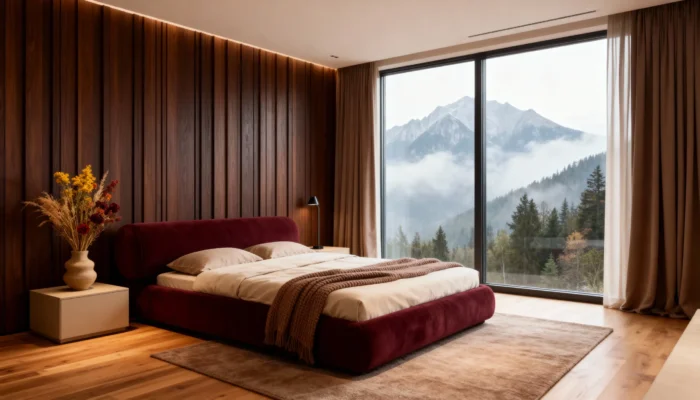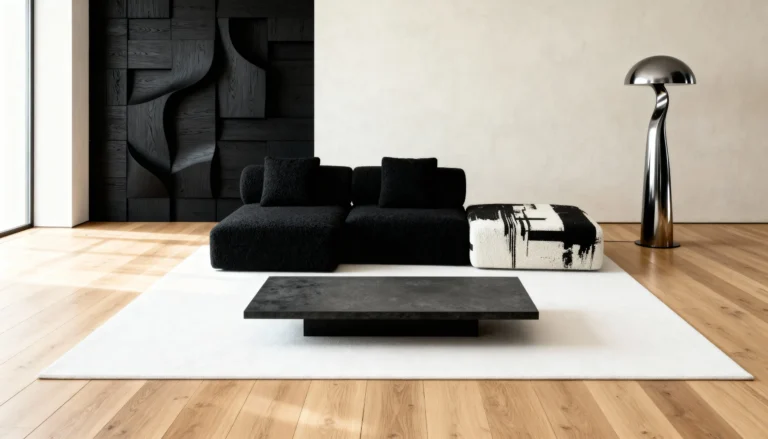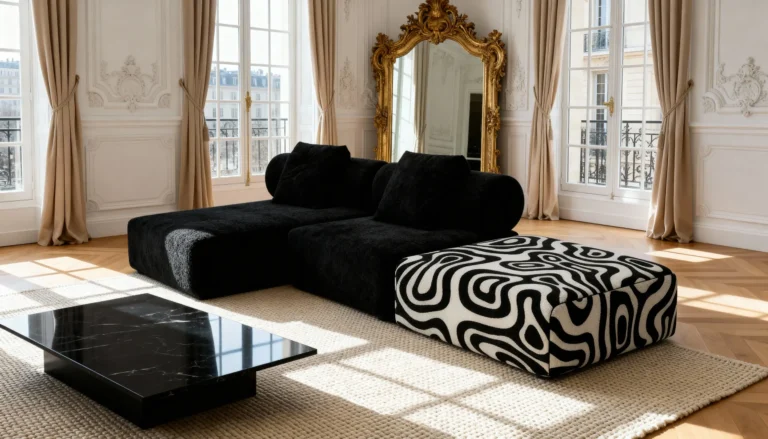
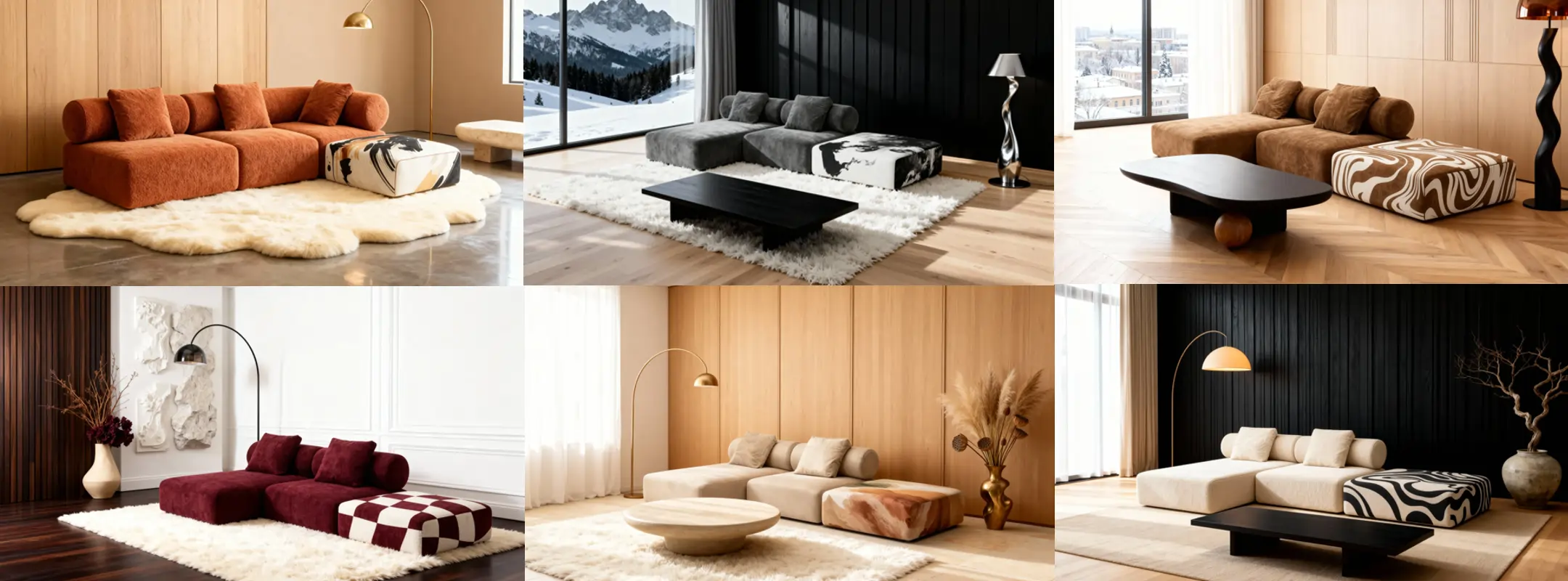
Light can transform a room. Warm wood becomes softer, a black wall deeper, the gray landscape outside the window almost becomes part of the interior. But there are objects that don’t just react to the space. They begin to collect it themselves.
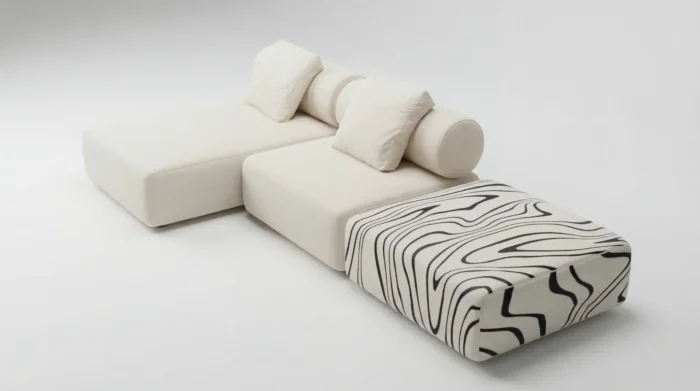
Exotiq works in exactly this way. Its modules do not behave like random blocks placed side by side. They form a rhythm: a place to talk, pause, rest, wait, meet, look. The cylindrical backrest gently holds the silhouette without turning the sofa into a heavy wall. And the individual printed module adds something that is often impossible to achieve with color alone: character.
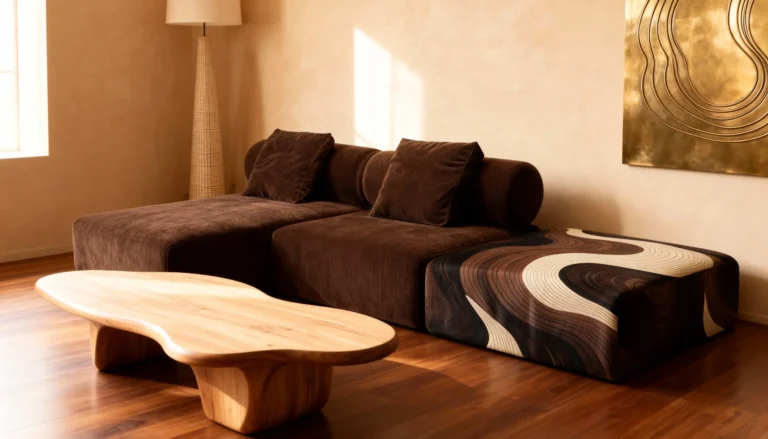
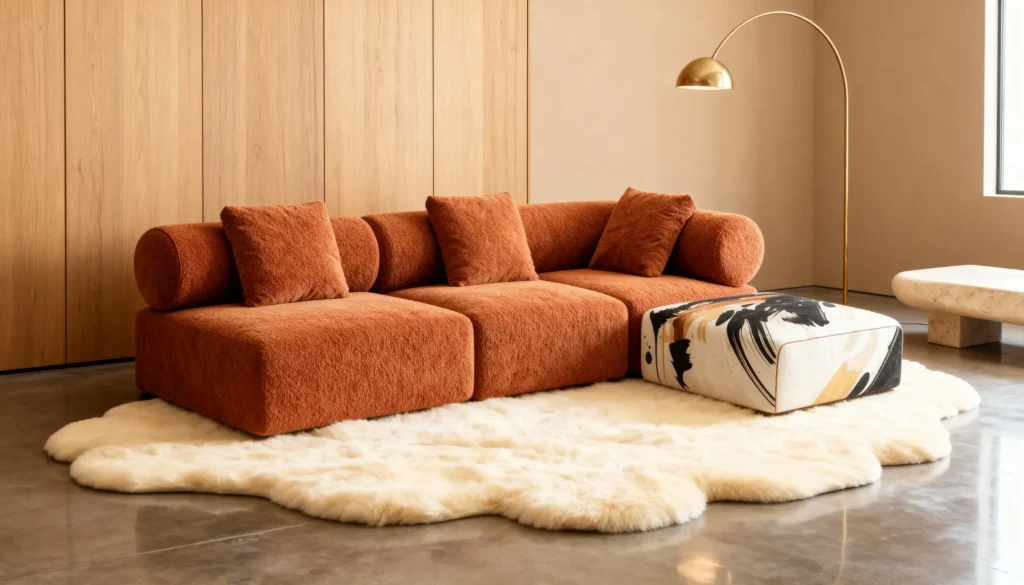
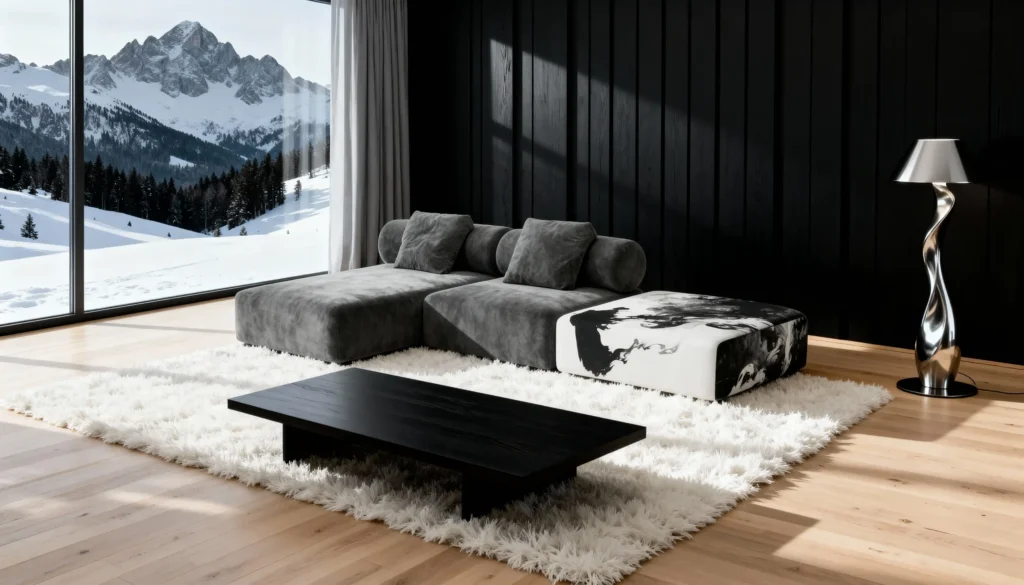
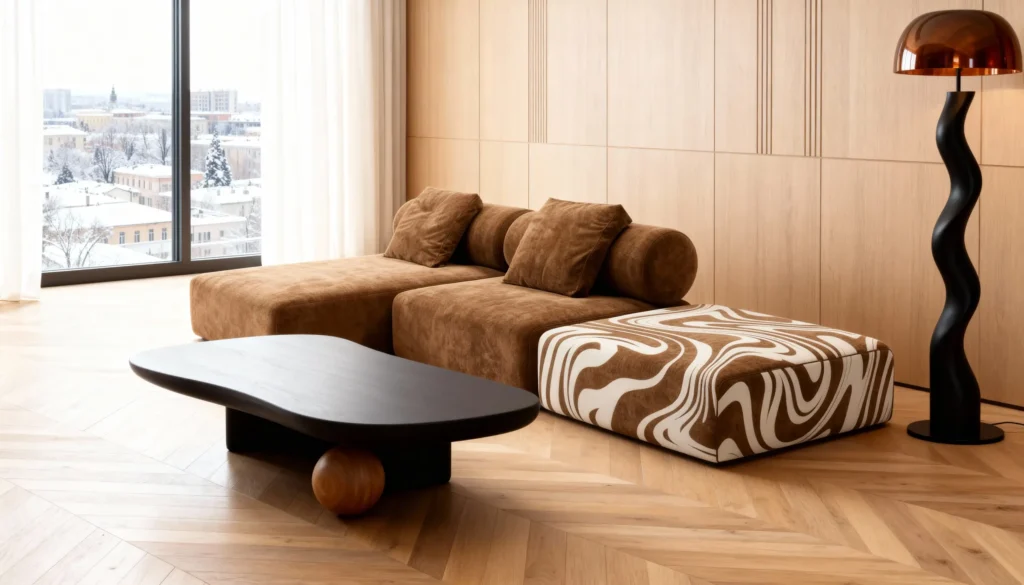
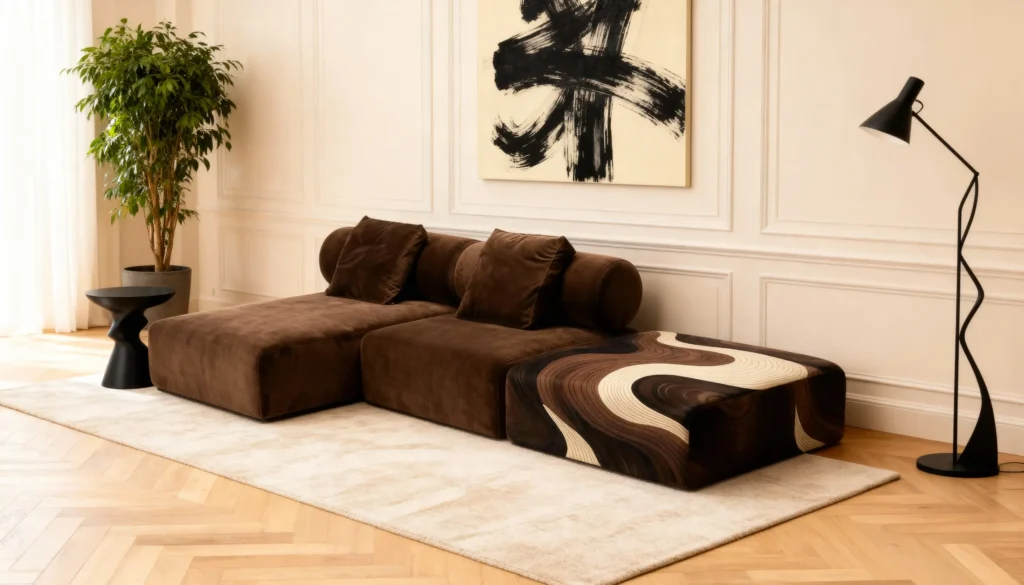
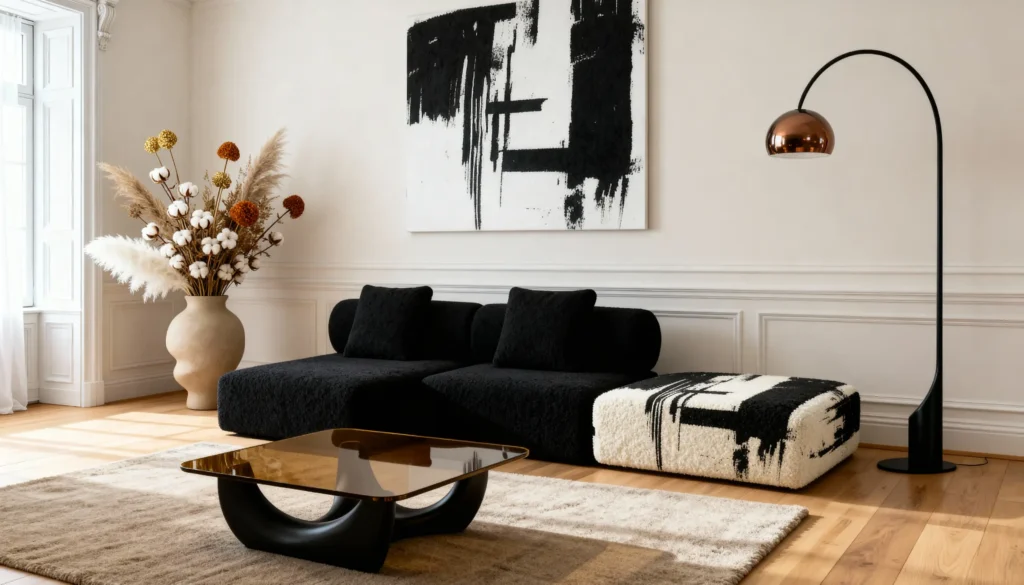
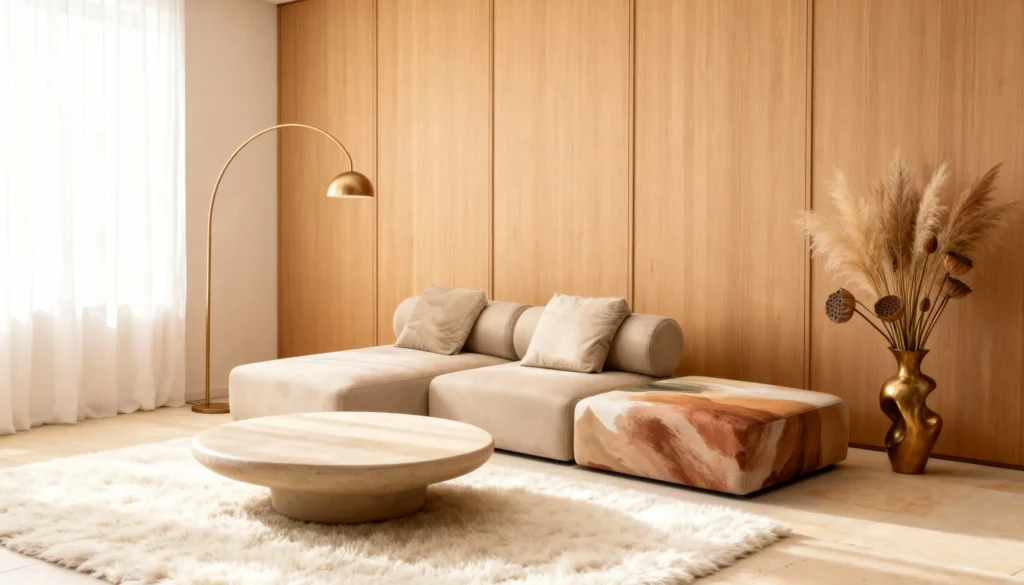
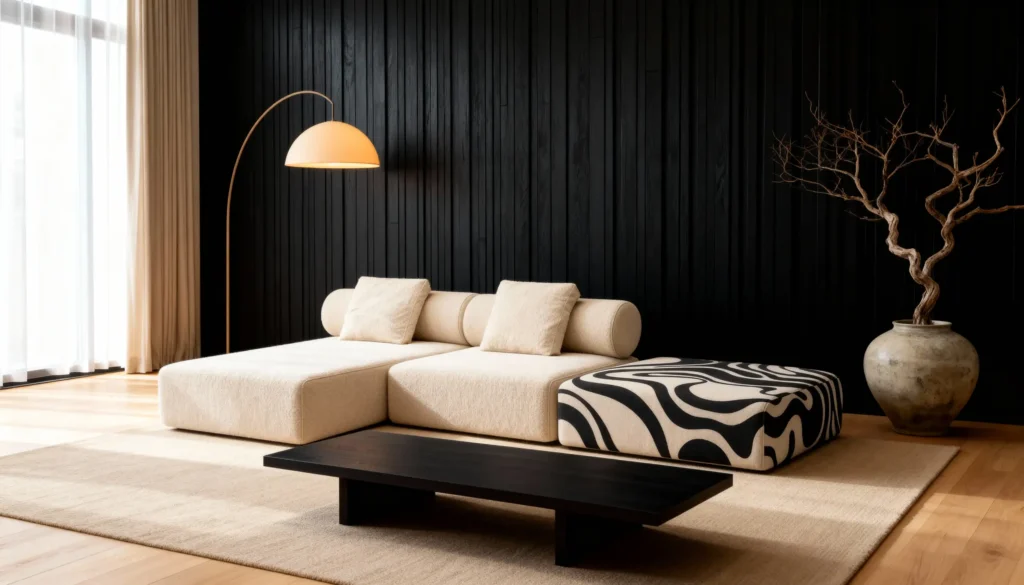
In one space, Exotiq can be light and calm — like Beige and black Illusion. In another, it becomes deep and almost gallery-like — like Black and white Illusion. In a warm living room, it resonates through caramel and brown waves. In a bold interior — through Orange Stroke, where the color no longer just supports the composition, but leads it forward.
Ago modular sofa Exotiq is not just one ready-made scenario. It is a system that allows you to customize the space through modules, fabric, color, print and fit. It can be made discreet or expressive, homely or commercial, warm or graphic. The main thing is not to choose “a sofa in general”, but to understand what role it should play in the interior.
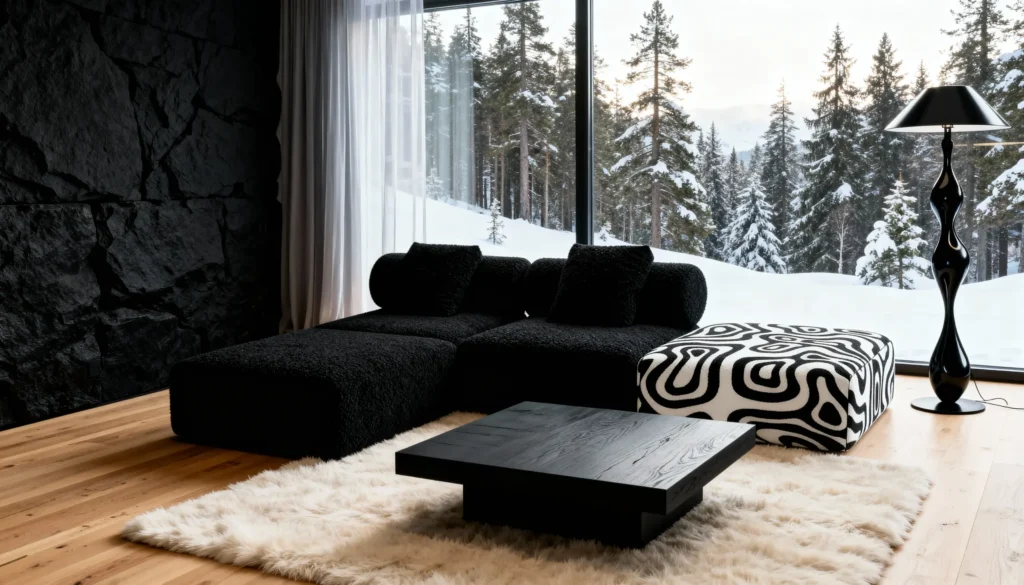
Exotiq as a system: not just a sofa, but a designer of space
In the conventional approach, a sofa is often perceived as a large object that needs to be “fitted” between the wall, the coffee table and the TV. Such a choice starts with dimensions, color and the question of whether it will fit in the room. But a modular system works differently. It does not start with an object, but with a scenario.
Exotiq can be considered as Designer sofa: individual seating modules form a composition, and the cylindrical backrest creates a soft support line. In some versions, the sofa looks straight and collected. In others, it looks more lounge, relaxed, open to the space. The accent module can work as an ottoman, an extension of the seating, a visual point or a separate plane for an art print.
That’s why sofa with backrest here it does not look traditional. The back does not press on the composition and does not close it. It has a cylindrical shape, so it is visually softer than the classic vertical back. It resembles not a barrier, but a horizontal architectural line that holds the silhouette and adds recognition to the subject.
Exotiq text formula:
SOFA CHARACTER = SHAPE × MODULES × COLOR × PRINT × SCENARIO
This formula explains well why one model looks so different in nine compositions. The constructive idea remains the same, but the surface language, color temperature, print rhythm, and interior context change.
Cylindrical backrest: a soft border between comfort and architecture
In Exotiq, the backrest doesn’t just support the body. It defines the silhouette. It’s the cylindrical shape that makes the sofa recognizable even before the eye moves to the fabric or print.
A classic backrest often creates a sense of mass: a rectangular plane, a vertical, a clear back edge. In Exotiq, this logic is softened. The cylindrical backrest works as a horizontal volume that seems to wrap around the seat. It gives the sofa a lounge atmosphere, but does not make it shapeless. The object remains collected, graphic and quite architectural.
This is especially important for modern interiors, where furniture should work not only functionally, but also compositionally. In a room with black wood panels, such a backrest emphasizes depth. In a light wood interior, it maintains softness. In a space with classic moldings, it adds modern contrast. Near a panoramic window, it does not block the feeling of air.
Therefore, Exotiq should be perceived not just as sofa with backrest, but as an object in which the backrest is part of the design. It is simultaneously responsible for comfort, shape and visual identity.
Nine compositions: one model, different characters
Exotiq shows that customization is not just about choosing “light or dark.” In this system, each composition has its own emotional code.
| Exotiq composition | Basic character | Where it works best |
|---|---|---|
| Beige and black Illusion | calm contrast, beige + black graphics | modern living room, lounge area, showroom |
| Beige with Color STROKE | warm base and colorful art gesture | bright interior, creative living room |
| Black and white Illusion | monochrome depth, optical accent | space with strong character, panoramic interiors |
| Black and white strokes | stroke, movement, graphic energy | cafe, office, studio, reception |
| Brown Tiramisu Swirls | warm lounge, brown depth | living room, private seating area |
| Caramel Vertigo | caramel tone and soft movement | warm modern interior |
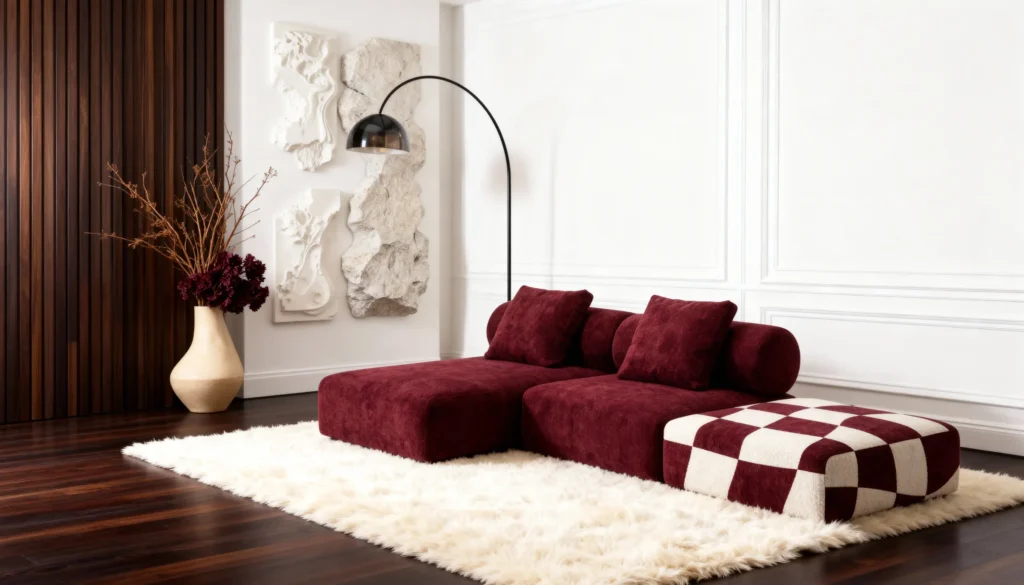
| Chess Illusion | chess rhythm, order and play | art living room, showroom, accent zone |
| Gray Japan fog | gray calm, nebula, minimalism | discreet living room, mountain house, slow space |
| Orange Stroke | energy, bold color, art impulse | modern living room, salon, creative space |
Beige and black Illusion is an option for spaces that need contrast without being too loud. The beige base remains soft, while the black print creates optical intrigue. This modular sofa is easy to imagine in an interior where there is already a black table, dark panels, graphic lamps or contrasting art.
Beige with Color STROKE works differently. Here the base is calm, almost airy, but the accent module adds an artistic gesture. It’s a good example of how modern modular sofas can be not sterile, but alive.
Black and white Illusion is the deepest monochrome scenario. Black modules absorb light, and a black and white printed block creates a strong point of attraction. In such a composition, the sofa becomes almost an art object.
Black and white strokes has a different graphic: not an optical wave, but a feeling of a stroke. It works well where the space needs energy: a cafe, a creative office, a showroom, a salon, a waiting area.
Brown Tiramisu Swirls and Caramel Vertigo are warmer stories. They are not about drama, but about depth, physicality, tactility and a sense of long pause. Such compositions work well in the living room, where the sofa should not only be beautiful, but also desirable for everyday use.
Chess Illusion adds an intellectual game to the composition. The chess module immediately structures the space, especially next to dark wood, white carpet or light walls.
Grey Japan fog is the most restrained option. The gray sofa here doesn’t look cold, because the texture and cylindrical back soften it. The printed module adds a misty depth, but doesn’t overload the interior.
Orange Stroke is the most energetic. It is a modern sofa for a space that is not afraid of color. The orange fabric adds warmth, and the art module works as a gesture that is impossible to miss.
Modules: how Exotiq adapts to space
Modularity is important not only so that the sofa can be made larger or smaller. Its real power lies in the ability to build a scenario.
One room requires a direct seating arrangement across from a table. Another requires a more relaxed lounge format. In a commercial space, a sofa can function as a waiting area, a short conversation area, or an Instagram point. In a private living room, it becomes the center of daily life: here people sit with coffee, receive guests, read, watch a movie, and relax after a day.
Exotiq allows you to think of a sofa not as one monolithic object, but as a composition. An accent module can be placed on the edge, making it a visual conclusion or, conversely, giving it the role of a focal point. The print does not have to cover the entire sofa. Sometimes one module works stronger than a fully printed form.
This is especially valuable for interiors that need balance. A completely bright sofa can quickly overwhelm a room. But a calm base and a single art module have a different effect: the space gains character without losing air.
How to choose an Exotiq configuration
- Determine the center of the room.
The sofa can face a table, fireplace, panoramic window, art object or communication area. - Understand the route.
Modules should not block a person’s natural path through space. - Decide where the emphasis is needed.
The printed module works better where the eye needs to stop. - Assess the interior temperature.
Caramel, brown, and beige versions go well with wood and warm light. Monochrome and gray go well with dark walls. - Leave visual air.
A strong sofa needs space around it, especially if there is an active art print in the composition.
Color and print: why one module can change everything
In Exotiq, the print doesn’t work as a decoration added after the shape. It becomes part of the sofa’s architecture. That’s why an accent module can change the entire logic of perception.
In Beige and black Illusion, the print adds clarity to the beige composition. In Beige with Color STROKE, it warms up the neutral base. In Black and white Illusion, it creates optical tension. In Black and white strokes, it repeats the language of painting. In Brown Tiramisu Swirls, it deepens the warm palette. In Caramel Vertigo, it adds movement. In Chess Illusion, it introduces rhythm and play. In Grey Japan fog, it works as a hazy contrast. In Orange Stroke, it supports the energy of the color.
PRINT = RHYTHM + COLOR + PERCEPTUAL DISTANCE
Up close, a print is read as fabric, texture, line, brushstroke. From a distance, it is read as a compositional spot. That is why it is important to evaluate it not only as a “beautiful drawing”, but as a tool for working with a room. The same art module can look calmer in a warm wooden space and much more dramatic next to a black wall.
This is the reason why modular sofa Exotiq works so well for customization. You can change not the entire model, but only the element that is responsible for the character.
For home, cafe, office and showroom
Exotiq easily transitions between private and commercial scenarios. This is its practical strength.
In the living room, it acts as the center of life. Not just a place to sit, but a soft area around which the room gathers. Beige with Color STROKE, Caramel Vertigo, Brown Tiramisu Swirls, Grey Japan fog are appropriate here. They give warmth, softness and enough character, but do not turn the space into an exhibition installation.
In bolder residential interiors, Black and white Illusion, Chess Illusion or Orange Stroke work well. They are needed when the sofa should become the main point of the room. Not a background. Not a “safe” choice. But an object that shapes the mood.
For cafes and lounges, not only the seating is important, but also the memorability. A guest may not remember the exact color of the walls, but he will remember a sofa with a strong graphic module. That is why Black and white strokes or Orange Stroke can work as part of the brand atmosphere.
For an office, showroom or reception area, Exotiq is interesting because it doesn’t look like a standard office sofa. It’s softer, more plastic, more objective. In the right fabric and color, it can be discreet, but not faceless. In the printed version, it’s noticeable, but not random.
Where Exotiq is best revealed
- in spacious living rooms with a low table;
- in lounge areas near the panoramic window;
- in a cafe where atmosphere is important;
- in showrooms and salons, where furniture works on first impressions;
- in reception areas, where waiting should be comfortable;
- in private interiors with a request for customization;
- in spaces where one object should become the compositional center.
Error → solution
Error: choose a sofa based on color alone.
Decision: Look at the role of the sofa in the room: should it be the background, center, accent, or soft boundary of the space.
Error: Be afraid of print because it can be “boring.”
Decision: use print in moderation — for example, on one module, which easily becomes a point of character without overload.
Error: buy a large sofa as a monolithic object.
Decision: choose a modular sofa that can be assembled to fit your actual route, area, and life scenario.
Error: putting an active sofa in an already overloaded interior.
Decision: leave clean surfaces, calm materials, and enough light around it.
Error: perceive a sofa with a backrest only as a function.
Decision: evaluate the back as part of the silhouette. In Exotiq, the cylindrical back forms a recognizable soft architecture.
Before / after
To: The space has quality materials, but it feels too flat. The wood, the carpet, the walls, the lighting—everything works, but there’s no object that holds the composition together.
After: Exotiq gathers the room around itself. The modules set the seating, the cylindrical back creates a soft horizontal, and the printed block adds a point to which the eye returns.
To: The interior is cautious, neutral, without risk.
After: One module with an art print changes the mood without repairs, complex solutions, and unnecessary decor.
To: A cafe or showroom has seating, but no image.
After: Graphic or colorful Exotiq becomes part of the customer experience and helps the space be memorable.
Customization: when a sofa is assembled for a task, not the other way around
In a strong interior, furniture should not look random. A sofa should support the architecture, light, materials, lifestyle or brand logic. That is why Exotiq customization is important not as an “additional option”, but as a normal path to the exact solution.
You can work with fabric, color, print, number of modules and overall composition. For one room, you need a calm base and one accent module. For another, a dark body and a contrasting print. For a commercial space, a series of sofas in a single language, but with different accents. For a private interior, an option that does not repeat typical solutions from the catalog.
Here it is appropriate to recall Dieter Rams’ principle: “Less, but better.” In the context of Exotiq, it is not about cold minimalism or the rejection of emotions. It is about precision. Not adding unnecessary things. Not overloading the form. Not making a print where there is enough texture. And not being afraid of an accent where it gathers space.
KAIZEN approaches such a sofa as a system. First you need to understand the space, then the scenario, after that the composition of the modules, and only then finally choose the fabric and print.
How to understand which Exotiq composition is yours
Choosing Exotiq should not start with the question “which is more beautiful?”, but with the question “what kind of space do we want to get?”.
For a calm but not empty living room, Beige and black Illusion or Grey Japan fog are suitable. They have character, but do not take all the air out of the room.
For a warm home center, look towards Brown Tiramisu Swirls or Caramel Vertigo. They work through softness, brown or caramel depth, natural materials, and a sense of long pause.
For an interior with a strong visual code, Black and white Illusion, Black and white strokes or Chess Illusion are appropriate. They interact well with graphics, art, dark accents, sculptural lamps.
For a space that needs energy, consider Orange Stroke. It’s not a background sofa. It immediately sets the temperature of the room and makes it bolder.
In this hub article, Exotiq is assembled as a system. Each composition can then have a separate article with its own focus: Beige and black Illusion is about calm contrast, Black and white Illusion is about monochrome depth, Brown Tiramisu Swirls is about warm lounge mood, Grey Japan fog is about gray minimalism, and Orange Stroke is about the energy of color and art print.
In the end, everything comes back to space. To the light that falls on the fabric. To the wall, which can be a background or a contrast. To the table, the carpet, the window, the tree, the stone, the silence or the movement. Exotiq does not try to be a “sofa for everything”. Its strength lies in another: it allows you to assemble exactly the scenario that a particular room needs.
To adapt Exotiq to your space — choose the fabric, print, number of modules and composition — you can write to Direct KAIZEN. It is enough to start with a photo of the room, a palette or a short description of the mood that the sofa should create. Then the system is built more precisely: module by module, color by color, detail by detail.