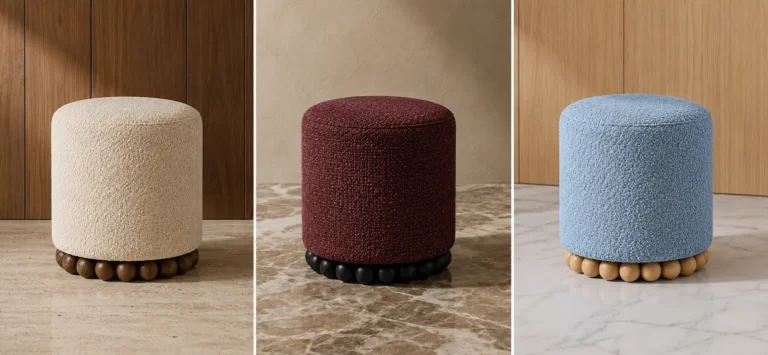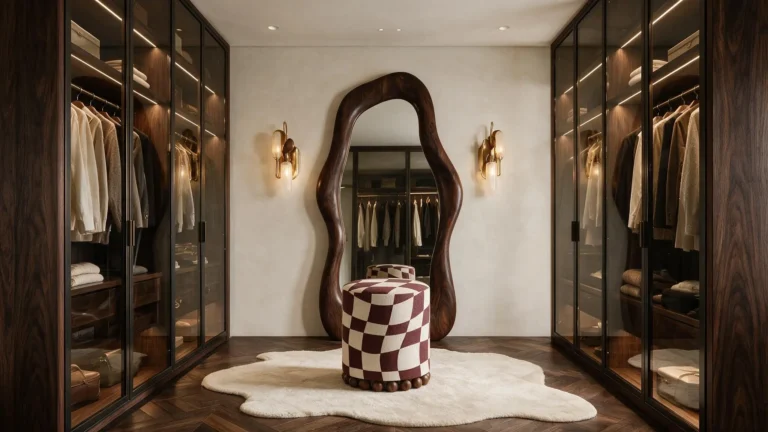
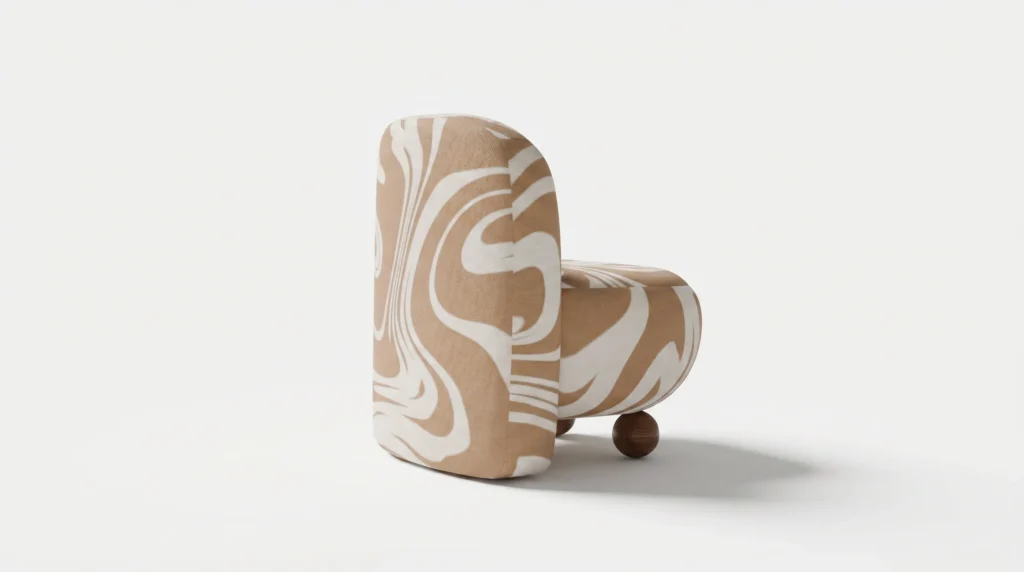
When a chair stands on a white background, only its shape is visible. A rounded back, a soft seat, spherical wooden legs, a flowing silhouette. But as soon as a print appears on this form, the object begins to speak a completely different language. The lines move along the back, transfer to the seat, wrap around the sides, change the perception of volume. The same chair is no longer just soft. It has character.
This is the point of the format. custom-made chair. It’s not about “choosing a different color from the catalog.” It’s about being able to create an object that works for a specific interior, person, brand, spatial scenario, or design concept. At KAIZEN, a chair can be calm, minimalist, warm, graphic, art object, commercial, or very personal — depending on how the shape, fabric, color, print, and environment are combined.
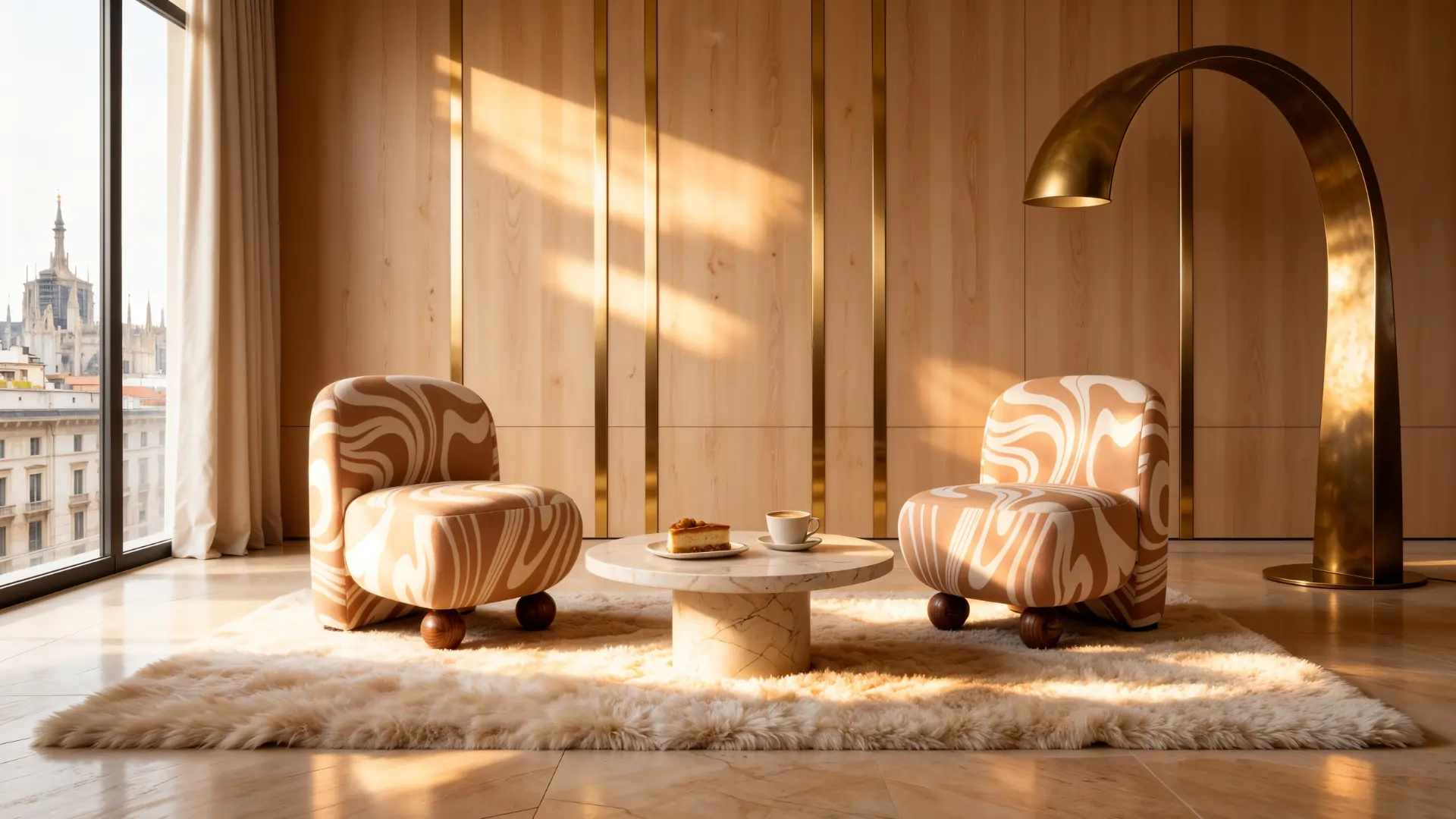
In the photo, the chair with a beige and white wavy print looks soft, but not neutral. It does not scream, does not overload the space, but has a clear visual presence. In a pair, at a marble table, on a fluffy rug, next to a golden floor lamp and wooden panels, such chairs create more than just a place to sit. They shape the scene: for coffee, conversation, waiting, meeting, pause or first impression.
What does a custom chair mean in KAIZEN?
A custom-made chair is an item where the solution is not reduced to a ready-made position “as is”. On the contrary, it is important to customize the furniture to the task. What is the space? What style? Who will use it? What mood should be created? Should the chair be a calm background, a personal accent or a strong art object?
In KAIZEN, customization can apply to several levels:
- fabrics;
- colors;
- invoices;
- art print;
- general mood;
- usage scenario;
- adaptation to the interior;
- working with a design concept;
- serial solution for corporate space.
This is important because the same shape can have different characters. In boucle, it will sound soft and cozy. In velor, it will be deeper and more intimate. In chenille, it will be calm and tactile. With an art print, it will be personal, graphic, almost gallery-like.
Therefore, a custom-made designer chair is not just an individual option. It is a tool that allows you to work more precisely with the interior.
Shape as a base: why it’s important to have a strong silhouette
For customization to work, an object must have a strong foundation. If the shape is weak, a print won’t save it. If the proportions are haphazard, an expensive fabric won’t make the chair compelling. That’s why in KAIZEN, the first level is the silhouette.
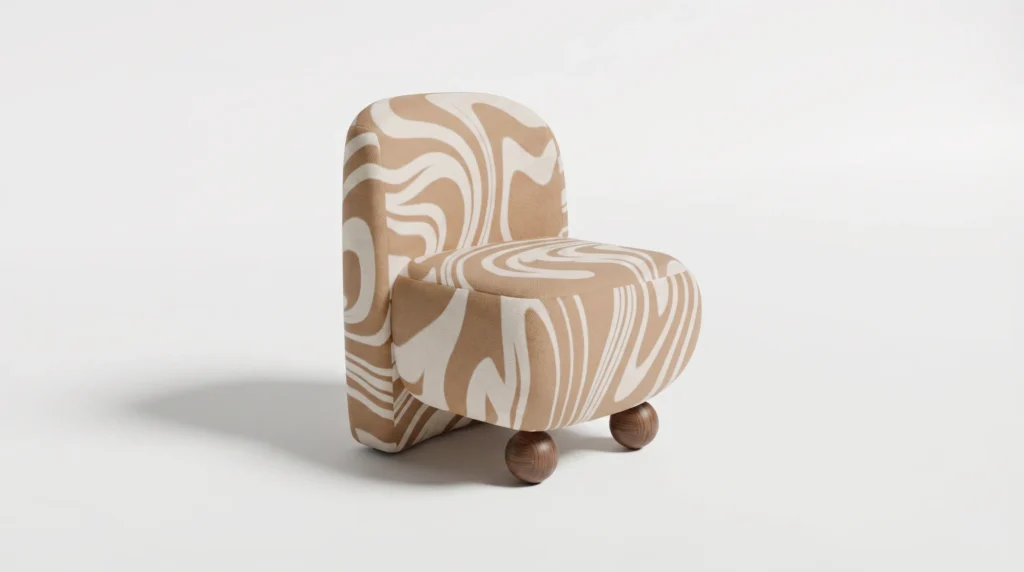
The chair in the photo has a rounded back, a voluminous seat, soft radius corners and spherical wooden legs. There is no dry straightness in this form. It does not resemble an office or technical chair. On the contrary, the object looks bodily, soft, almost sculptural. That is why the print does not lie on it by chance, but enhances the plasticity.
The wavy lines on the fabric repeat the feeling of movement. They seem to flow around the shape, emphasize the roundness, and make the chair more alive. Thanks to this, the printed chair does not look like furniture that has simply been painted. It is perceived as a whole object.
KAIZEN formula for a custom-made chair:
strong shape + correct fit + tactile fabric + precise print + space scenario
When all the elements work together, a chair ceases to be “one of the options.” It becomes an object created for a specific task.
Fabric: the first level of personalization
Fabric determines not only the look of a chair, but also how it feels. This is especially important for upholstered furniture, because people come into contact with it with their bodies: they sit down, touch it with their hands, lean on it with their back, feel the texture every day.
For a custom-made chair, fabric can solve various problems.
If you want a calm living interior, soft textured materials, light shades, boucle, chenille, matting work well. If you want depth, you can use velor, rich colors, darker palettes. If you want to create a more expressive object, an art print comes into play.
The fabric also affects how the chair behaves in light. In a space with large windows, the print can change throughout the day: becoming softer in the morning, more contrasting in direct light, deeper in the evening. A textured surface enhances this feeling, because the light does not just fall on the fabric, but passes through its relief.
That’s why fabric selection is not a technical step after design. It’s part of design.
Color: how the chair fits into the interior
A custom-made chair should either support the interior palette or deliberately create an accent. Both options are correct if the decision is accurate.
The beige and white print in the photo works delicately. It doesn’t create a harsh contrast, but adds movement. This option is easy to imagine in a modern living room, lounge area, private office, hotel room, salon, showroom or waiting area. It is soft enough for a residential interior and expressive enough for a commercial one.
Color in a chair can play several roles:
| The role of color | How it works in the interior |
|---|---|
| Supports palette | Connects the chair to the wood, walls, carpet, curtains |
| Creates an accent | Adds a focal point to the space |
| Softens the architecture | Makes the room warmer and less harsh |
| Strengthens the brand | Works with corporate identity |
| Conveys mood | Creates a feeling of calm, energy, depth or lightness |
This is a particularly useful tool for designers. An armchair can be a point through which color is introduced into an interior. Not on a large surface of the wall, not on the entire sofa, but in one concentrated object.
Print: when a chair becomes personal
A printed chair is one of the strongest trends in KAIZEN. Print allows you to take furniture beyond the boundaries of standard upholstery. It can be graphic, natural, abstract, soft, expressive or very delicate. But most importantly, it should work with form.
In the photo, the wavy print does not argue with the chair. It emphasizes its roundness and adds movement. The white pattern on a beige base looks calm, but not faceless. This is a good example of how a chair with a print can remain interior, and not turn into a random decorative spot.
The print is appropriate if:
- the space needs a personal accent;
- the interior is too neutral and needs character;
- the designer wants to create a unique item for the client;
- corporate space needs recognition;
- you need to support the brand palette;
- The lounge area should be memorable;
- Furniture should work as an art object.
In a residential interior, a print can speak about a person. In a corporate interior, it can speak about a brand. In a hotel or salon space, it can speak about an atmosphere. In a design project, it can speak about a concept.
That’s why print at KAIZEN isn’t just a decoration. It’s a way to make furniture more precise.
Designer chair for home
In a home interior, a custom-made armchair often solves the problem of personal space. It can stand in the living room, bedroom, near the window, in a dressing room, in an office or in a reading area. But regardless of the location, its role is the same: to create an object that feels like one’s own.
In the living room, an armchair can complement a sofa group or create a separate area for coffee. In the bedroom, it can be a place for breakfast, a book, silence or clothes. By the window, it can become a point of contemplation. In the office, it can soften the workspace and add informal depth to it.
The main advantage of customization is that the chair does not need to be “forced into place.” It can be designed to immediately work with the materials of the room: wood, stone, curtains, carpet, lighting, wall color, painting, or other furniture.
Sometimes it’s enough to change the fabric to make the object calmer. Sometimes you need a print to make the chair the main accent. Sometimes a pair of chairs is important, as in the interior photo: two identical objects create symmetry, dialogue and a finished lounge composition.
Custom-made armchair for interior designers
For a designer, a custom-made chair is not just a product line. It is a tool. It allows you to customize a space more precisely than a standard ready-made model.
The designer can use the chair as:
- personal emphasis of the client;
- a colorful spot in a neutral interior;
- soft sculpture in the recreation area;
- a pair of chairs for a dialogue composition;
- element near the window;
- subject for reading corner;
- part of the lounge area;
- art object in a modern space;
- a bridge between furniture, textiles and decor.
The ability to work not only with color, but also with print is especially valuable. If the project has a complex palette, author’s graphics, brand identity, or a specific moodboard, a chair can become an object that brings these solutions together into one form.
In this approach, furniture is not selected at the end “to fit what is left.” It becomes part of the concept from the very beginning.
Corporate customers: when a chair works for the brand
KAIZEN focuses not only on private interiors, but also on corporate customers. For offices, showrooms, salons, hotels, co-working spaces, studios, reception areas and waiting spaces, a custom-made chair can be of particular value.
In such spaces, furniture works not only for comfort. It forms the first impression. A person enters the space and even before the conversation begins, they feel: is the brand bold or restrained, warm or cold, technological or human, mass or attentive to detail.
A printed chair can be part of this message. It doesn’t have to be a literal logo or direct corporate colors. Often, it’s enough to convey the brand’s mood through palette, rhythm, texture, and shape.
For a corporate project, you can create:
| Space | The role of a custom chair |
| Reception | First impression and soft waiting area |
| Showroom | An item that reinforces the brand’s character |
| Beauty salon | Comfortable and photogenic area for clients |
| Coworking | A place for an informal break |
| Office lounge area | Recovery space between work blocks |
| Hotel room | Atmospheric object for relaxation |
| Boutique space | Visual accent and part of identity |
It is important not to confuse such a chair with an office work chair. This is not about sitting at a computer, but about soft place of pause, expectations, conversations, recovery or impressions.
Studio approach: not choosing from the shelf, but working with the task
KAIZEN does not work like a random catalog where you just need to choose a ready-made option. The logic is closer to a studio approach: first understand the task, then select the shape, fabric, color, print and scenario.
This process can be described as follows:
- Understand space.
Home, bedroom, living room, office, showroom, lounge area, reception or hotel room. - Determine the role of the chair.
Should it be a quiet background, a personal accent, a paired element, an art object, or part of the corporate identity? - Choose your mood.
Calm, warmth, depth, lightness, graphicness, energy, intimacy, premiumness. - Choose the fabric.
Velour, boucle, chenille, matting or other material for the task. - Solve the print issue.
A monochromatic solution or an art print? A delicate rhythm or a strong visual gesture? - Check the composition.
How does a chair work next to a table, a rug, a light, a window, sofa, wall, decor? - Specify the details.
This is where the kaizen philosophy comes into play: step by step, bringing solutions to greater accuracy.
In the furniture industry, kaizen is not a slogan about “ideality.” It is attentiveness to gradual improvement: shape, fit, fabric, seam, proportion, body contact, interaction with space. Don’t make it louder. Make it more precise.
Minimalism + comfort: DNA KAIZEN
At KAIZEN, minimalism does not mean coldness. And comfort does not mean visual heaviness. Between these two poles, the brand’s character is born.
Minimalism is manifested in the purity of form: without unnecessary decor, without random details, without overload. Comfort in a soft silhouette, rounded volumes, pleasant fit, tactility of the fabric. Customization adds a third level: the object can be made closer to a specific person or space.
That is why a custom-made chair from KAIZEN should not look like “too much designer stuff that is not used”. It should remain alive. People should sit in it. There should be coffee next to it. It should be comfortable to wait, talk, read, relax, take photos of the space, receive a client or start the morning.
The design here is not separated from the body. It works together with it.
How to understand which custom chair you need
Before ordering, you should answer not just one question, “What color do you like?”, but several more specific ones.
For residential interior:
- where the chair will stand;
- whether it will be single or double;
- should it be an accent;
- do you need a print?
- what fabric will be pleasant in daily use;
- does the chair match the sofa, carpet, curtains, wood;
- Do you want the subject to be calm or expressive?
For a design project:
- what role does the chair play in the concept;
- does it support moodboard;
- whether a series of items is needed;
- should the chair repeat the palette or create contrast;
- whether it will be a key visualization point;
- Is it possible to enhance the idea of space through print?
For corporate customers:
- what first impression should the space create;
- Is it necessary to support the brand identity?
- how many chairs are needed;
- how often they will be used;
- what level of wear resistance is required;
- Is the photogenicity of the area important?
- Should the furniture be memorable to customers?
Such questions help not just “buy a chair,” but create a solution.
A chair as a pair: when two objects are stronger than one
In the interior photo, two armchairs with the same print stand around a round marble table. Between them – coffee, dessert, a soft carpet, warm light, a large window. This is no longer a single accent, but a finished composition.
Paired chairs work well in:
- living rooms;
- lounge area;
- waiting area;
- salon;
- showroom;
- hotel room;
- private office;
- space for negotiations in a soft format.
The pair creates a dialogue. People sit not in a row or in front of a screen, but opposite each other or at an angle. This changes the nature of communication. The conversation becomes less formal, the space more human.
This is especially valuable for corporate interiors. Furniture doesn’t just fill space, it programs behavior: to wait comfortably, to speak calmly, to stay longer, to remember the atmosphere.
Why a custom-made chair is not an excess
Sometimes it seems that customization is only needed when you want something very unusual. In fact, it’s the opposite. A custom-made chair is often needed precisely for precision.
The finished item may be beautiful, but a little off: the color doesn’t fit the palette, the fabric is too cold, the print is too active, the shape is right, but the mood doesn’t match. Customization allows you to remove that “almost.”
In a private interior, this means that the object takes root better. In a design project, it means that the solution more accurately corresponds to the concept. In a corporate space, it means that the furniture works for the brand, and not just performs a function.
A custom-made chair is not an excess. It’s a way to make furniture a part of the space, not a compromise in it.
Conclusion
A custom-made chair doesn’t start with a fabric or a print. It starts with a question: what character should the space have? Calm, warm, minimalist, art object, corporate, personal, intimate, or bolder?
In KAIZEN, the answer to this question is transformed into an object. The shape provides the foundation. The fabric is the touch. The color is the emotion. The print is the individuality. The scenario is the meaning. And the studio approach helps to collect all this into one designer chair that does not look random in space.
This is how an armchair becomes more than furniture. In a residential interior, it becomes a personal place to relax. In a designer’s work, it becomes a compositional tool. In a corporate space, it becomes part of the brand’s impression. In KAIZEN, it becomes an example of how minimalism, comfort, customization, and the kaizen philosophy can work together.
A printed chair, a plain chair, a paired lounge composition or a personal art object – it all starts with a precise task. Then the object can be customized to the interior, person or space so that it doesn’t just stand in the room, but truly belongs to it.