Pouf: a soft mobile interior element that changes the space without unnecessary noise
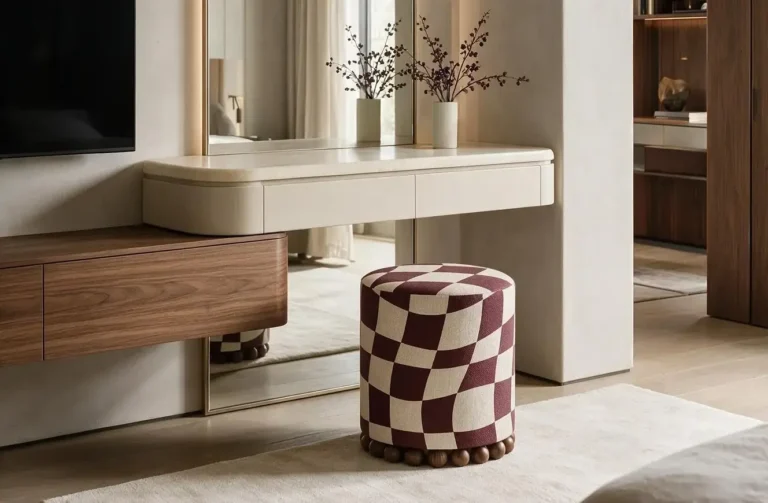
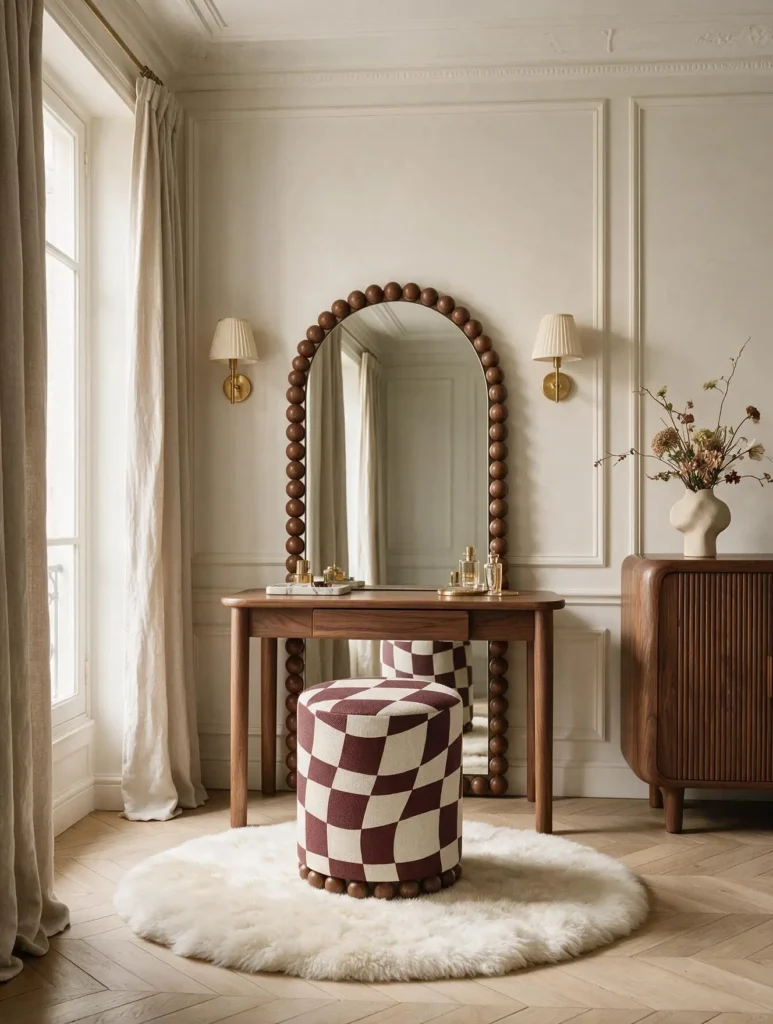
The bright bedroom is kept quiet. Tall windows let in soft daylight, the fabric of the curtains falls in calm verticals, a wooden dressing table stands in front of a large mirror, and a fluffy white carpet lies on the floor. The space is already assembled, already beautiful, already correct. But it is the round pouf with a burgundy and white print that makes it alive.
It doesn’t take up much space. It doesn’t compete with a mirror, a table, or a bed. But the gaze still turns to it: to the soft cylindrical volume, to the graphic cell, to the warm wooden base with round details. There is more to such an object than just seating. It creates a small center of ritual – to sit in front of the mirror, put clothes next to it, take a pause before the day.
That is why the decision buy a pouf It should not be perceived as a small purchase of “another seat.” In a modern interior, an ottoman works differently. It is a soft, mobile element that changes the logic of a room: it adds a place for pause, an accent, tactility, color, a scenario, and a sense of completion.
In KAIZEN, the pouf does not look like a random addition to the furniture. It can be thought of as a separate art object, part of a composition or a custom item for a specific bedroom, living room, hallway, salon or office. This is the approach we have already talked about in the article “Furniture as an art object”: an expressive object can not overload the space, but on the contrary – gather it around itself.
What is a pouf in a modern interior?
An ottoman is not just a low stool with a soft seat. In modern interiors, it has become a flexible object that can change its role depending on the room, shape, fabric and mood.
In the bedroom, a pouf works next to a dressing table, bed, or wardrobe. In the living room, next to a sofa or armchair. In the hallway, as a convenient place to put on shoes or put a bag. In a beauty salon, as an element of a waiting area or beauty zone. In the office, as an informal seating area in a lounge space. In a showroom, as a detail that supports the customer experience and helps the space be memorable.
In other words, a pouf is an object between function and mood. It is practical enough to use every day, and compact enough to allow for more boldness in fabric, color or print.
Formula:
POOF = PLACEMENT + MOBILITY + ACCENT + SCENARIO
A chair usually has a clear role. An armchair requires more space. A bench works in a longer line. And an ottoman easily transitions between zones. Today it stands by the dressing table, tomorrow – next to the chair, the day after tomorrow – in the hallway or next to the sofa.
This mobility is what makes it valuable. A pouf doesn’t dictate a room’s layout forever. It allows the space to change.
How is an ottoman different from a bench, chair and armchair?
To choose the right pouf, it’s important to understand how it differs from other seating items. Because often people are looking for one thing, but in reality they need something completely different.
| Subject | Main role | Where it works best | When to choose |
|---|---|---|---|
| Pouf | mobile soft landing and accent | bedroom, living room, hallway, salon | when you need a compact item without a back |
| Banquet | elongated fit or soft line | by the bed, in the dressing room, in the hall | when you need more seating space |
| Chair | vertical landing | kitchen, work desk, dining area | when back support and clear height are important |
| Chair | a complete place to relax | living room, lounge area, office | when a deep seat and backrest are needed |
An ottoman doesn’t replace all of these items. It serves a different purpose: creating a soft spot where a large armchair would be redundant, a ottoman too large, and a chair too stiff or formal.
This is its strength. The pouf does not overload the interior, but provides tangible benefits. It may be small, but not secondary.
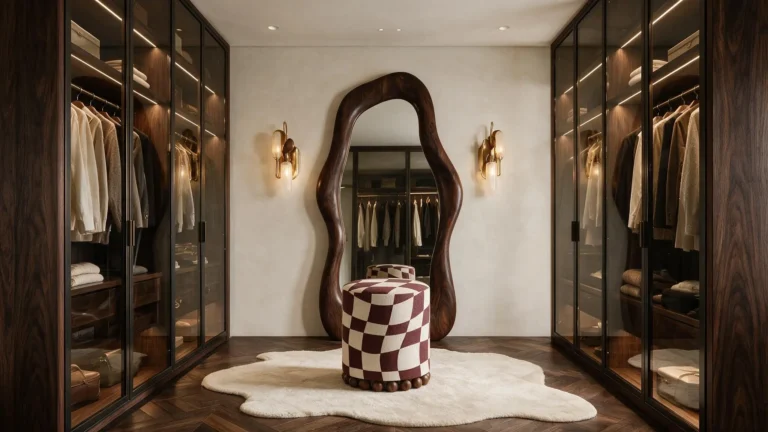
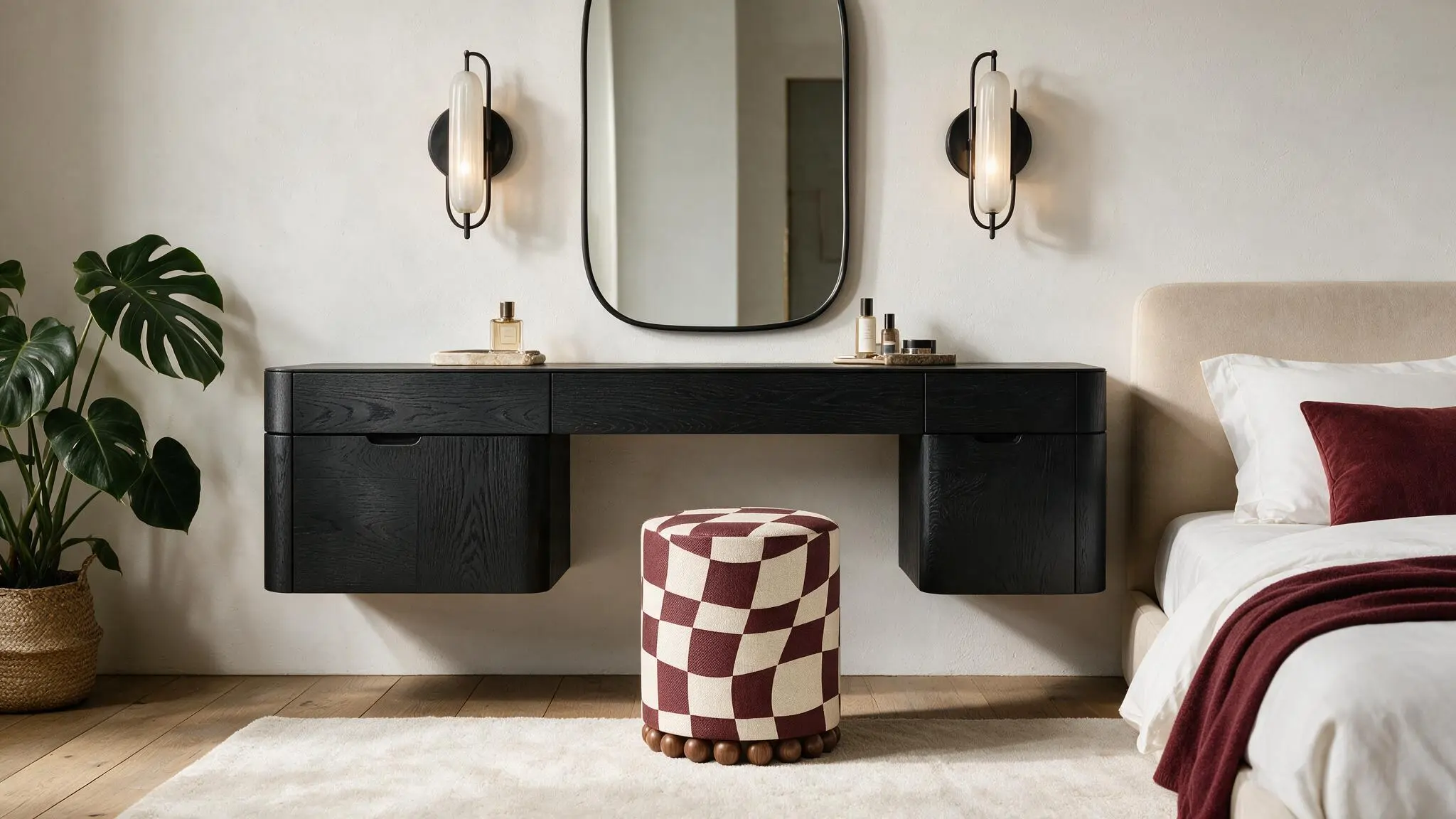
In a light, classic interior, a round pouf with a checkered print adds graphics and warmth. In a modern bedroom with a black dressing table, the same type of item works differently: it contrasts with the laconic furniture, supports the burgundy textiles and adds a lively accent to the space.
One shape, different moods. That’s why the pouf is so well suited for customization.
Where to use an ottoman: from the bedroom to the office
A pouf easily adapts to different scenarios. But that doesn’t mean that the same pouf will automatically fit everywhere. It’s important to understand the role it should play in a specific space.
Pouf in the bedroom
In the bedroom, the pouf works as an object for morning and evening rituals. It can stand by the dressing table, next to the wardrobe, next to the bed or on a soft rug. Tactility, shape, color and a sense of calm are important here.
The burgundy and white print in this scenario adds a warm graphic rhythm rather than an aggressive contrast. It resonates with the wood, textiles, mirror, and lamps, making the bedroom feel less “flat.”
Pouf in the living room
In the living room, an ottoman can be an extra seat, a footrest, a cushion next to a sofa, or an accent next to a chair. If the interior is calm, a printed ottoman adds energy. If the space is already active, a solid-colored fabric works better.
Pouf in the hallway
In the hallway, the pouf is responsible for the first feeling of home. You can sit on it to put on your shoes, put down your bag, take a short break at the mirror. For a narrow space, size and shape are important: the pouf should not block movement.
Pouf in the salon or showroom
In a commercial space, a pouf works not only as furniture, but as part of an experience. In a beauty salon, fashion showroom, reception or lounge area, it can support a brand identity through fabric, color or art print.
Pouf in the office
In the office, a pouf helps to make the space less formal. It is appropriate in a waiting area, co-working space, soft-format meeting room or break room.
Error → solution
Error: Choose a pouf only based on the principle of “I like the shape.”
Decision: First, determine the scenario: near the mirror, near the bed, next to the sofa, in the hallway, or in a commercial area.
How to choose the shape of a pouf
The shape of a pouf determines how the object behaves in space. It affects not only comfort, but also the visual language of the room.
A round pouf softens straight lines. It works well next to a dressing table, in a bedroom, living room, salon or reception. It has no sharp corners, so it fits easily into the space and does not create a sense of obstruction.
A square pouf looks more structured. It is easier to combine with a modular sofa or a geometric interior. A rectangular pouf is closer to a banquette: it is appropriate next to a bed, in a dressing room or a long hallway. A low pouf is more suitable for a lounge scenario, a higher one for a dressing table or a short landing.
In the interiors shown, the round shape works very well. It matches the rounded-top mirror, the decorative ball base, the soft rug, the lamps, and the overall feeling of fluidity. Even the checkered print doesn’t look stiff thanks to the rounded body.
Shape selection formula:
POUF SHAPE = SCENARIO + PROPORTION + MOVEMENT IN SPACE
Before buy a pouf, it is worth answering three questions:
- Where will he stand most of the time?
- Will there be active movement around it?
- Should it be a quiet addition or an accent?
If the pouf will stand next to the dressing table, the height and comfort of the short seat are important. If next to an armchair, the ratio with the height of the seat. If in the hallway, compactness and stability. If in the salon, visual expressiveness is also important.
How to choose fabric: texture is just as important as color
The fabric determines how the pouf feels to the touch and how it interacts with light. The same shape can look completely different in different fabrics.
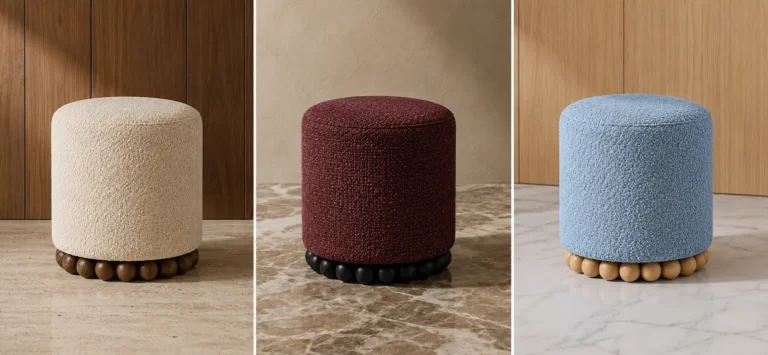
Velour adds depth and softness. Bouclé creates a voluminous tactile feel and a sense of coziness. Mat looks more structured and calm. Chenille can give a warm, dense, delicate effect. Art-printed fabric turns an ottoman into an object with its own voice.
In the case of the burgundy and white check, not only color is important, but also rhythm. The print adds movement to a static form. It works almost like a graphic pattern in the interior: it supports the burgundy plaid, echoes the wood, contrasts with the black dressing table or warm walls.
The fabric should match the scenario. For a bedroom, you can allow more softness and delicacy. For a hallway or salon, practicality becomes more important. For an office or showroom, there is a balance between durability and visual character.
Before / after
To: The dressing table looks beautiful, but the area feels unfinished.
After: A soft, printed pouf creates seating, accents, and a sense of personal ritual.
This is the case when fabric is not just “upholstery.” It becomes the language of the object.
How to choose the color of a pouf
The color of the pouf can either dissolve the object in the space or make it the main accent. Both options are correct if they meet the task.
A light pouf adds lightness. Beige or milky works well in a bedroom, salon, beauty area, soft living room. Gray is more versatile and calm. Black is graphic, contrasting, architectural. Burgundy, terracotta, blue, green or mustard can work as an emotional accent.
The burgundy and white pouf in these interiors is successful precisely because it does not exist on its own. In the first space, it supports the warm wood, decorative mirror frame and classic softness of the room. In the second, it connects the burgundy plaid, pillow, neutral wall and black dressing table.
| Color solution | Impression | Where appropriate |
|---|---|---|
| White / milky | light, purity, softness | bedroom, living room, beauty area |
| Gray | peace, versatility | living room, office, hallway |
| Black | graphics, contrast | modern interior, reception |
| Burgundy | depth, warmth, accent | bedroom, dressing room, lounge |
| rhythm, individuality | designer interiors, showrooms, salons |
The color of the pouf doesn’t have to match the color of the sofa, walls, or curtains exactly. It’s often better if it picks up on one shade and adds a new layer to the space.
Why customization is important
A ready-made pouf from a store can do the basic job of providing a place to sit. But if you need the item to work in a specific interior, customization becomes much more important.
At KAIZEN, you can think of a pouf not as a ready-made compromise, but as an object that is customized to the space. Everything matters: size, fabric, print, color, character of the legs or base, connection with the sofa, armchair, bed, dressing table or brand palette.
Customization is especially important in three cases.
The first is a private interior.
When you need the pouf to not look out of place next to the bed, mirror or sofa.
The second is a design project.
When an architect or designer assembles a space as a system, where every texture and color has meaning.
The third is commercial space.
When a salon, showroom, office or hotel needs furniture that supports the character of the brand.
That’s why KAIZEN works with designers not only as a manufacturer, but as a partner in creating an object for a specific purpose. A pouf can be neutral, graphic, warm, bold, soft, contrasting or almost an art object. But most importantly, it has to be accurate.
Charles Eames said: “Details are not details. They create design.”
This is especially true for a pouf. A small object is very sensitive to details: a slightly different height, fabric, print scale, or base color — and it already sounds different.
When is it worth buying a pouf, and when is it better to choose another item?
A pouf is not suitable for every task. And it’s important to be honest about this.
Worth it buy a pouf, if you need a compact soft item for short seating, accent, mobility or additional scenario. An ottoman is appropriate when you don’t want to put a large chair, but the space lacks a soft spot.
It is better to choose a bench if you need more seating space or an elongated shape near the bed, in the hall or dressing room. It is better to choose an armchair if you need a backrest, deep rest and a long seat. It is better to choose a chair if it is a work or dining scenario.
A short checklist before choosing
- Determine the location: bedroom, living room, hallway, salon, office.
- Determine the role: seating, accent, footrest, beauty zone, additional module.
- Check the proportion: the pouf should not hinder movement.
- Choose a shape: round, square, rectangular, low or high.
- Choose a fabric: calm, textured or printed.
- Match the color to the space.
- Consider customization if a ready-made solution does not provide the exact result.
It’s important to take your time here. A pouf may seem like a small item, but that’s why it often becomes the detail that either completes an interior or looks random.
KAIZEN pouf: a soft object with character
At KAIZEN, a pouf is not an “extra stool.” It is a soft object that can be part of a larger story: about a bedroom where you want to start the day more slowly; about a living room where flexibility is needed; about a hallway that welcomes you not with a cold function, but with warmth; about a salon or showroom where furniture works to impress.
In this approach, it’s not just the shape and fabric that matter. What matters is the thought with which the object appears in space. It should correspond to the person, the brand, the room, the light, the movement, and the mood.
That’s why it’s worth looking at the category separately. KAIZEN poufs. There, a pouf can be perceived not as a random purchase, but as a starting point for choosing a shape, print, fabric, and character.
A round pouf with a burgundy and white print shows this logic well. In a classic, light bedroom, it sounds soft and almost retro. In a modern bedroom with a black dressing table, it is more graphic and contrasting. The same type of object, but a different context changes its mood.
This is the power of a pouf: it is small, but it can change the feel of a room.
Conclusion: the pouf as a small object with a big impact
An ottoman doesn’t take up much space. But it can make a big difference. It adds seating where it’s lacking. It creates a pause where space was just a passageway. It gives an accent where the interior looked too neutral. It supports a ritual where a mirror, light, fabric, and mood are important.
Before buy a pouf, it is worth looking not only at the price, color or overall shape. It is worth considering what role it should play: to be a quiet addition, a soft accent, a graphic gesture, part of the beauty zone, an extension of the chair or a brand element in a commercial space.
KAIZEN creates poufs as objects that can be adapted to a specific interior. Through fabric, size, print, shape, color and collaboration with designers. Therefore, the pouf becomes not just an additional seat, but a point where the space gets more life.
If you want to choose a pouf for your bedroom, living room, hallway, salon or office, you can start by looking at KAIZEN pouf categories and keep the main question to yourself: not “which pouf is beautiful?”, but “which pouf will be right for this space?”.