Зміст
A living room doesn’t always need another large item. Sometimes what it lacks isn’t a second sofa, a massive armchair, or a new coffee table, but a small soft spot that changes the logic of relaxation.
Pouf for sofa works exactly like this. It can be an extension of the sofa, an additional seat, a footrest, a soft table, an accent next to a chair or a mobile element of the lounge area. It can be moved closer to the sofa, placed next to a chair, taken to the center of the rug or left as a separate object in the composition.
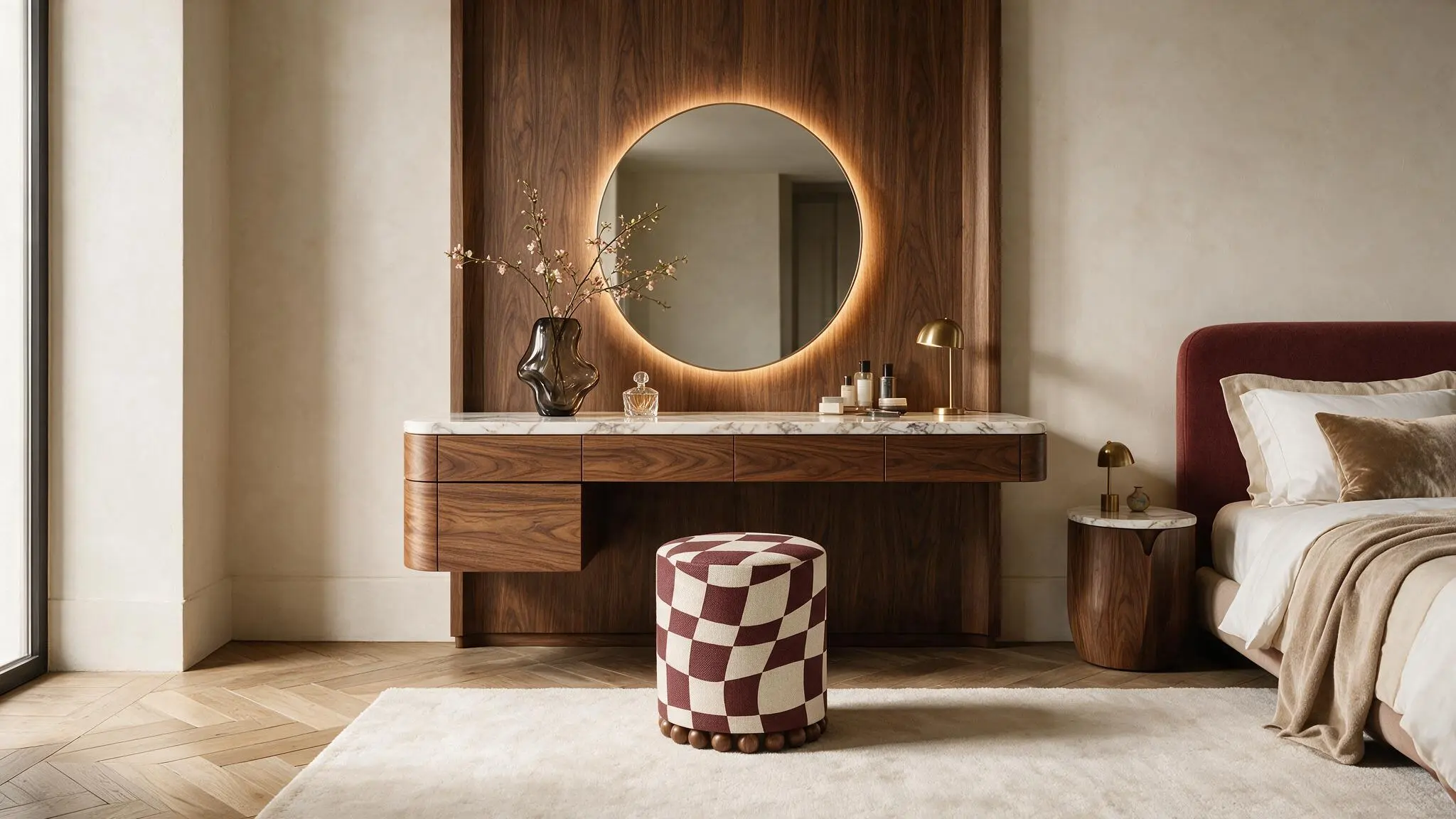
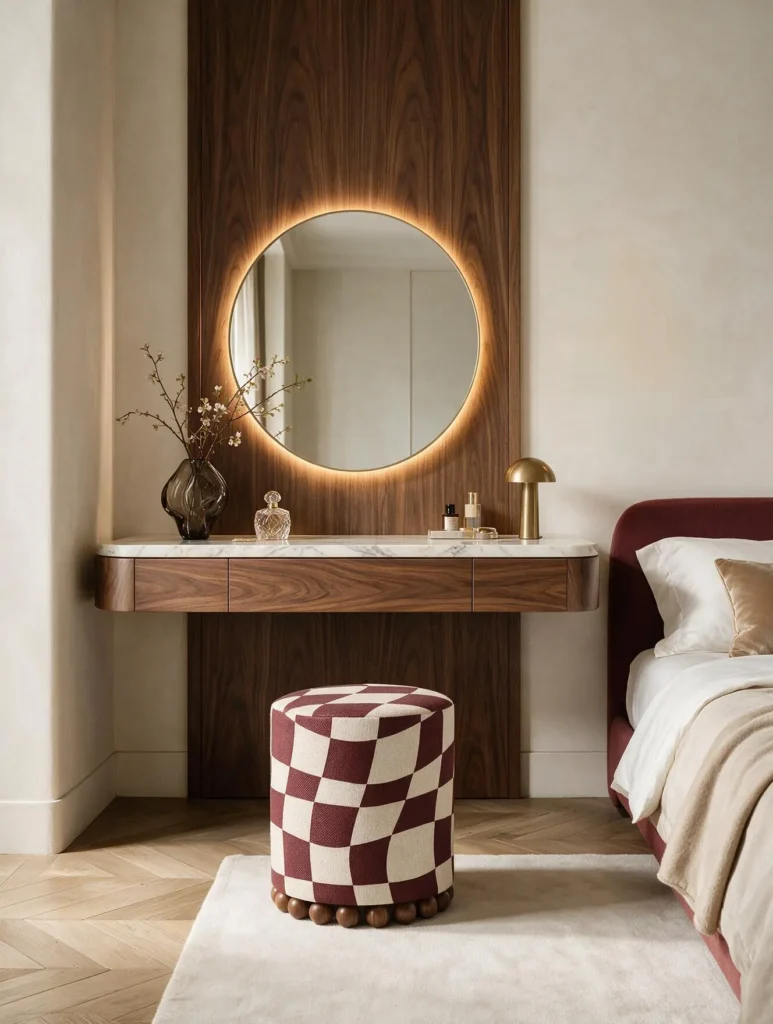
The photo shows not a classic sofa scenario, but a bedroom with a soft lounge logic: a large textile volume, a carpet, warm wood, a mirror, muted lighting and a round pouf with a burgundy and milky print. But this example is a good example of the role of a pouf in a living room. It does not “fill an empty space”. It gathers a soft scenario around itself.
In the living room, the same logic works near the sofa: the pouf adds pause, flexibility, tactility, and the ability to change the space without rearranging large furniture.
A pouf in the living room is not a secondary item
Often, an ottoman is seen as an accessory: something small next to the sofa that can be bought “later.” But in a well-designed interior, it is the small soft objects that often determine how a person uses a room.
The sofa sets the main area. The armchair adds an individual place. The coffee table holds the center of the composition. A pouf in the living room makes the space flexible. It allows you not to fix one scenario forever.
Today, an ottoman can stand in front of a sofa as a footrest. Tomorrow, it can become an additional seat for guests. In the evening, it can work as a soft table for a blanket, book, or tray. In the lounge area, it can connect a sofa and an armchair into one composition.
Formula:
POUF IN THE LIVING ROOM = MOBILITY + SEATING + ACCENT + RELAXATION SCENARIO
That’s why you shouldn’t choose an ottoman as a random detail. It should match the sofa, rug, coffee table, chairs, lighting, and overall character of the room.
Pouf near the sofa: a continuation of the soft area
The simplest scenario is to place an ottoman next to the sofa. But even here there are several different solutions.
An ottoman can stand in front of a sofa and act as a footrest. This creates a more relaxed lounge atmosphere: a person is not just sitting, but resting. If the sofa has a deep seat, such an ottoman enhances the feeling of a soft zone.
The second option is to place an ottoman on the side. Then it becomes an extra place to put a blanket, a book, a pillow, or sit down while talking. This works well in small living rooms where there is no room for another chair.
The third scenario is a pouf in the center of the composition. If there is a large rug, a sofa and an armchair, a pouf can become a soft center instead of a classic coffee table or next to it.
| Pouf location | How it works | When to choose |
|---|---|---|
| In front of the sofa | footrest, lounge-rest | for evening relaxation |
| Side of the sofa | additional seating or space for things | for a compact living room |
| In the center of the carpet | soft table or accent | for an open lounge area |
| Near the chair | extension of individual resting place | for reading or pausing |
| Between the sofa and the armchairs | connects the composition | for flexible arrangement |
You can read more about the logic of soft relaxation areas in the article “Lounge chair”. The pouf works in the same system, only more compact and mobile.
Pouf as an additional seat
There is always a guest scenario in the living room. Even if the room is designed for a family, from time to time more seating is needed: someone comes for coffee, sits closer to the sofa, participates in a conversation, moves around the room.
Pouf for the living room solves this problem well because it doesn’t look like a “spare chair.” It remains a part of the interior even when no one is using it.
It is especially important that the pouf does not create a hard fit. A person can sit sideways, turn back to the sofa, put the pouf closer to the chair or move it to another part of the room. Such freedom is very important for a modern living room, where the space often performs several functions: rest, conversation, watching a movie, reading, working with a laptop, meeting with friends.
An ottoman as a seat is appropriate if:
- there is not enough space in the living room for an extra chair;
- flexible seating for guests is required;
- I want to maintain the lightness of the space;
- the sofa area should be more informal;
- The interior lacks a soft accent.
At KAIZEN, the pouf doesn’t look like a technical addition to the sofa. Thanks to the fabric, print, leg color, and shape, it can be an independent object with character.
Pouf as a footrest
A footstool is one of the most convenient scenarios for an ottoman in the living room. But it’s important not to turn it into a utilitarian detail. In the right proportion, an ottoman next to the sofa creates the feeling of a complete relaxation area.
For this, height, softness, and distance from the sofa are important. If the pouf is too high, your legs will be in an unnatural position. If it is too low, the scenario will not work comfortably. If it is too far away, it will cease to be an extension of the sofa.
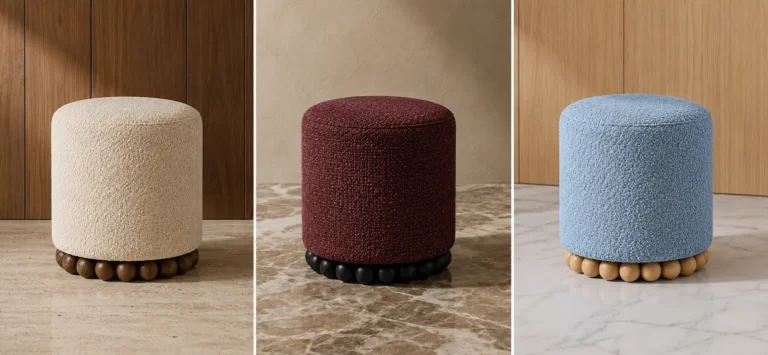
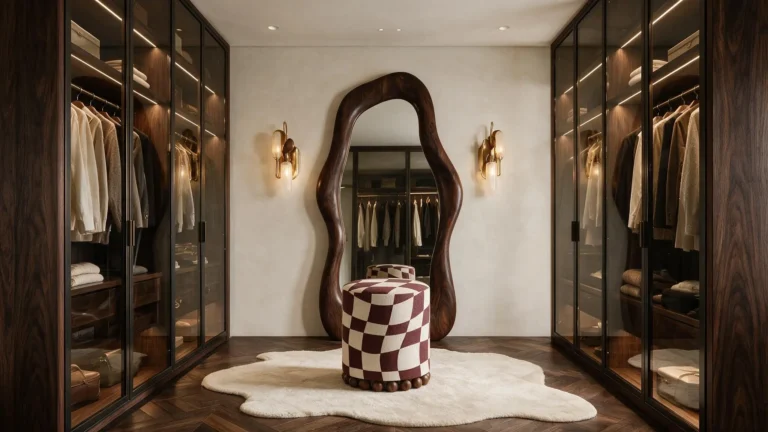
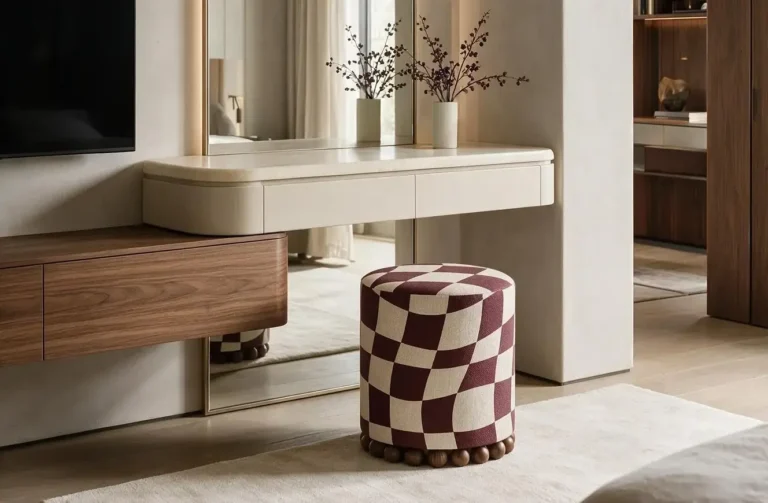
The pouf in the photo has a rounded shape and a soft fit. In a living room, this format would work well in front of a sofa or armchair: it has no sharp corners, fits easily into a carpeted area, and doesn’t look bulky.
Error → solution
Error: buy a pouf for the sofa only by color.
Decision: Check the height, softness, distance from the sofa, and how the pouf will work with your body while you relax.
Error: putting the pouf too far away.
Decision: perceive it as part of the sofa scenario, not as a separate stool.
Pouf as an upholstered table
An ottoman can replace or complement a coffee table, especially if the living room has a soft lounge feel and you don’t want to add another hard surface.
You can put a blanket, magazine, book or decorative tray on the pouf. If you use a tray, the pouf becomes a soft table for a cup, candle or small items. This does not mean that it will completely replace the classic table, but it can make the center of the living room less rigid.
This scenario works particularly well:
- in small living rooms;
- in lounge areas without a formal coffee table;
- next to the modular sofa;
- in a space with a soft carpet;
- in the area near the chairs;
- in the informal family room.
Shape matters here. A round pouf feels softer and lighter. A rectangular or square one can work better as a surface. If the pouf has an active print, like in the photo, it also becomes a visual centerpiece.
Modularity and flexibility of arrangement
A modern living room rarely lives in one scenario. During the day, it can be a space for working with a laptop. In the evening, it can be a place for a movie. On weekends, it can be a guest area. Sometimes the sofa faces the TV, sometimes the conversation shifts to the armchairs, sometimes the center of the room needs to be cleared.
A pouf supports this flexibility better than many other objects. It can be rearranged without complicated logistics. It can work on its own or as part of a modular composition.
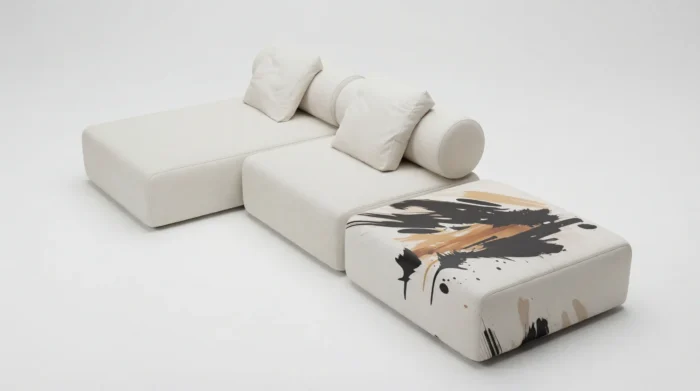
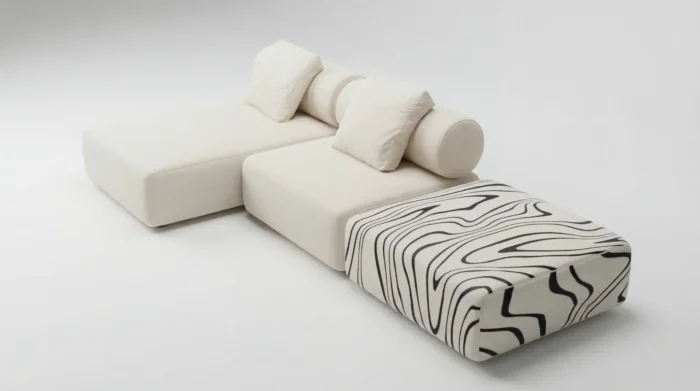
This is especially important for sofas. If the sofa is large or modular, an ottoman can become a soft extension: an additional element that changes the fit. If the sofa is compact, an ottoman provides additional space without increasing the size of the sofa itself.
You can see KAIZEN sofas in the section sofas. It is with a sofa that an ottoman most often creates a living lounge system: not one fixed object, but a flexible composition for different situations.
Modularity formula:
SOFA + POUF = MORE SCENARIOS WITHOUT A NEW LARGE ITEM
Composition with chairs
An ottoman doesn’t have to belong only with a sofa. It can work with armchairs—especially in a lounge area where informal seating is important.
For example, a living room might have a sofa, one accent chair, and an ottoman between them. Then the ottoman ties the arrangement together. It doesn’t create another vertical like a chair, but it adds a soft center. A person can use it as a footrest, extra seating, or a side table.
If the chair itself has a strong character, the ottoman can be more subdued. If the chair is neutral, a printed ottoman can take on the role of an accent. In the article “Accent chair as an art object for the interior” It’s clear how one soft object can change the mood of a space. The pouf works on the same principle, but is more compact.
| Composition | The role of the pouf |
|---|---|
| Sofa + pouf | extended vacation |
| Armchair + pouf | personal lounge area |
| Sofa + armchair + pouf | soft center of composition |
| Two chairs + pouf | informal conversation area |
| Sofa + banquette + pouf | multilayer soft zone |
This logic also works in hotel, salon and commercial spaces. For example, Ritmo Synergy banquette for hotel shows how soft objects can shape not only the seating but also the atmosphere of a space. In the living room, an ottoman serves a similar role—only on a more domestic scale.
Fabric and print: how to make a pouf an accent, not a random spot
The pouf in the living room is often the center of attention: next to the sofa, on the rug, next to the coffee table or armchair. Therefore, the fabric is as important as the shape.
In the photo, the pouf has a burgundy and milky checkered print. In the space, it rhymes with the burgundy headboard and warm shades of wood. If you transfer this logic to the living room, the pouf can support the color of the pillows, blanket, painting, carpet, chair, or decorative details.
Several strategies are possible for the living room:
| Decision | Effect | When appropriate |
|---|---|---|
| Solid fabric in the color of the sofa | peace and integrity | if the space already has accents |
| Contrast fabric | expressive point | if the sofa is neutral |
| Textured fabric | depth without brightness | for minimalist living rooms |
| Art print | character and focus | if the room lacks emotion |
| Dark pouf | graphicness | near the light sofa |
| Light pouf | lightness | in a private or dark room |
KAIZEN is separately developing the topic of art textiles for furniture. You can read about it in the article “KAIZEN Furniture Factory: Art Textiles for Furniture”. This approach is especially important for a pouf near the sofa: a small object can become a carrier of a big mood.
How to choose the size of a pouf for the living room
The size of the ottoman depends on the sofa, rug, and scenario. A small ottoman is easier to move around, but works more as an accent or extra seat. A larger ottoman is better suited as a soft table or centerpiece.
It is important not to choose an ottoman in isolation. It should be proportional to the sofa. A ottoman that is too small can get lost next to a large modular sofa. A large ottoman can take up the entire aisle next to a compact two-seater sofa.
Guide:
- for a compact living room – a small round or square pouf;
- for a large lounge area – a larger pouf or a set of several soft elements;
- for a sofa with a chaise longue – an ottoman on the side or near the armchair;
- for a classic straight sofa – an ottoman in front of the seat;
- for a space with several chairs, an ottoman in the center of the composition.
If the pouf is to be used as a footrest, its height should be close to the height of the sofa seat or slightly lower. If as a table, stability is important. If as additional seating, comfortable softness and the right height are needed.
Pouf in the lounge area: an informal recreation center
A lounge area is a space where not only the object but also the state is important. Here, a person does not just sit. They rest, talk, read, watch a movie, drink coffee, change their posture, move the blanket, put their feet up, and turn to the interlocutor.
The pouf is perfect for this scenario because it doesn’t require a single way of using it. It can be used intuitively. That’s why it works well in living rooms, coworking spaces, salons, showrooms, hotel lobbies, and home lounge areas.
In the article “Upholstered furniture: 6 steps to the finished product” describes how KAIZEN approaches furniture creation: choosing a model, fabric, print, size, coordinating details, and manufacturing. For a living room pouf, this process is important because the object should not be “almost suitable,” but accurate in height, fabric, color, and character.
Before / after
To: The living room has a sofa and armchairs, but the center looks stiff or empty.
After: The ottoman adds a soft spot that can be used as a seat, a stand, or a table.
To: The sofa is comfortable, but the relaxation scenario is limited.
After: The pouf allows you to change the seating position, stretch your legs, add space for a guest, or reconfigure the lounge area.
When to choose an ottoman for your sofa
An ottoman for a sofa is especially appropriate if:
- The living room lacks flexible seating.
- I want to make the sofa more lounge-oriented.
- There is no room for a second chair.
- Need a footrest without a massive recliner.
- The center of the room looks empty.
- I want a soft table instead of a hard coffee table.
- Need an accent piece without replacing the sofa.
- The space should change for guests, movies, reading or conversations.
The pouf doesn’t have to match the sofa. It’s often better when it’s a little different: in texture, print, color, shape. That way, it doesn’t dissolve, but adds a new layer to the space.
The main thing is to keep this difference under control. The burgundy and milky pouf in the photo works precisely because it has a connection with textiles and warm wood. In the living room, it could just as well support burgundy pillows, a wooden shelf, a rug, or an accent chair.
Conclusion: an ottoman makes the living room more flexible
A pouf in the living room is not just a small seat next to the sofa. It is an object that changes the scenario of the room. It can be an extension of the sofa, a footrest, an additional place for guests, a soft table, an accent next to an armchair or the center of the lounge area.
Its strength is in its mobility. The sofa sets the basic structure, and the pouf allows you to change it without much rearrangement. That’s why it works well in modern living rooms, where the space should not only be beautiful, but also lively.
The example photo shows the main principle: a small soft object can gather a composition around itself. Carpet, textiles, wood, mirror, light and a large soft volume begin to sound together. In the living room, this role is played by a pouf near the sofa – a small but important point of the lounge scenario.
A properly selected pouf for the living room doesn’t look like an accessory. It becomes part of the rhythm of the room: where you want to sit, stretch your legs, put a blanket, place a tray, or simply make the space softer.