Зміст
A designer pouf is not just a soft place placed where there is a free corner. It is a small object with a big responsibility. It can support a bedroom, organize a beauty zone, become an accent near a sofa, enliven a hallway, complement a beauty salon or make a showroom more recognizable.
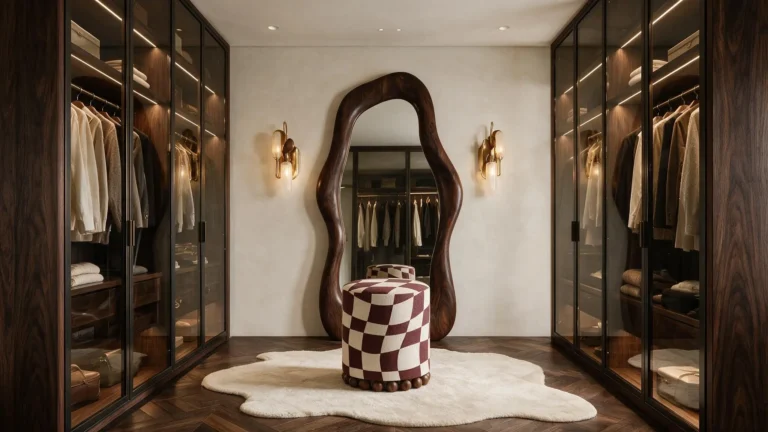
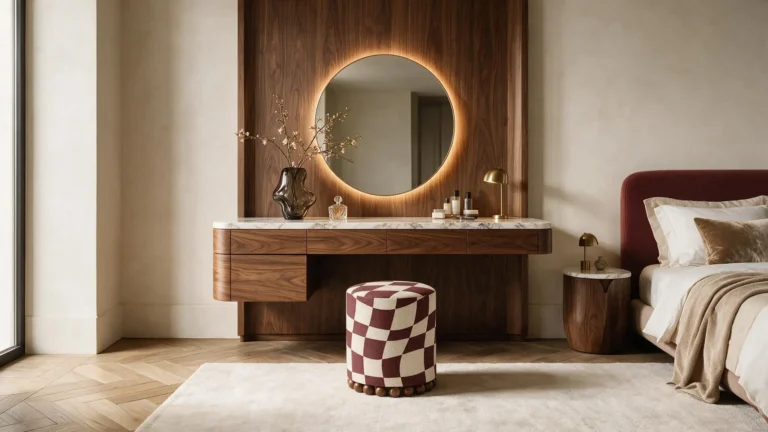
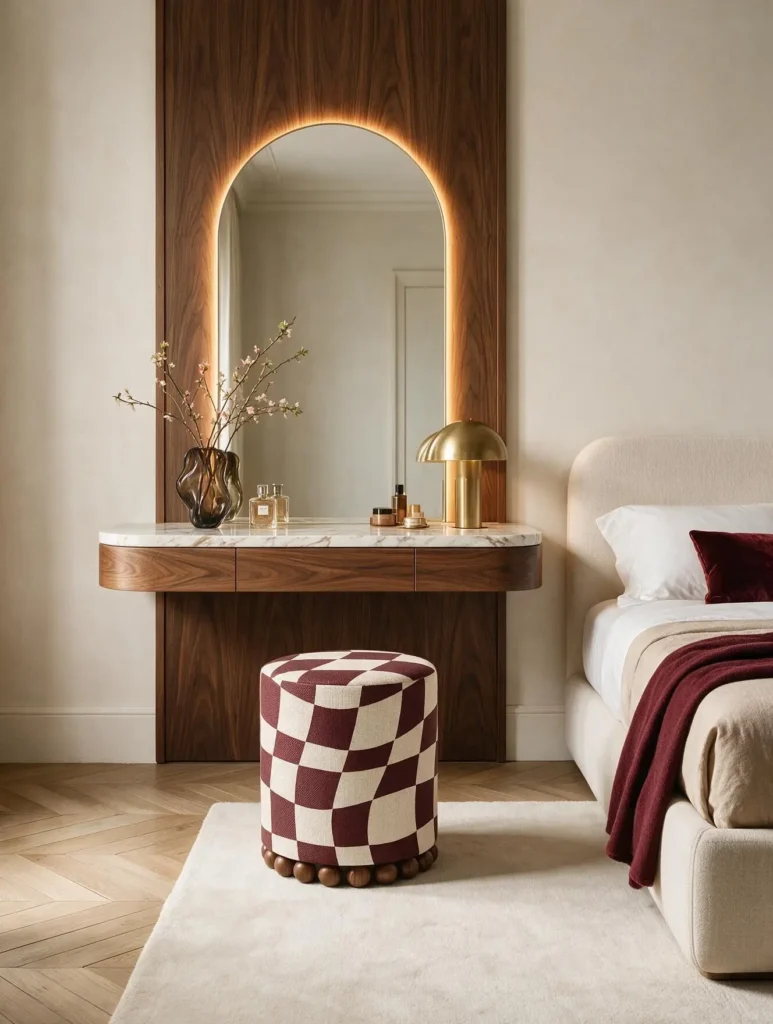
The photo clearly shows this idea. The space is built on a calm base: wood, light walls, a soft carpet, a mirror with lighting, a marble surface, a bed with textiles. But it is the round pouf with a burgundy and milky print that gives the interior character. Without it, the room would remain beautiful, warm, and correct. With it, rhythm appears.
This is the essence of the topic. designer poufs. Design here is not in the word “expensive” or the abstract epithet “stylish.” Design is about shape, proportion, fabric, art print, color, legs, usage scenario, and precision in space.
What makes a pouf designer?
Not every soft pouf is a designer one. An object can be beautiful, soft, comfortable, but still remain neutral. A designer pouf has a stronger logic: it is created not only for seating, but for interaction with the interior.
Everything is important in a designer pouf:
| Element | What is design? |
|---|---|
| Form | how the object is read in space, does it have a soft silhouette, does it look random? |
| Proportion | whether the height, diameter and volume correspond to the specific scenario |
| Cloth | what a touch, texture, depth of color and practicality |
| Art print | Does the subject add character, rhythm, and recognition? |
| Color | whether it supports the interior palette or creates the desired accent |
| Base / legs | Is there a detail that completes the image? |
| Scenario | where the pouf works: near the bed, mirror, sofa, in the salon or showroom |
In the images, the pouf works exactly as a designer piece. It has a simple round shape, but it doesn’t look basic. Its burgundy and milky print creates graphics. The spherical wooden base adds sculpturality. The proportion allows it to be used near a dressing table, mirror or bed. It is beautiful from all sides, which is important for outdoor areas.
A small item that can hold the entire interior
In a large space, the main role is often given to the sofa, bed, wardrobe or table. But sometimes the character of a room is created not by the largest object, but by the most accurate one.
A designer pouf can be just such an element. It doesn’t take up much space, but it attracts the eye. It doesn’t change the architecture of the room, but it changes its tone. It doesn’t require a complete interior renovation, but it can make the space more personal.
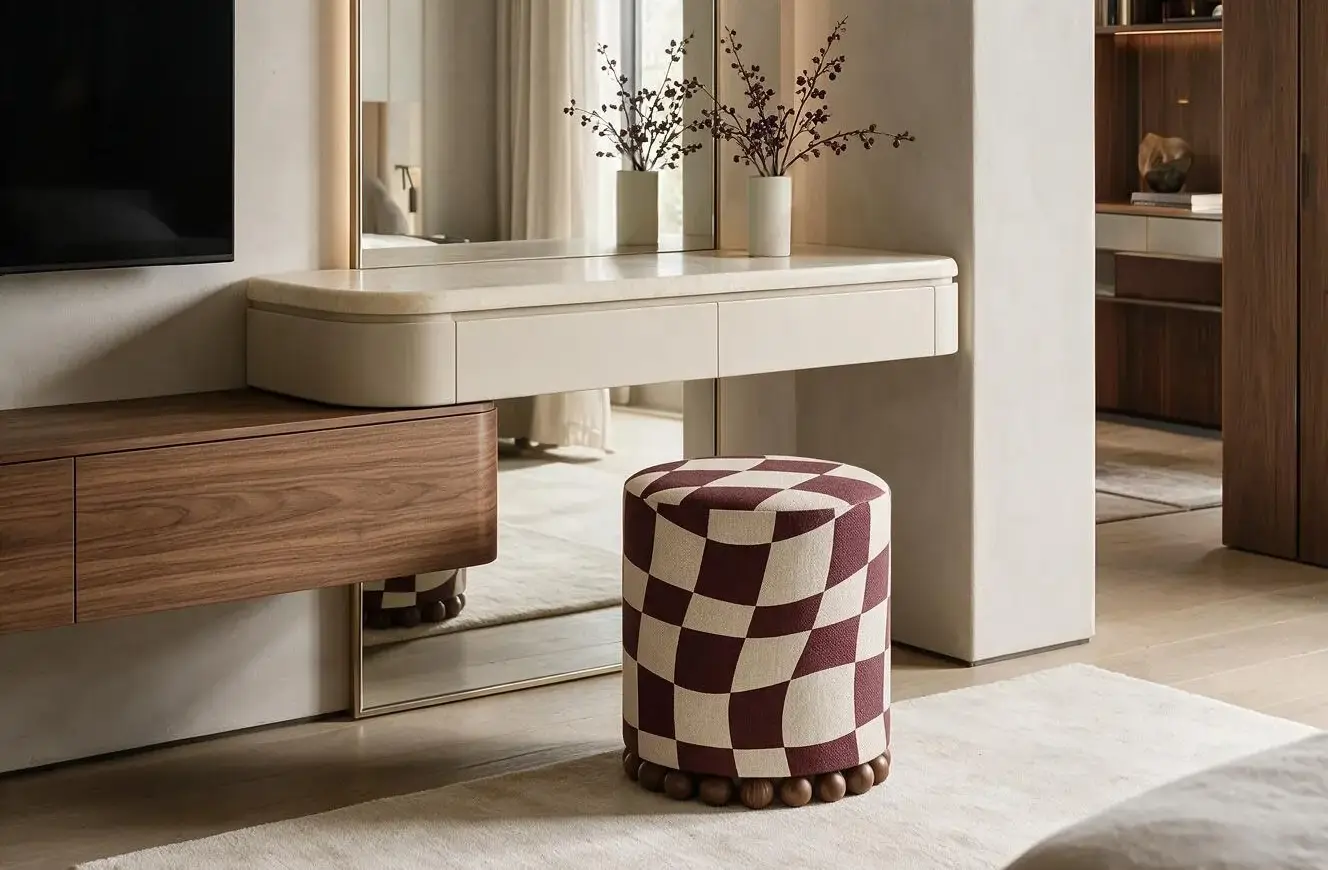
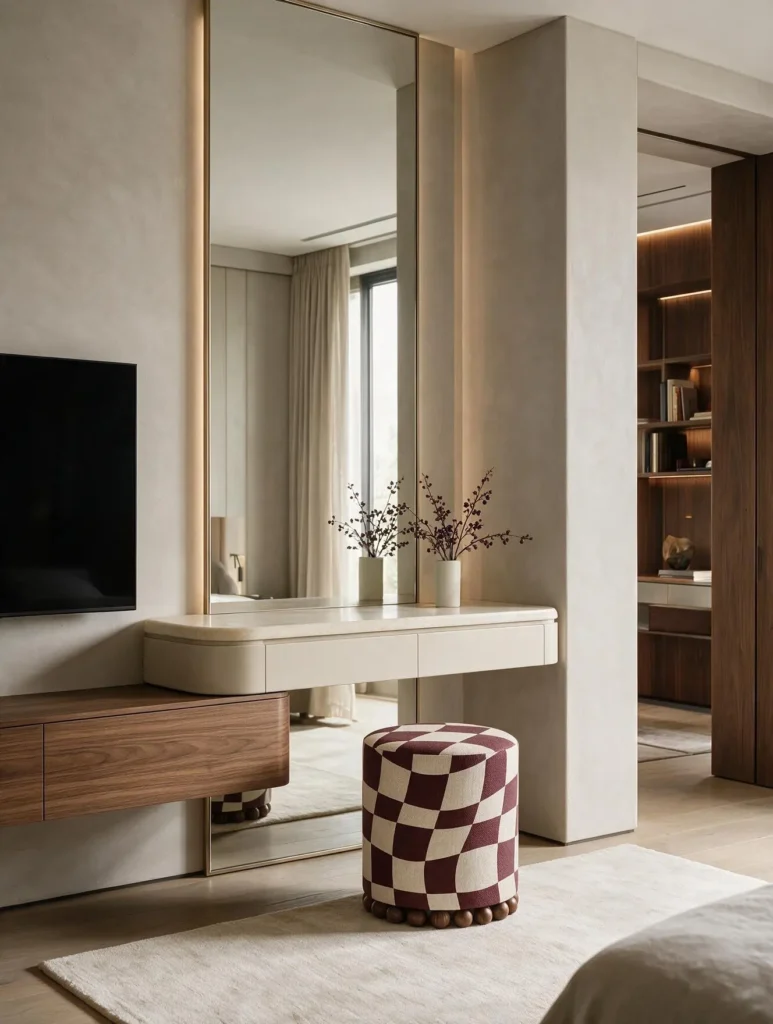
In the first photo, the pouf stands between the bed and the dressing table. It connects several zones: sleep, grooming, mirror, morning ritual, evening light. In the second photo, the pouf near the mirror works almost like an interior sign: it is open, reflected, holds the composition and does not hide under the table.
This is an important feature of a designer pouf: it doesn’t require a lot of space, but it does need the right place.
Shape: Why a Round Pouf Works Softly
The shape is the first thing that determines the character of a pouf. A round silhouette is perceived softer than a rectangular one. It has no sharp corners, so it fits more easily into a bedroom, hallway, living room, dressing room or beauty area.
A round designer pouf works well where the space already has a lot of verticals and planes: mirrors, consoles, facades, walls, doors, wood panels. It softens this geometry.
This is especially noticeable in the photo: the wooden panel, console and mirror create a strong vertical. The pouf below adds a rounded, soft volume. It does not argue with the architecture, but balances it.
Formula:
DESIGNER POUF = SOFT SHAPE + PRECISE PROPORTION + EXPRESSIVE MATERIAL
If the shape is too simple and unsupported, the pouf can look like an ordinary stool. If the shape is too complex, it quickly becomes tiring. Balance is important in a design object: enough expressiveness, but without overload.
Fabric: not a background, but part of the character
The fabric of a pouf is just as important as the shape. It determines the first impression: whether the pouf looks warm or graphic, soft or bold, calm or accent.
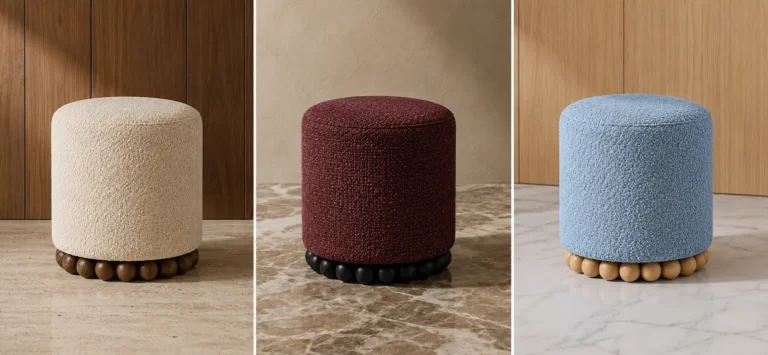
In designer poufs, the fabric should not be random. It should support the scenario of the space. For a bedroom, it can be a soft, tactile texture. For a beauty salon, it can be a more practical material that holds its shape well and easily fits into the client scenario. For a showroom, it can be an expressive fabric or an art print that is memorable.
The photo shows a burgundy and milky checkered print. It works in several directions at once:
- adds graphic rhythm;
- supports burgundy bed textiles;
- contrasts with the light carpet;
- rhymes with warm wood;
- makes the pouf an independent accent;
- does not overload the space thanks to its simple round shape.
You can read more about the role of the pouf in the living room and lounge scenarios in the article “Pouf by the sofa”. It is clearly visible there that fabric can change not only the appearance of an object, but also the way it is used.
Art print: when a pouf becomes not a decoration, but a statement
An art print is one of the strongest points for a designer pouf. It can turn a small object into the center of a composition.
But the print should be built into the design, not just applied on top. It is important how it fits the shape. Is it readable on a rounded volume. Does it not break at the seams. Does it correspond to the scale of the room. Does it support the colors of the interior.
At KAIZEN, art print is part of the author’s approach. It allows you to create a pouf that does not look typical. Such an object can be calm or bold, graphic or picturesque, contrasting or delicate.
This topic resonates with the article “Designer sofas with prints”. The print on the sofa works on a large scale, while on the pouf it works compactly. But the principle is the same: the textile becomes not the upholstery, but the language of the object.
For a small interior, a printed pouf is often safer than a large sofa with an active fabric. It gives character, but does not take over the entire room.
Proportion: Why a small object needs to be precise
A pouf has no right to be “almost suitable”. Due to its small size, any error in proportion is quickly felt. Too high – it is uncomfortable to sit on. Too low – it gets lost. Too wide – it hinders movement. Too small – it looks random.
A designer pouf should match the place:
| Scenario | What proportion is important? |
|---|---|
| By the dressing table | comfortable seating height, compactness, beautiful appearance in the mirror |
| Near the sofa | height should work as a footrest or extra seat |
| In the hallway | the object should not block the passage |
| In the bedroom | The pouf should be soft but not bulky. |
| In the beauty salon | requires stability, practicality and photogenicity |
| In the showroom | expressiveness and recognizability from different angles are important |
In the photo, the pouf is open. It is visible in its entirety: from above, from the side, in space, in connection with the carpet, table, mirror and bed. That is why it should be integral. In such an area, you cannot hide an unsuccessful back or a random base.
More about compact seating near the mirror in the article “Pouf for dressing table”. This is one of the most accurate scenarios for a designer pouf, because the object is always visible.
Non-standard without chaos
A designer pouf doesn’t have to be weird. Non-standard is not about a complex shape for the sake of a shape. It’s about an object that has its own idea.
The pouf in the photo’s unconventionality is not manifested in its excessive silhouette, but in the combination of elements: a rounded shape, a graphic checkered print, spherical legs, warm wood, burgundy accents, and soft textiles. It looks recognizable, but not flashy.
This is an important principle for private interiors and B2B projects. In a salon, showroom, hotel or office, an object should be memorable, but not interfere with people using the space. The design should work not only in a photo, but also in real motion.
Error → solution
Error: to think that a designer pouf should be as bright as possible.
Decision: seek precision: shape, fabric, color, and script must work together.
Error: choose a print separately from the interior.
Decision: look at the entire space: wood, carpet, sofa, bed, mirror, light, textiles.
Error: buy a designer pouf only as decoration.
Decision: Immediately determine how it will be used: seat, accent, stand, beauty zone, lounge area.
Author’s KAIZEN approach
For KAIZEN, a designer pouf is not a “finished product in a beautiful fabric.” It is an item that can be customized to fit the space.
The author’s approach is manifested in several things:
- Form. The pouf should be soft but collected.
- Cloth. The material is selected according to the scenario: bedroom, living room, salon, showroom, hallway.
- Art print. Print creates character, not just decorates a surface.
- Basis. Legs or a decorative bottom complete the silhouette.
- Customization. You can work with color, fabric, print, size, and details.
- Context. The object is not created by itself, but for a specific interior.
That’s why KAIZEN logically works with both private clients, interior designers, and B2B spaces. A pouf may be small, but its impact on a room is big.
Collaboration with designers
For interior designers, an ottoman is a handy tool. It allows you to add an accent without radically changing the space. If the interior already has a sofa, bed, chairs, cabinets and a basic palette, a designer ottoman can be the final touch that brings everything together.
Flexibility is important when working with designers. You need to get into the concept, visualization, palette, scenario, proportion, and budget. This is where KAIZEN customization makes sense: you can choose not the “closest ready-made version,” but the exact item.
For a project, a designer can choose:
- plain fabric for a calm interior;
- art print for the accent area;
- deep color for the lounge space;
- textured fabric for the bedroom;
- practical material for commercial interiors;
- the color of the legs matches wood, metal or other furniture.
This is especially important when a designer is creating not just a beautiful picture, but a space in which people will live or work every day.
B2B projects: salons, showrooms, hotels, offices
In B2B spaces, designer poufs serve a dual role. They need to be functional and make an impression at the same time.
In a beauty salon, a pouf can become part of the beauty zone, a waiting area, or a photogenic accent near the mirror. In a showroom, it can support the brand’s style. In a hotel, it can add intimacy to a room or lounge area. In an office, it can soften a reception or informal relaxation area.
For such spaces, the following are important:
| Parameter | Why is it important in B2B? |
|---|---|
| Fabric durability | the item is used more often than at home |
| Visual recognition | furniture works for the brand image |
| Compactness | In commercial spaces, every meter counts. |
| Photogenicity | Salons and showrooms often live in visual content |
| Customization | you need to get into the identity, palette and concept |
| Quality of execution | the item should look stable after daily use |
In such projects, a designer pouf cannot be perceived as a trifle. It often finds its way into the frame, into the waiting area, into the client’s first contact with the space.
Private interiors: bedroom, living room, hallway
In a private interior, a designer pouf works more softly. It doesn’t have to be loud. Its task is to make the space more personal.
In the bedroom, it can stand next to a dressing table or wardrobe. In the living room, next to a sofa or armchair. In the hallway, near a mirror. In the dressing room, as a soft landing for choosing an image.
All these scenarios are different, but the principle is the same: the pouf should support the rhythm of life.
In the living room, it can be part of the lounge area. In the bedroom, it can be part of the morning ritual. In the hallway, it can be a soft first impression. Near the dressing table, it can be a place to pause in front of the mirror.
Design here is not about making an object “noticeable at all costs.” Design is about making it relevant.
Designer poufs and large upholstered furniture
The ottoman often seems like a separate category, but in fact it has a lot in common with sofas, armchairs and banquettes. All of these objects work through shape, fabric, fit, tactility and script.
In the article “Designer sofas: a space of tranquility” These are large, soft objects that shape the atmosphere of a room. A pouf does the same thing on a smaller scale. It doesn’t physically occupy the center of the room, but it can become the center of attention.
And the article “Printed chair” shows how art textiles change the perception of a seating object. For a pouf, it is even more concentrated: smaller form, stronger focus, faster visual effect.
That’s why a designer pouf can be the first step to a bolder interior. You don’t have to order a large sofa with a print right away. You can start with a small item that will show how the space reacts to color, texture, and art.
When to buy a designer pouf
Buy a designer pouf It’s not worth it when you just “need another place.” But when the interior lacks a precise soft accent.
Such an item is appropriate if:
- The space looks beautiful, but too neutral.
- Need an accent without replacing large furniture.
- There is a lack of completeness near the mirror or console.
- The living room needs a flexible lounge area.
- The bedroom lacks a soft morning scenario.
- A salon or showroom needs an item that is memorable.
- A designer is looking for a custom element for a specific project.
- You need to combine function, fabric, color, and art print.
The main thing is not to choose an ottoman in isolation. It should be viewed in the context of the entire interior: where it will stand, what will be nearby, how it will be seen in the mirror, how it works with textiles, carpet, wood, sofa or bed.
Conclusion: Design starts with precision
A designer pouf is a small object that can hold the character of an entire interior. But only when it is not empty “designerness” but precise work with shape, fabric, proportion, color, print, and scenario.
In the photo, the pouf looks strong not because it is bright in itself. It is strong because it works with the space: the burgundy print supports the textiles, the milky color rhymes with the carpet and bedding, the wooden base echoes the panel and furniture, and the round shape softens the architecture.
This is exactly how a designer item should work. Not as a random decoration, but as part of the interior logic.
For KAIZEN, designer poufs are an opportunity to create small but meaningful accents for private interiors, salons, showrooms, hotels and design projects. Through customization of fabric, color, print and details, a pouf can become not just “another seat”, but an object that speaks the language of a specific space.