Зміст
The scene where it all begins
Space was no longer silent—it was waiting for the command.
The light slid along the walls as if testing their readiness to take shape. The air was clean and precise, without random movements, without unnecessary shadows. The house did not yet know its inhabitants, but it was already ready for life.
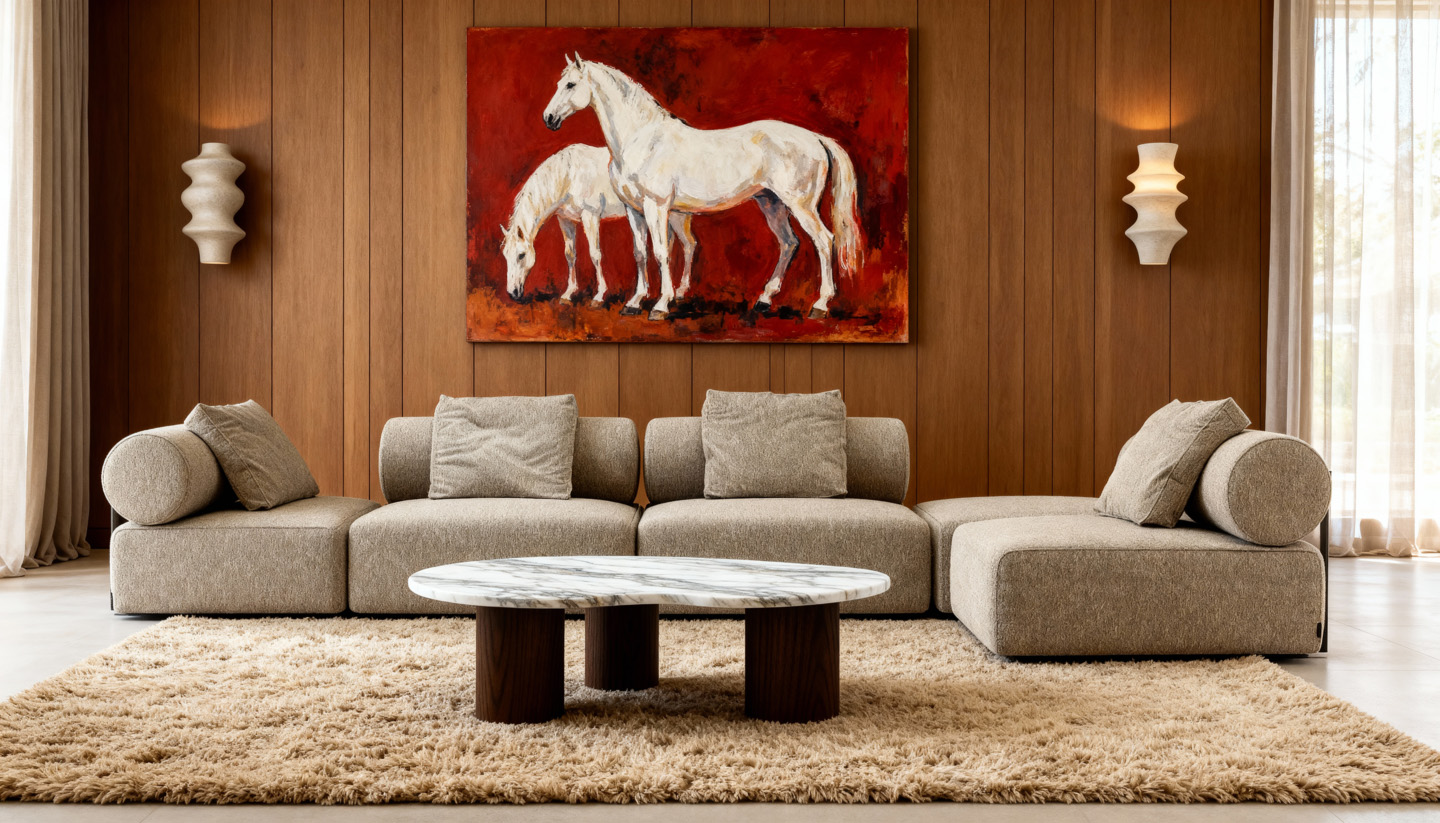
There is a picture on the wall.
Two white horses stood side by side, as if stopped in a moment between movement and stillness.
One was called Kai — he looked ahead, tense, focused, ready to move.
The second one — Zen — his posture was even, his gaze deep, almost motionless, like the silence before a decision.
They were not decoration.
They were coordinate system.
The space beneath them gathered around balance: speed and calm, momentum and pause, idea and form. There was to be no random furniture. No object could appear simply because it “fits the size.”
In this house, the furniture had to fulfill a different role.
They had to adapt to the rhythm of life, and not impose your own.
They had to know where a person stops and where they move on.
They were supposed to be part of the logic, not decoration.
Kai and Zen looked from the picture, as if reminding:
The future is not a choice between speed and peace.
The future is the exact balance between them.
It is from this point that the interior, created not according to a template, begins,
and according to the kaizen principle — constant, conscious improvement of space for humans.
What does “custom furniture” really mean?
Short answer: it’s not about choosing upholstery—it’s about matching the space and life scenarios.
CUSTOM FURNITURE =
SPACE × SCENARIO × PROPORTIONS
Ready-made solutions are created “for everyone.” Individual ones are for a particular house: with its light, scale, movement of people and rhythm of the day.
Why ready-made furniture often doesn’t work in real apartments
Short answer: they don’t know your space.
Typical problems:
the sofa blocks the aisles;
the table “presses” with mass;
the chairs look alien;
accents are not readable.
READY-MADE FURNITURE → BY PRODUCT
CUSTOM FURNITURE → PERSONALIZED
Furniture as a system, not a set of objects
Individual interior is connections:
sofa ↔ wall ↔ light;
table ↔ seating ↔ movement;
texture ↔ color ↔ silence.
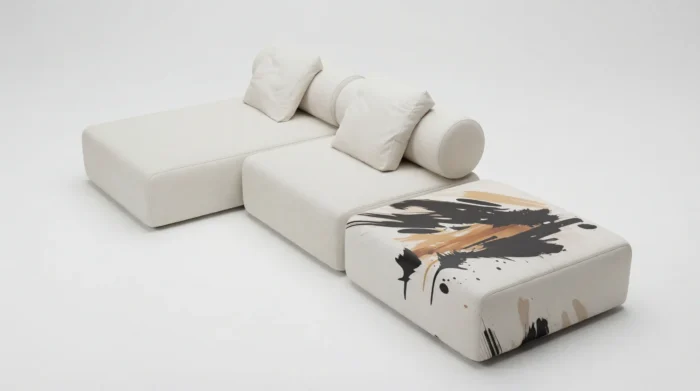
“Author’s prints “and shapes only work when the furniture becomes a focal point, not a decoration.”
The role of the furniture studio in the process
Short answer: The studio is a translator between desire and form.
Furniture studio:
analyzes space;
removes restrictions;
offers solutions, not options;
thinks systematically.
This is not “manufacturing”, but experience design.
Customization: a tool, not a whim
Customization is:
different seat depth;
modified module;
adaptation to windows or niches;
individual print;
working with scale.
“Designer sofas with prints are becoming accent only when their form is subordinate to space.”
Custom-made furniture and the psychology of comfort
Short answer: The body senses proportions faster than the eyes.
COMFORT =
SUPPORT × SOFTNESS × SPACE AROUND
The correct height, depth, angle is what not visible, but what creates a sense of home.
Accents that don’t overload
Custom-made furniture allows you to work with accents pointwise:
one strong sofa;
one texture;
one print.
“Modern interior doesn’t need many accents – he needs the right one.”
Typical client fears — and real answers
Fear 1: “It’s hard”
Decision: The studio leads the process from idea to implementation.
Fear 2: “I don’t know what I want”
Decision: It is enough to know how you live.
Fear 3: “It’s too individual”
Decision: that’s why the interior works for years.
Infographics: how an individual interior is formed
STEP 1 — Space Analysis
STEP 2 — Life Scenarios
STEP 3 — Proportions
STEP 4 — Materials
STEP 5 — Accents
Table: ready-made furniture vs custom-made furniture
| Criterion | Ready | To order |
|---|---|---|
| Adaptation | Limited | Complete |
| Proportions | Standard | Under the space |
| Accents | Typical | Individual |
| Scenarios | General | Personal |
Custom-made furniture as a long-term solution
Short answer: They don’t age morally because they don’t follow trends.
Customized furniture:
don’t try to please everyone;
do not overload;
leave space for life.
Quote about KAIZEN
“KAIZEN is an approach in which each solution becomes a little better than the previous one, and furniture is part of the evolution of the space.”
FAQ
When is custom-made furniture really justified?
When the space is non-standard or the atmosphere is important.
Is this approach suitable for apartments?
Yes, especially for compact or open floor plans.
Does individuality limit choice?
On the contrary, it structures it.
Can multiple zones be combined?
Yes, custom-made furniture creates logic between zones.
Is it more difficult to maintain?
No, if the decisions are well thought out.
Conclusion
Custom-made furniture is not about choosing a model.
This is a choice of approach in which space, form, and life are combined into a single system.
This is how an interior is born that you want to return to.