Зміст
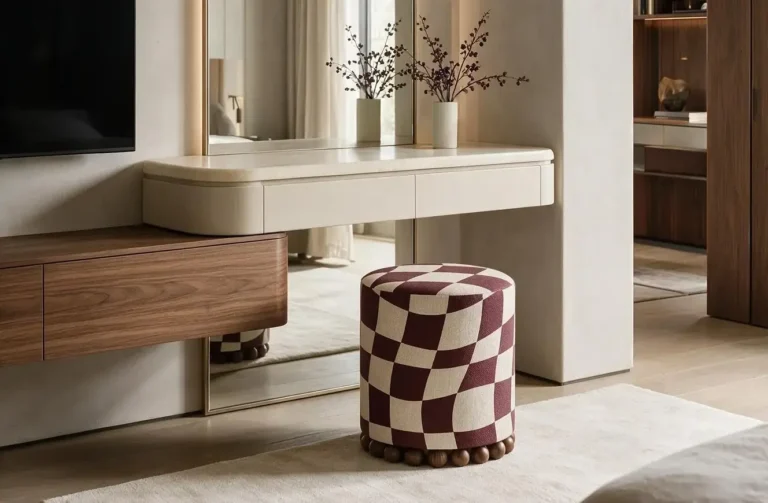
Mornings in the bedroom begin not with movement, but with silence. Light slowly passes through the wood, touches the soft textiles, slides across the mirror and stops on a small object next to the dressing table. The round pouf does not take all the attention, but changes the feeling of the room: there is a place for pause.
Sit in front of the mirror. Put your clothes next to you. Throw a blanket on the bed. Leave your bathrobe or sweater on for a few minutes. Do your morning ritual not in a hurry, but in a gentle rhythm. This is what you need pouf in the bedroom — not as a random extra seat, but as a small zone between function and mood.
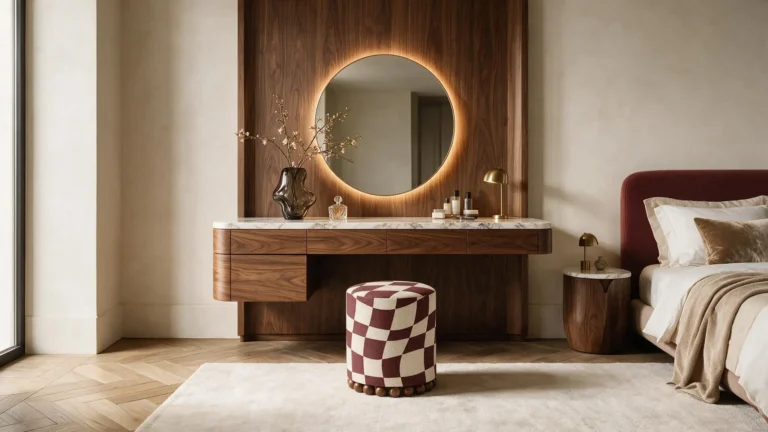
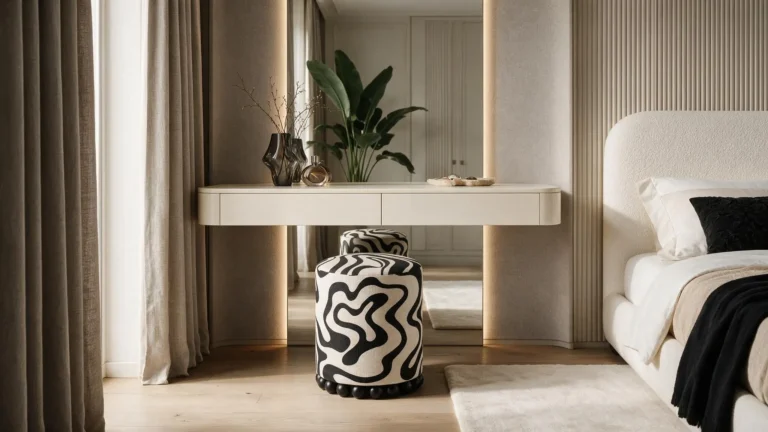
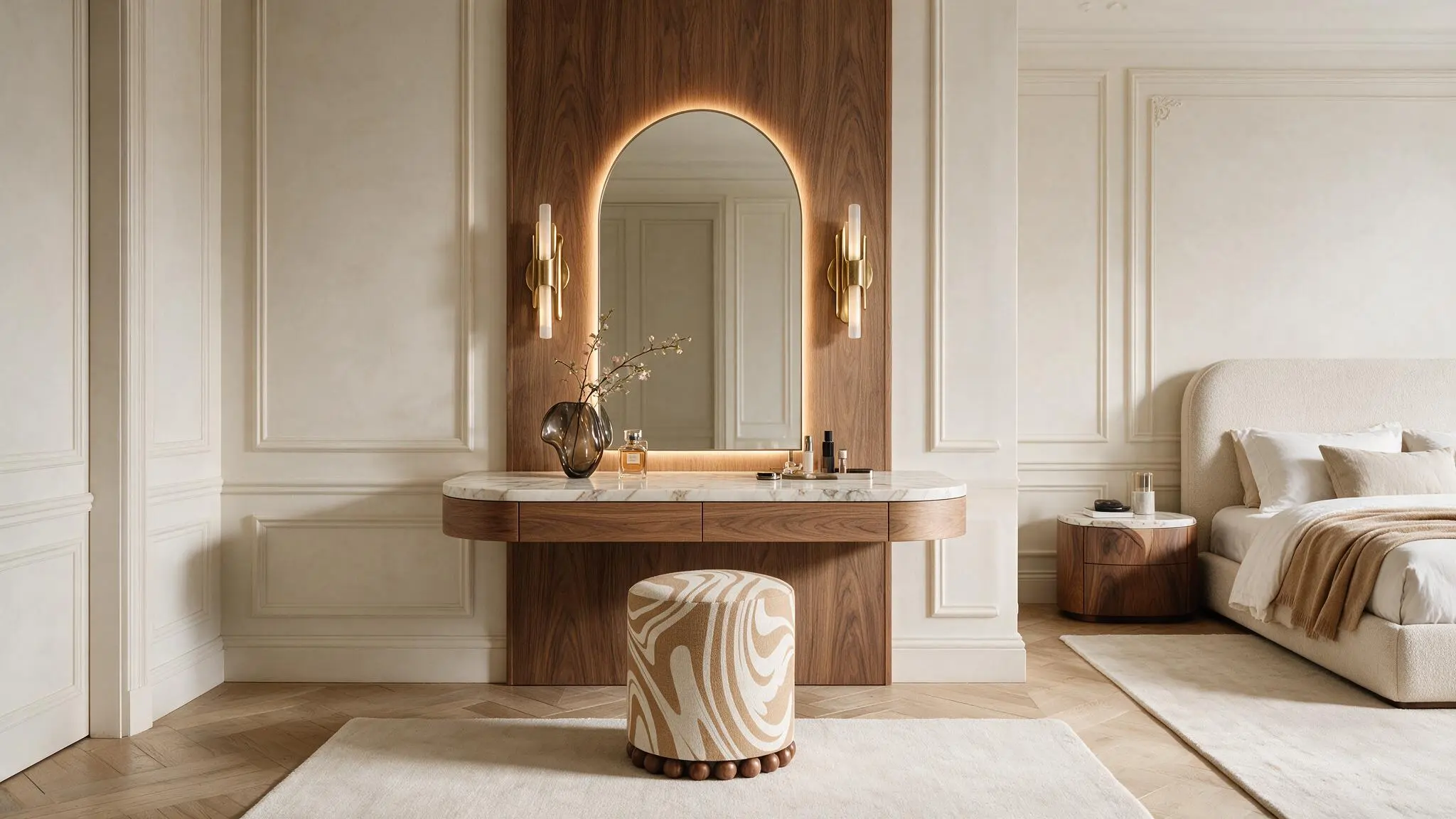
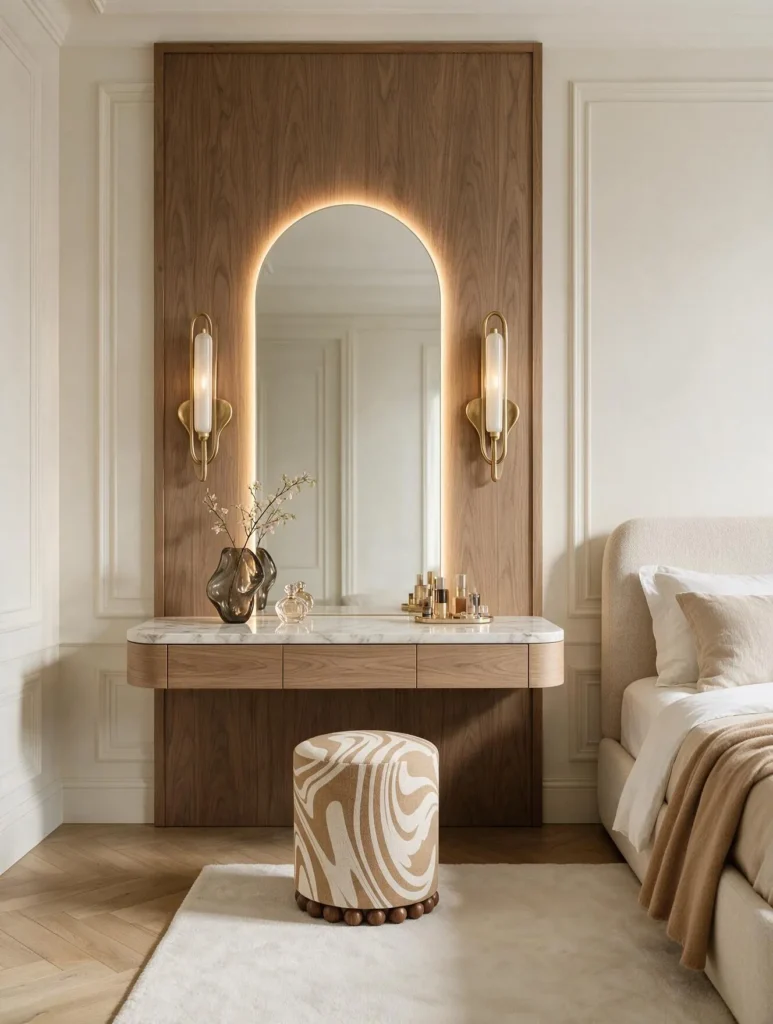
In the images, the bedroom is built on light walls, wood, warm lighting, a soft bed, a beige blanket and calm textiles. A pouf with a beige and milky wavy print supports this atmosphere: it does not disturb the silence of the room, but adds rhythm, tactility and a sense of completion to it.
Why a pouf in the bedroom is more than just a place to sit
The bedroom is the least public space in the house. You don’t want too much noise, too much functionality, or random objects. Everything should work more softly: the light, the fabrics, the shapes, the colors, the distances between things.
Ottoman in the bedroom often sought as a compact fit. But its role is broader. It can become part of the morning scenario, evening relaxation, dressing area or beauty ritual near the mirror. This is an item that does not dictate a new function to the room, but adds a comfortable soft pause to it.
Formula:
POUF IN THE BEDROOM = PAUSE + TACTILITY + RITUAL + ACCENT
A chair near the dressing table can look too rigid. An armchair takes up more space. A bench creates a long horizontal line. And a pouf remains mobile, compact and soft. It can be placed near the mirror, moved to the bed, used near the wardrobe or left as a decorative and functional accent.
Pouf by the bed: a place for a blanket, clothes and an evening break
A pouf works quietly by the bed. It doesn’t replace a bedside table or compete with a bench. Its role is more delicate: to create a soft spot where a short action is needed.
You can put a blanket on it before bed. Leave your clothes on until the morning. Sit down to change your shoes. Put down a book for a few minutes. Take off your home sweater. All this doesn’t sound like a big function, but it is these small actions that make a bedroom comfortable.
Bedside pouf especially appropriate if there is not enough space for a large bench near the bed. It does not block movement, does not weigh down the interior and is easy to change position. In a small bedroom this is important: the object should be useful, but not take up space.
| Bedside scenario | How does a pouf work? | What to consider |
|---|---|---|
| Evening relaxation | provides space for a blanket or clothes | the fabric should be pleasant to the touch |
| Morning preparation | creates a short landing | comfortable height is important |
| Compact bedroom | replaces a large banquet | better round or soft shape |
| Accent near textiles | supports blanket, pillows, carpet | the color should rhyme with the palette |
| Area near the bed and mirror | combines two scenarios | The pouf should look good from all sides. |
A pouf by the bed should not look like an office or technical object. In the bedroom, a different language is important: softness, roundness, fabric, shade, tranquility.
Pouf by the dressing table: a morning ritual without haste
The dressing table is one of the most intimate areas of the bedroom. It needs light, a mirror, a surface for small items, a comfortable seat and a sense of personal space. While a chair can make this area too formal, an ottoman adds softness.
In the images, the pouf stands in front of a wooden dressing table with a marble top. Above it is an arched mirror with warm lighting, next to it are brass lamps, a decorative vase, perfumes and cosmetics. The pouf does not look random, as it supports the warm palette of wood, light textiles and wavy plasticity of the space.
In such a scenario pouf in the bedroom becomes part of the morning ritual. It doesn’t just provide a place to sit. It changes the pace: it allows you to sit down, stop, tune in to the day, do your skincare or makeup without feeling rushed.
Before / after
To: The dressing table looks beautiful, but the area feels unfinished.
After: The pouf adds seating, tactility, and a sense of personal morning routine.
For such a space, it is important that the pouf has a neat shape and looks good from all sides. Unlike a chair, it is more often exposed, so the fabric, seams, shape and legs become part of the composition.
Pouf near the wardrobe: a soft pause between choice and movement
A dressing area often has a clear function: cabinets, mirror, shelves, clothes, shoes. But because of this functionality, it can lack softness. An ottoman adds what no closet can: a place to pause.
A pouf near the wardrobe is not only needed for sitting. It helps organize short actions: putting clothes on, choosing an outfit, putting on shoes, leaving a bag, trying on things in front of the mirror. This is not a hallway or a store wardrobe – this is a private space, so the object should be tactile and calm.
Rounded shapes work well in such areas. They do not create sharp corners, do not impede movement, and visually soften cabinets, doors, facades, and vertical lines of mirrors.
A pouf near the wardrobe can be:
- calm monochromatic, if there are already many details in the room;
- textured, if you need to add depth without active color;
- with a print, if the dressing area is too neutral;
- dark if the bedroom has a deep palette;
- light, if you need to maintain air and cleanliness.
This scenario is close to the hallway, but softer in mood. In the article “Pouf in the hallway / corridor” We analyzed how a pouf works for the first impression upon entry. In the bedroom, it works not for a meeting, but for private comfort.
Bedroom fabric: tactility matters more than effect
In the bedroom, fabric is felt more strongly than in many other rooms. Here, a person is closer to textiles: bedding, blankets, curtains, carpet, pillows, bed upholstery. Therefore, the material of the pouf should not just “match the color”, but maintain the overall softness of the room.
For the bedroom, these work well:
| Fabric/surface | Feeling | Where appropriate |
|---|---|---|
| Boucle | coziness, texture, comfort | by the bed, in a bright bedroom |
| Velour | depth, softness, saturation | in the bedroom with evening light |
| Chenille | warmth, peace, nobility | near the dressing table or wardrobe |
| Basket | structure, restraint | in a modern minimalist bedroom |
| Art print | accent, rhythm, individuality | when space lacks character |
In the images, the pouf has a light wavy print in warm beige and milky tones. This is a good example of accent without harsh contrast. The print is noticeable but not dramatic. It adds movement but doesn’t break the silence of the bedroom.
You can read more about how material changes the character of the same object in the article “Making Poufs: How Material Changes Furniture”. This topic is especially important for the bedroom: the wrong fabric can make even a beautiful shape look alien.
Pouf color: pastel silence or deep accent
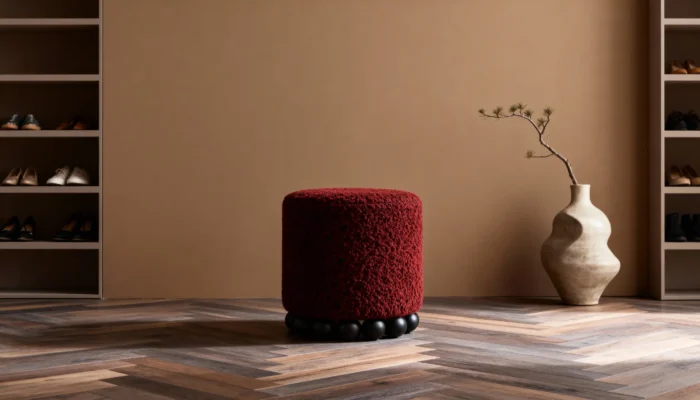
Color in the bedroom should be used more carefully than in the living room or showroom. Strong contrast is not always necessary here. Often the best result is a subtle combination of shades: milky, beige, sand, warm wood, muted burgundy, caramel, terracotta, olive, deep green, chocolate.
Pastel and light shades make a bedroom feel lighter. They work well if the room is built on natural light, soft curtains, a light bed and warm wood. Deep colors add intimacy: dark velour, burgundy chenille, green or chocolate textiles can create a more evening mood.
The art print in the bedroom should be balanced. If it is too active, the room will lose its silence. If it is too weak, the pouf will dissolve. In the images, the print works exactly like a soft rhythm: it repeats the smoothness of the arched mirror, the warm palette of the wood, and the wavy logic of the textiles.
Error → solution
Error: choosing a bright pouf just because the bedroom seems neutral.
Decision: choose a color or print that supports the plaid, wood, carpet, light, or shade of the walls.
Error: make all objects the same beige.
Decision: Add texture or a delicate print to keep the bedroom from becoming flat.
Error: perceive the pouf as a separate decor.
Decision: look at it as part of a scenario: bed – wardrobe – mirror – morning – evening.
How to choose the shape and height of a pouf for the bedroom
The shape of an ottoman affects how softly it fits into a bedroom. A round ottoman works well next to a dressing table, wardrobe or bed because it has no sharp corners and doesn’t look heavy. It easily interacts with a rug, an arched mirror, round lamps or smooth lines of furniture.
A rectangular ottoman or small stool works best at the foot of the bed. They create a horizontal line and can be a place to store a throw or clothes. But if space is limited, a round shape is often more flexible.
The height depends on the scenario:
| Place | What height is needed? | Why |
|---|---|---|
| By the dressing table | comfortable for sitting in front of the mirror | important morning ritual |
| By the bed | average or slightly lower | The pouf should not compete with the bed. |
| Near the wardrobe | convenient for changing shoes | short stable landing required |
| In the center of the soft zone | proportional to the carpet and furniture | important composition |
| In a small bedroom | compact | should not take away movement |
Selection formula:
THE RIGHT POUF = HEIGHT × SHAPE × FABRIC × PLACE
A pouf can be beautiful on its own, but wrong in a particular room. Therefore, it is better to choose it not as a standalone item, but as part of a route: from the bed to the mirror, from the wardrobe to the exit, from the evening blanket to the morning light.
Pouf as an accent: when a bedroom gets character without noise
The accent in the bedroom doesn’t have to be loud. It can be quiet but precise. A printed pouf is just that, if you choose the right palette.
In this interior, light walls, classic moldings, wood, a soft bed, and warm lighting create a very calm base. The pouf adds personality, not contrast for contrast’s sake. Its wavy print enlivens the space, and the wooden spherical base maintains the warmth of the furniture.
It is important that the pouf does not look “too functional”. In the bedroom this is critical. If the object resembles a stool or an office chair too much, it destroys the atmosphere. If it has a soft shape, tactile fabric, a thoughtful print and the right scale, it becomes part of the silence.
KAIZEN develops exactly this approach to upholstered furniture: form, fabric and art textiles should work together. More about this logic in the article “KAIZEN Furniture Factory: Art Textiles for Furniture”.
As Dieter Rams said: “Good design is as little design as possible.” For the bedroom, this means: one precise pouf is better than many random decorative details.
How to prepare for choosing a pouf for the bedroom
Before choosing an ottoman, you should look at the bedroom not as a set of furniture, but as a sequence of actions. Where you wake up. Where you leave the blanket. Where you choose your clothes. Where you look in the mirror. Where you want to sit down for at least a minute.
A short checklist:
- Determine the main place for the pouf: near the bed, dressing table or wardrobe.
- Check if it does not interfere with movement between zones.
- Choose a shape: round for softness, rectangular for horizontality.
- Coordinate the fabric with the bedding, throw, curtains, and rug.
- Choose a color: pastel for quiet or deeper for an accent.
- Decide if you need a print.
- Consider whether the pouf should be mobile or permanently located in one area.
You shouldn’t add an item to your bedroom just because “there’s room.” The pouf should support a ritual. That’s when it won’t be an extra detail, but a part of your daily comfort.
Where to see KAIZEN upholstered furniture
If you need a pouf that won’t look random in a bedroom, you should look not only at the finished shape, but also at the ability to choose the fabric, print, color, and overall character of the item.
IN KAIZEN store You can see upholstered furniture that is created around the idea of tactility, accent and customization. This is especially important for the bedroom: the object should correspond not only to the interior, but also to the morning and evening rhythm of a person.
The pouf can be light and almost invisible. It can be textured. It can have a delicate print. It can become an accent near the dressing table or a soft spot near the wardrobe. The main thing is that it does not argue with the bedroom, but helps it sound quieter and deeper.
Conclusion: an ottoman in the bedroom creates a state, not a function
The bedroom doesn’t need unnecessary objects. But it does need soft scenarios. Places to sit in front of the mirror. To put down a blanket. To leave clothes for the morning. To pause between the bed and the wardrobe. To stop in the evening, when the day is over.
This is what gives pouf in the bedroom. It doesn’t shout about its function, doesn’t take up a lot of space, and doesn’t turn a room into a furniture display. It works delicately: through shape, fabric, color, tactility, and proximity to daily rituals.
A pouf by the bed adds comfort. A pouf by the wardrobe adds pause. A pouf by the dressing table adds ritual. And the right material makes this small object part of the atmosphere.
In a bedroom, it’s not the amount of furniture that matters, it’s the feeling. Sometimes a single soft pouf can make a room feel more personal, peaceful, and complete.