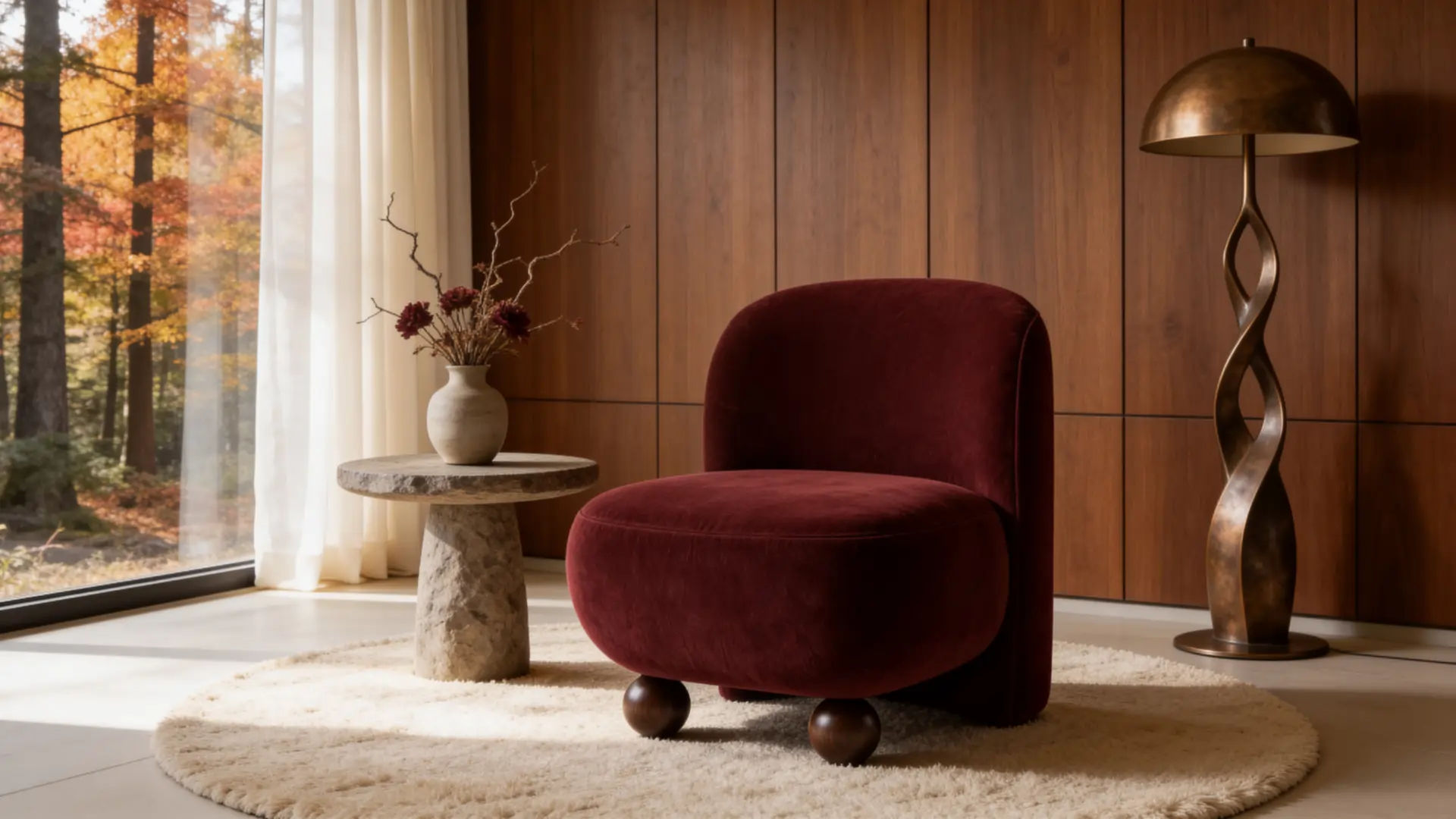
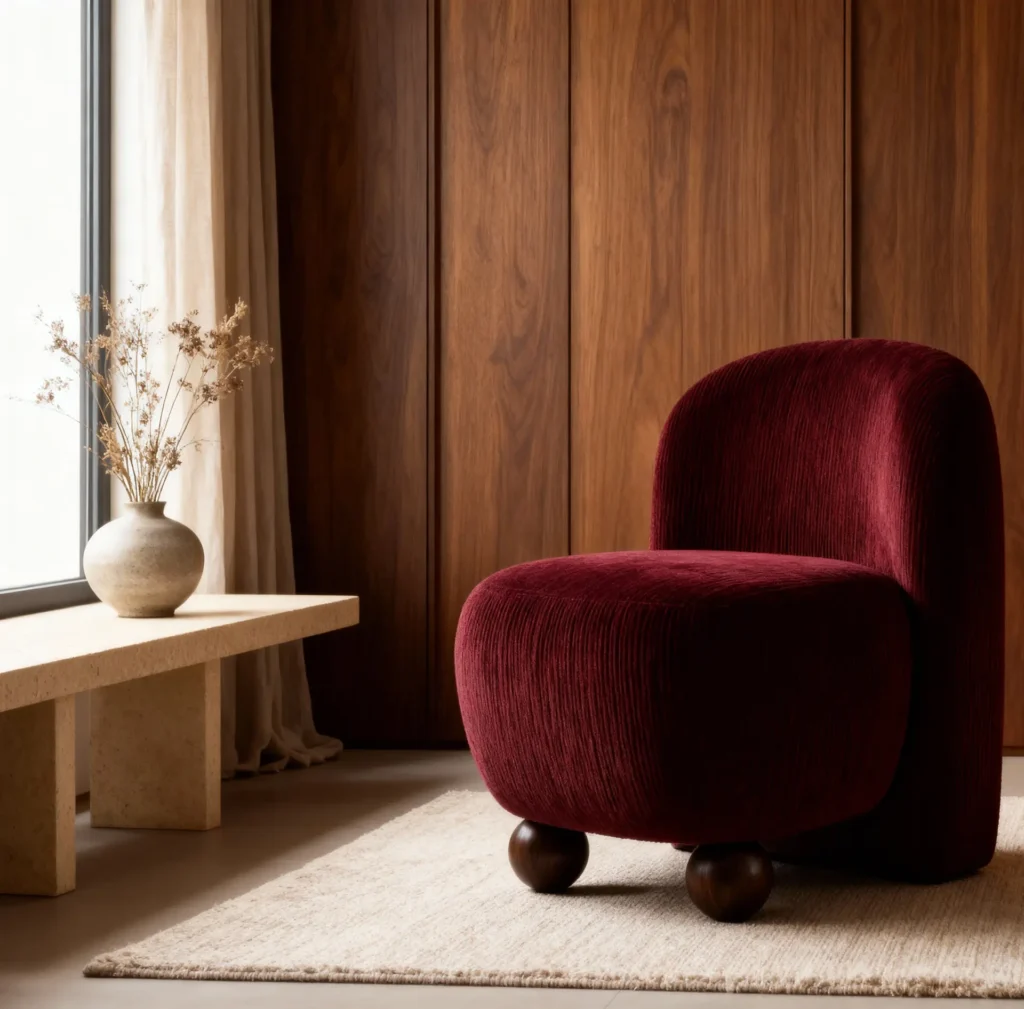
Light enters the room slowly. It passes through a light curtain, touches the wooden panels, falls on the light carpet and stops on a burgundy chair by the window. Nearby is a small table, a vase with dry branches, the silence of the morning or evening. In such a space, an upholstered chair is no longer perceived as just another place to sit. It becomes a point to which you want to return.
This is where the right choice begins. Not with color, not with size, and not even with shape. First, you should understand what role the chair should play in the home. It can be a place for reading, a private relaxation area, an accent in the living room, a soft object in the bedroom, or a design object that gathers the interior around itself.
For KAIZEN, a lounge chair is not just a random piece of furniture. It is an object with character, physical comfort and visual presence. Its shape should be soothing, its fabric should evoke a desire to touch, and its silhouette should work in the interior even when no one is using it.
Why a soft chair changes the feel of a home
Many interiors have a sofa, a table, a wardrobe, a bed, shelves, lighting. Everything is functional. Everything has its place. But often one item is missing that creates a personal zone. Not a common one, not a walk-through one, not “for everyone at once,” but a personal one.
An upholstered chair solves this problem very accurately. It does not require much space, but it can change the scenario of the room. In the living room, it creates a separate place for conversation or coffee. In the bedroom, it is a quiet corner for mornings and evenings. By the window, there is a zone for contemplation. Next to the floor lamp, there is a place for a book. In the dressing room, it is a practical and at the same time aesthetic object. In a spacious hall or lounge area, it is a soft pause between movement and action.
The main value of a chair is not that it “adds seating.” Its value is that it creates a separate ritual. To sit down with a coffee. To put down the phone. To read a few pages. To think. To recover from the day. To talk to someone not at a table, but in a softer, more relaxed format.
That’s why a designer chair often becomes a favorite item in the home. It’s not just about comfort, but also about the feeling: you can slow down a bit here.
Shape: why rounded chairs are perceived as softer
Modern upholstered chairs are increasingly moving away from rigid straight lines. Radius shapes, voluminous seats, rounded backs, and sculptural silhouettes are appearing in space. This is not just a visual trend. Such shapes interact with the body and space in a different way.
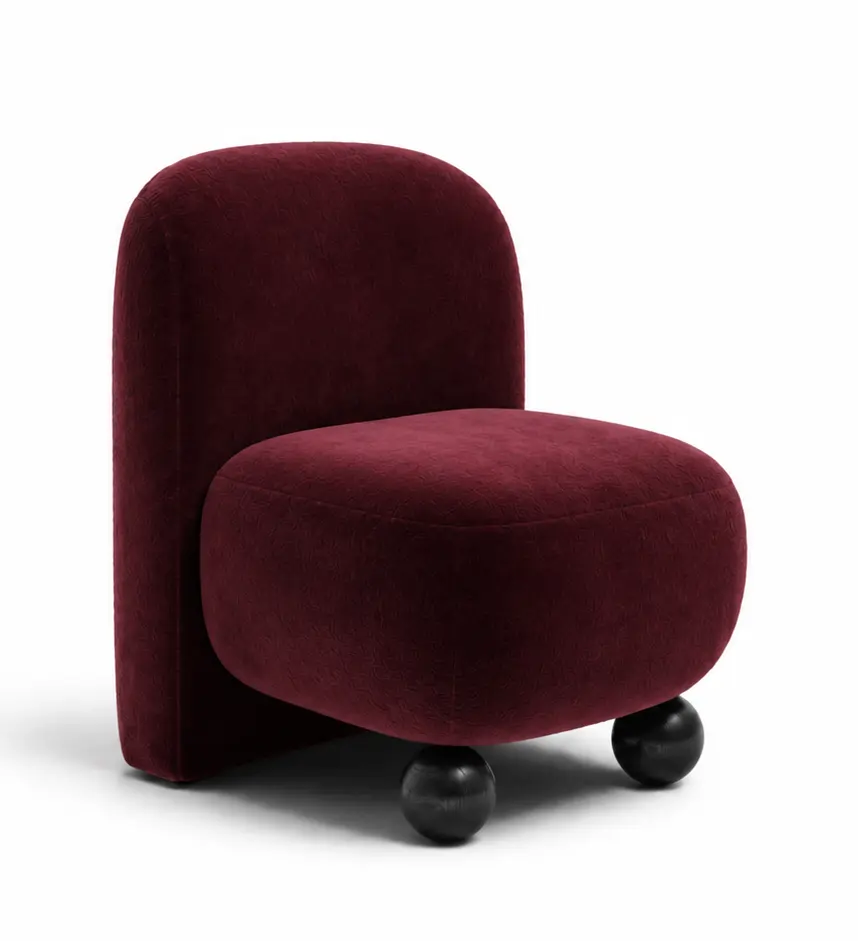
The chair in the photo has a rounded vertical back, a soft, voluminous seat, and spherical legs. It does not have sharp geometry that creates tension. On the contrary, the shape seems to smooth out the room, making it calmer, warmer, more tactile.
The rounded back acts as a soft visual support. It doesn’t overwhelm the space, but it gives the object a distinct silhouette. The voluminous seat creates a sense of invitation: you want to sit in such a chair, not just look at it. The ball-shaped legs add substance and a bit of playfulness, thanks to which the chair doesn’t look heavy, even if it has a rich dark color.
In a good chair, the shape works on two levels at once:
for the body — support, softness, comfortable fit;
for interior — silhouette, proportion, rhythm, character.
Therefore, you shouldn’t choose an upholstered chair just based on the principle of “I like the color.” It’s important to look at the entire plasticity of the object: how the seat transitions into the backrest, how the chair stands on the floor, whether it has visual balance, and whether it looks random next to other furniture.
Lounge chair: what true comfort means
A lounge chair doesn’t have to be big, deep, or overly soft. Often, comfort comes not from size, but from balance. The body should feel supported, but not stiff. The seat should be soft, but not sinking. The back should support, but not slouching.
In the home scenario, this is especially important. A chair is not used for five minutes in a showroom, but every day: in the morning, after work, on weekends, while reading or talking. If the fit is uncomfortable, even the most beautiful object quickly turns into decoration. If comfort is thought out, the chair becomes a part of life.
A good upholstered chair should give the feeling that the shoulders can drop, the back can relax, and the body can’t constantly search for the “right” position. That’s why rounded shapes, soft volumes, and tactile fabrics work so well in relaxation areas.
The formula for a successful chair for the home:
soft shape + correct fit + pleasant fabric + appropriate color + clear script
If even one element is missing, the item may look beautiful, but not become a favorite. And the task of KAIZEN is to create not just photogenic furniture, but things that you want to return to.
Where to put an armchair at home
The same chair can work differently in different rooms, which is why it’s important to think not only about the model but also about the future location before making a choice.
| Where is the chair? | What role does it play? | What is important to consider |
|---|---|---|
| In the living room | Additional seating area, conversation, composition with sofa | Distance to the table, carpet, floor lamp, balance with the sofa |
| In the bedroom | Private corner for morning, evening, reading | Softness of fabric, roomy color, proximity to window or bed |
| By the window | A place for contemplation, coffee, and pauses | Natural light, view, small table nearby |
| In the office | Informal area for reading or conversation | Discreet color, gathered shape, comfortable fit |
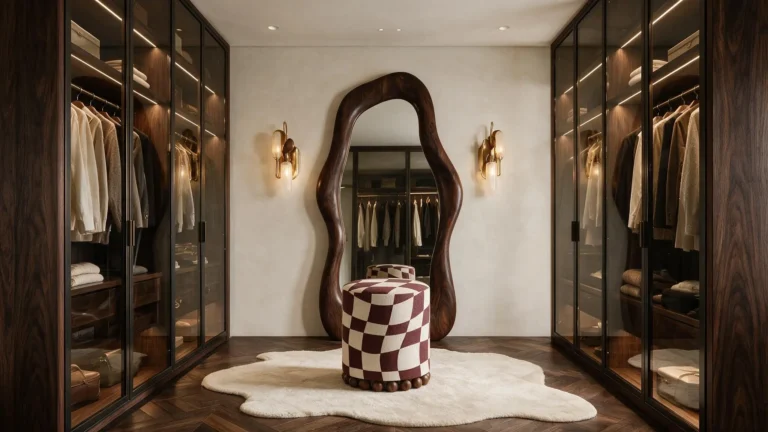
| In the dressing room | Practical and decorative item | Compactness, fabric that matches interior materials |
| In the lounge area | Soft waiting or recovery area | Fabric durability, expressive silhouette, easy care |
A living room armchair usually works as part of an overall composition. It can be placed next to a sofa, a coffee table, a fireplace, a floor lamp or a bookshelf. In this case, it should not argue with the sofa, but create additional rhythm.
A bedroom chair has a different character. It’s more personal. It doesn’t have to be very contrasting—sometimes a deep, calm shade, textured fabric, and soft silhouette work better. It can be the place where the day begins: with coffee, silence, plans. Or the place where the day ends.
A reading chair requires an even more precise scenario. The light, the position of the body, the distance to the table, the ability to put a book or a cup nearby are important here. Such a chair should not be random. It should create a small system around itself.
Fabric: velour, boucle, chenille, matting
Fabric not only determines the look but also the feel of a chair. The same silhouette can sound completely different depending on the material.
A velour chair looks deeper, softer, more saturated. Velour or velvet texture works well with color: burgundy, terracotta, graphite, olive, cream or blue in this design become more complex and expressive. Velour is especially appropriate where you want intimacy, warmth and a little dramatic depth.
A boucle armchair creates a different effect. Boucle is associated with a soft, voluminous texture, light, comfort, and a modern, calm interior. It works well in bedrooms, living rooms, lounge areas, Japanese, minimalist, contemporary, or soft modern spaces.
Chenille gives a feeling of density and home comfort. It can be very successful for a lounge chair, if you want softness, but without too much shine. Mat sounds more restrained, more structured, a little more architectural. It is well suited for modern interiors, where texture is important, but excessive decorativeness is not needed.
It is better to start choosing a fabric not with the question “what is fashionable?”, but with the question “what mood does the space need?”.
Velour — depth, softness, expressiveness.
Boucle — comfort, light texture, relevant volume.
Chenille — density, comfort, calm tactility.
Basket — structure, restraint, modern simplicity.
For KAIZEN, fabric is not a secondary detail. It is the language the chair speaks to the space.
Color and Character: Why a Burgundy Chair Works So Well
The burgundy soft chair in the photo has a special power. It is not bright in the literal sense, but deep. This color does not scream, does not stand out from the interior, does not look random. It adds warmth, maturity and character to the space.
In combination with wooden panels, burgundy becomes even deeper. With a light carpet, it becomes softer. Next to stone, it becomes more noble. Next to a large window, it becomes more lively, because natural light constantly changes its shade throughout the day.
This is how a designer chair works: it doesn’t just “have color,” but enters into a dialogue with the entire interior. Wood, textiles, light, flooring, decor, plants, metal, stone — everything affects how the object is perceived.
If the interior is very neutral, a chair can become a point of character. If the space is already saturated, a chair can support one of the existing palettes. If the room seems cold, an upholstered chair in a warm shade can help make it more human. If depth is lacking, a dark velour or a thick textured fabric can add just the layer that was missing.
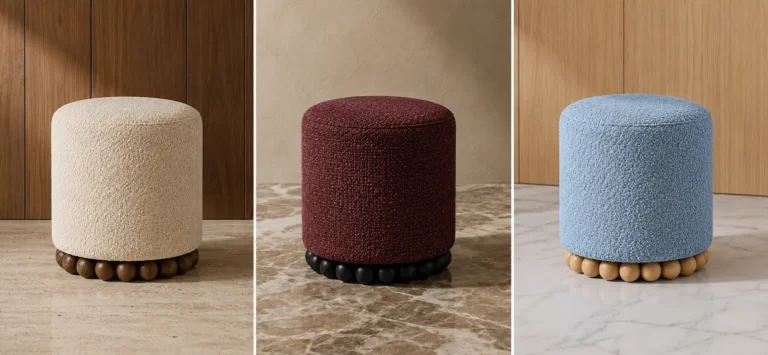
Printed armchair: when you want more individuality
Not every interior needs a print. But when a space lacks a personal touch, a printed chair can be a very accurate solution. Especially if it is not a random ornament, but a visual motif that reflects the character of a person or the concept of a space.
In KAIZEN, print can work as an extension of the idea of furniture. It can be graphic, soft, natural, expressive, minimalist or almost art object. Thanks to this, the chair ceases to be just upholstery on a form. It becomes a personal object.
A printed chair is appropriate when:
- the interior needs a focal point;
- want to add character without completely updating the room;
- the designer creates a personal accent for the client;
- the space should support a certain mood or brand;
- a monochromatic solution seems too calm;
- you need to combine several interior colors in one item.
In hub logic, this is an important direction: first a person looks for a soft chair or a lounge chair, and then realizes that they can choose not only the shape, but also the character. This is where personalization begins.
How to choose an upholstered chair: a practical route
To make a successful choice, you should go not from the catalog to the price, but from the script to the item.
1. Determine the location
A living room chair, a bedroom chair, and a reading chair can have a similar shape but different roles. In the living room, composition is important. In the bedroom, intimacy. For reading, light, seating, and comfort next to a table are important.
2. Understand the scenario
What exactly do you need an armchair for: reading, drinking coffee, relaxing after a day, creating an accent, complementing a sofa, decorating a corner by the window, creating a lounge area? The more precise the scenario, the easier it is to choose the fabric, color, and shape.
3. Evaluate the proportions
A soft chair shouldn’t get lost in the room, but it shouldn’t overwhelm it either. A compact, rounded shape often works better than a chunky one, especially if the space already has a sofa, table, sideboards, or lots of decor.
4. Choose a fabric that feels right
Not just for color, but for tactility. Velour, boucle, chenille, and matting provide different experiences. A chair is an object that is touched every day, so the fabric should look good not only in the photo.
5. Decide if you need a print
A solid color chair can be deep and expressive. But if you want a personal touch, a print opens up more possibilities. It can make an item bolder, more graphic, or more emotional.
6. Think about the future composition
A chair rarely exists on its own. Nearby there can be a floor lamp, a rug, a table, a painting, curtains, a sofa, a window. A good choice is when the chair is not just beautiful on its own, but enhances the entire space.
Common mistakes when choosing a chair
Error: Choose a chair based on the photo alone.
Decision: Think about the real scenario: where it will be located, how it will be used, what kind of lighting will be nearby.
Error: be afraid of saturated color.
Decision: Look not only at brightness, but at depth. Burgundy, olive, terracotta or graphite can be very calming if properly incorporated into the interior.
Error: buy “neutral so you don’t get bored.”
Decision: Choose not impersonality, but precise character. It is a well-thought-out item that often remains a favorite for a long time.
Error: disregard the fabric.
Decision: choose the material to the touch, lighting, style of the room and frequency of use.
Error: perceive the chair as an addition to the sofa.
Decision: see it as an independent object that can create a separate area in the house.
What styles are modern KAIZEN upholstered chairs suitable for?
A rounded designer chair works well in a variety of interiors if you choose the right fabric, color, and mood.
In minimalism, it softens the space and prevents it from becoming cold. In contemporary, it adds sculpturality. In modern, it maintains clean lines but makes them more alive. In Japanese, it can work through a natural palette, boucle, chenille or warm neutral fabrics. In eclecticism, a chair can become an object that unites different colors, textures and moods. In more classic modern interiors, a deep velor or burgundy fabric adds a sense of intimacy and status without excessive decorativeness.
That’s why an upholstered chair shouldn’t be seen as a narrow trend. If the shape is balanced and the fabric is carefully selected, the item can live in the interior for a long time.
Soft chair as part of the KAIZEN system
In KAIZEN, it is important not to just create a beautiful piece. It is important that the furniture works with the person, the space and the mood. A chair can resonate with a sofa, a banquette, textiles, a rug, wood, light or an art print. It can be calm or bold, plain or printed, homey or more gallery-like.
For interior designers, such a chair is a convenient tool. It can become a client’s personal accent, a point of color, a soft sculpture, an object by the window, an element of the lounge area or a detail that completes the composition. For the homeowner, it is a place that gradually becomes their own.
In the future cluster structure, a hub article about a lounge chair could lead to separate articles about a living room chair, a bedroom chair, a reading chair, a designer chair, fabrics, prints, and a custom chair. This way, the user can move from a general choice to a specific scenario.
Conclusion
An armchair is not a small detail of the interior. It can change the way a person uses a room. Create a place to pause. Add character. Soften the architecture. Gather around you a light, a rug, a table, a book, a cup of coffee and a few minutes of silence.
A properly chosen lounge chair doesn’t just sit in your home. It works every day: with its body, shape, color, fabric, and mood. And if you want this item to be not just a random item, but truly yours, you should start with the main question: not “which chair should I buy?” but “what feeling do I want to have in my space?”
At KAIZEN, you can choose a soft designer chair to suit your specific interior, scenario and character: in velour, boucle, chenille, matting, in a plain design or with an art print. This way, the chair becomes not just furniture, but a personal resting place – the very object you want to return to.