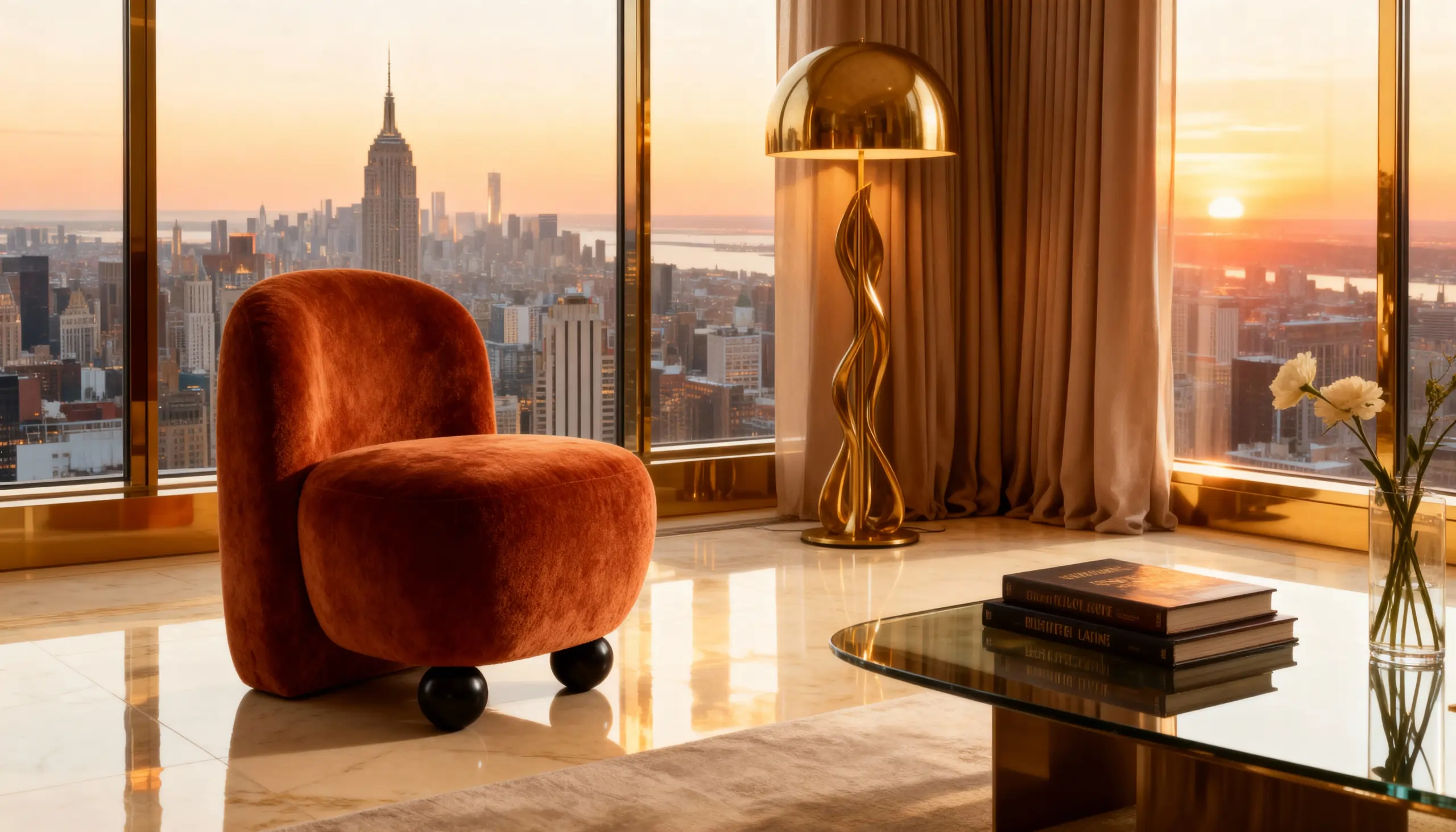
There is a moment in the living room when the space ceases to be just a room. Books lie on the glass table, flowers stand in a vase, the city behind the panoramic window slowly sinks into the golden light of the evening. The sofa may remain the main functional area, but the eye still stops at the armchair – terracotta, rounded, soft, with spherical legs and a silhouette that does not dissolve in the interior.
That’s how a living room chair works. It doesn’t just add another seat. It creates a separate scenario: to drink coffee, to have a leisurely chat, to put down the phone, to read a few pages, to look out the window, or simply to be in the room differently. Not in the center of the general movement, but a little off to the side – in your own soft zone.
At KAIZEN, an armchair in the living room is not a random object “for the sofa”. It is a separate form that can hold the composition, set the mood, soften the architecture and add character to the space. Especially when it comes to the OASIS armchair: sculptural, rounded, textured, with a feeling of soft volume and calm strength.
Why the living room chair has its own role
The living room usually gathers many scenarios. Here people receive guests, watch movies, drink coffee, read, talk, work with a laptop, relax after a day. But if the entire space is built only around the sofa, it often becomes too general. There is a place for everyone, but there is not always a place for one.
A living room chair solves this very problem. It creates a personal point within a shared room. On a sofa, a person is often part of the company. In a chair, they are part of their own rhythm. It is a subtle but important difference.
When an armchair stands by a panoramic window, it turns the view of the city or garden into a daily ritual. When there is a coffee table nearby, there is a place for coffee, a book, a glass of water, a magazine or a laptop. When there is a floor lamp nearby, an evening zone is born. When an armchair stands next to a sofa, the living room becomes more lively, because it does not have one large seating area, but a dialogue of forms.
That’s why an armchair shouldn’t be seen as a secondary item. In a well-designed living room, it can be the detail that makes the room complete.
OASIS: a chair that works as a soft sculpture
The OASIS chair has an expressive shape: a rounded back, a voluminous seat, soft lines, spherical legs. It has no sharp geometry or dry office verticality. This chair looks as if you want to not just sit in it, but immerse yourself in a short pause.
Its silhouette works well in a living room with different moods. In the first interior, a terracotta armchair stands by a panoramic window overlooking the city. Nearby is a glass table, books, flowers, a marble floor, soft curtains, a floor lamp with a sculptural base. Here, the armchair adds warmth and physicality to the space. It seems to balance the large city panorama: behind the glass is the scale, inside is a personal place.
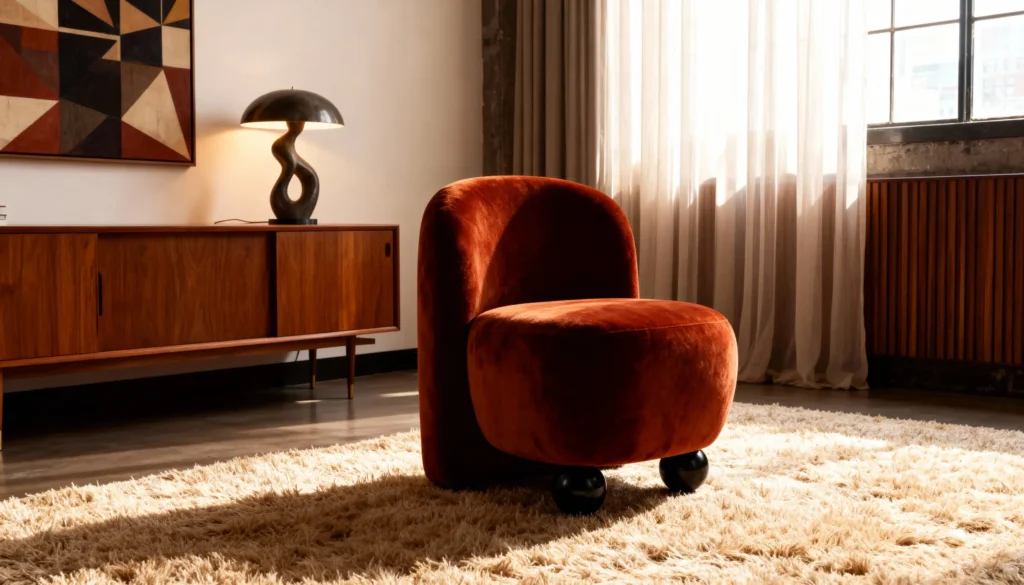
In the second interior, the armchair stands on a light carpet, next to a wooden cabinet, a lamp, a picture and curtains. Here it sounds more intimate. The terracotta color resonates with the wood, warm light and graphics on the wall. The living room becomes not just beautiful, but alive.
This is an important property of a designer chair: it does not behave the same in different spaces. Its character changes with the light, materials, carpet, table, view from the window, and even the time of day.
Where to put a living room chair
A living room chair works best when a scenario is created around it. Simply placing it in a “free corner” is not enough. You need to understand what exactly the person will be doing in that point of space.
| Place in the living room | What scenario creates | What to add next |
|---|---|---|
| Near the panoramic window | Coffee, contemplation, conversation, evening break | Small table, floor lamp, blanket |
| Next to the sofa | Dialogue area for guests and family | Coffee table, carpet, shared lighting |
| Near the bookshelf | Reading, silence, personal ritual | Lamp, table, book stand |
| In the corner near the floor lamp | Chamber space for relaxation | Soft light, carpet, textiles |
| By the coffee table | Coffee, conversation, short break | Books, decor, flowers, candle |
| Opposite the sofa | Balance of composition and ease of communication | Carpet, center table, second chair |
The strongest solutions usually arise where the chair has not only a place, but also a reason to be there. By the window – because there is light and a view. By the table – because there is coffee and a book. By the floor lamp – because it is evening. By the sofa – because there is conversation.
When this reason is understood, the chair doesn’t look random. It becomes part of the life of the room.
Window chair: your own point of contemplation
A panoramic window is a strong architectural element. But it doesn’t create space by itself. For a person to truly enjoy the view, there needs to be an object by the window that invites them to stop.
A lounge chair in the living room by the window works very naturally. It doesn’t block the space, but makes the view part of the daily experience. In the morning it could be coffee. In the evening it could be the city in warm light. In the afternoon it could be a few leisurely minutes between tasks.
In the photo with the city panorama, the OASIS is exactly like that: not in the center of the room, but in the center of attention. It does not compete with the view, but creates a point from which you want to live this view. A glass table with books next to it reinforces the scenario: this is not just a “window chair”, but a ready-made zone for a pause.
In such cases, it is important to consider the scale. The chair should not be so large that it covers the window, but it should not be lost in the panorama. A rounded silhouette and rich color help to find balance.
The armchair next to the sofa: not an application, but a dialogue
Most often, an armchair in a living room is placed next to a sofa. This is logical, but it is easy to make a mistake here: choose an armchair as a “smaller version” of the sofa. As a result, the composition becomes predictable and a little heavy.
It is much more interesting when the chair enters into a dialogue with the sofa. It can have a different shape, a different fabric, a different color or a different silhouette. The main thing is that there is not a random difference between the objects, but a thoughtful interaction.
For example, if the sofa is rectilinear and restrained, a rounded upholstered chair can soften the composition. If the sofa is neutral, the chair can take on the color. If the sofa is large and monolithic, a chair with ball legs will add a lighter, more objective rhythm.
This way, the living room becomes not just a set of furniture, but a stage for communication. People can sit not facing the TV, but facing each other. Conversation becomes more natural. The space becomes less formal.
Coffee table: a small detail that completes the scenario
A chair without a table often looks beautiful, but it doesn’t always work comfortably. In the living room, a surface is almost always needed next to the chair: for a cup, a book, a phone, glasses, a vase, a candle, a magazine or a glass of water.
In the first photo, a glass table with books completes the composition. It doesn’t draw attention, but it explains how to use this area. Here you can sit, take a book, put down coffee, have a conversation, or just look out the window.
Different types of tables work well for the OASIS chair:
- glass – if you want lightness and reflection of light;
- wooden – if you need to add warmth;
- stone – if the interior needs more texture;
- metal – if the space is modern and graphic;
- a small sideboard – if there is not much space.
It is important that the table is at a comfortable distance. If you have to reach for it, the scenario falls apart. If it is too big, the chair loses the feeling of its own zone. In the living room, there is always a balance between beauty and the gesture of use.
Floor lamp and light: how to turn an armchair into an evening spot
Light can completely change the perception of a chair. During the day, it lives in natural light, reflecting color, showing texture, interacting with windows. In the evening, local light takes on the main role.
A floor lamp near the armchair creates a sense of a completed zone. It is a signal: here you can sit in the evening, read, talk, drink tea, stay in the semi-darkness. In a living room, where there is only general overhead light, there will be no such effect.
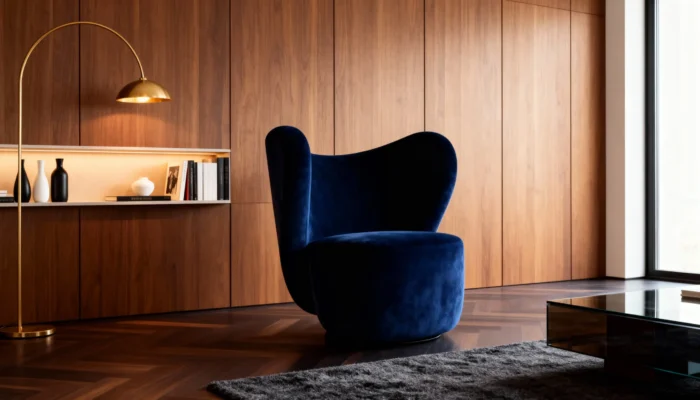
In the photo, the floor lamp works not only functionally, but also sculpturally. Its shape echoes the plasticity of the chair. Together, they create not just an illuminated point, but a vertical composition: the chair as a soft volume, the floor lamp as a light sculpture.
Warm light works especially well for a soft chair in the living room. It highlights the fabric, makes the color deeper, removes excess coldness and helps the body switch from the daily rhythm to rest mode.
Armchair and bookshelf: a living room for a quiet ritual
A living room chair can easily become a reading chair if there is a book, light and silence nearby. It is not necessary to create a separate library. A shelf, a rack, a small stack of books on a coffee table or even a single magazine that you want to leaf through is enough.
If the main scenario is reading, it is worth considering the fit and location even more precisely. The chair should not have its back to strong light, if in the evening it creates discomfort. There should be a lamp nearby. The table should be close enough. The fabric should be pleasant not only to the eye, but also to the hands.
You can read more about this in a separate KAIZEN article about reading chair, where the scenario of a book, coffee, blanket, light, and comfortable seating is analyzed.
In the living room, such an area is especially valuable. It allows you to read without being completely isolated from the house. A person remains in the common space, but has his own soft spot.
Materials and construction: why comfort starts inside
On the outside, a living room chair is perceived through its shape, color, and fabric. But everyday comfort depends on how it’s made on the inside. It’s the design that determines whether the seat will be stable, whether it will feel soft by accident, and whether the chair will withstand regular use.
The OASIS chair uses a frame made of furniture plywood. The seat base is built on furniture belts, which add elasticity. The filling combines EL2842 polyurethane foam, highly elastic HR 35-35 polyurethane foam and synthetic winterizer. This structure allows you to get a balance between soft first contact and internal support.
This is important for the living room. An armchair can be used every day: for coffee, conversation, reading, waiting, relaxing after work. If it is too soft and slouchy, the body quickly gets tired. If it is too hard, the feeling of relaxation disappears. A good upholstered armchair should support, not just “be fluffy”.
The upholstery fabric can be different: velor, matting, chenille, boucle, eco-leather. This opens up the opportunity to adapt the chair to a specific interior: from a soft home scenario to a more expressive lounge space.
Fabric and color: how to choose an upholstered chair for the living room
The terracotta armchair in the photo shows well how color can change a room. It is warm, deep, noticeable, but not loud. In an urban interior with panoramic windows, it adds humanity and warmth. In a living room with wood, carpet and evening light, it enhances intimacy.
For a living room chair, the color should work not in isolation, but in conjunction with the surrounding materials. It is important to look at what is already in the room: wood, stone, glass, metal, curtains, carpet, sofa, paintings, lamps.
If the living room is neutral, the chair can take on the accent. If the interior is saturated, it is better to choose a calmer fabric, but leave the expressive shape. If the space lacks warmth, terracotta, burgundy, caramel, olive or sand shades will help. If you need more graphics, you can work with dark fabrics, contrasting legs or a print.
An upholstered chair in the living room shouldn’t just be “in tune.” It should support the mood of the room or deliberately create a new layer.
Customization: when the chair adapts to the space
One of the important advantages of KAIZEN is the possibility of adaptation. The OASIS armchair can be selected by textile, art print and size. This is especially valuable for the living room, where the armchair must interact precisely with the sofa, carpet, curtains, coffee table, lighting and overall palette.
Customization is needed not only when you want something very bold. On the contrary, it often helps to make an object more precise and calm. For example, match the fabric to the wood in the interior. Match the color with the painting. Repeat the warm tone of the curtains. Add an art print that will support the mood of the space. Or create an armchair that will become a personal accent for the designer’s client.
There is a short thought in the kaizen philosophy: “Kaizen is continuous improvement”. In the furniture industry, this can be read very practically: not to make an object random, but to refine its shape, fit, fabric, color, proportions, and usage scenario step by step. This way, furniture ceases to be just a commodity and becomes a precise solution for a specific life.
Lounge chair for the living room: how to understand that the choice is a good one
A good chair doesn’t just look pretty in the photo. It changes behavior in the room. If after its appearance a person sits by the window more often, picks up a book more often, drinks coffee more often not in the kitchen, but in the living room, talks more often without rushing – it means that the item is working.
You can check the choice through several questions:
- Is it clear what this particular chair in the living room is for?
- Is there a table, light, or other scenario element nearby?
- Doesn’t the chair look random next to the sofa?
- Does the fabric support the overall mood of the room?
- Is the landing comfortable for real relaxation?
- Do you want to sit in this chair, not just look at it?
- Does it add character to the interior?
- Can it remain relevant after a change in decor?
If the answers are mostly “yes,” the chair has truly become part of the space, not just an object in it.
How a living room chair relates to other KAIZEN materials
If you need to look at the topic more broadly, you should start with the hub article about soft chair for relaxation. It explains how an upholstered chair works in different rooms and why it creates a personal pause zone.
If you plan to have a place in your living room for a book, coffee, and silence, this article will be useful. reading chair. It will help you better think about lighting, seating, table, and comfort for your shoulders, back, and arms.
If the emphasis is on the aesthetics, form and role of the object in the interior, go to the material about designer chair as a character of the interior. There, the chair is seen as a soft sculpture, an art object, and a personal sign in space.
Current models can be viewed in the category KAIZEN armchair, and new interior images — in Instagram KAIZEN.
Conclusion
A living room armchair is not just a piece of furniture that you put next to a sofa. It is a separate area for relaxation, coffee, conversation, a book, evening light and a short break in the middle of the day. It can stand by a panoramic window, by a coffee table, next to a floor lamp, opposite a sofa or by a bookshelf. In each case, the main thing is not the place itself, but the scenario that the armchair creates.
OASIS shows how an upholstered chair can be comfortable, sculptural and distinctive at the same time. Its rounded shape softens the space, the terracotta color adds warmth, the textured fabric creates tactility, and the possibility of customization allows you to tailor the piece to a specific living room.
At KAIZEN, you can choose an upholstered chair for your living room not as a random purchase, but as a thoughtful element of the interior: with the right fabric, color, shape, mood, and role. So that there is a place in your home where you want to sit not because there is nowhere else, but because that is where you feel the pause best.