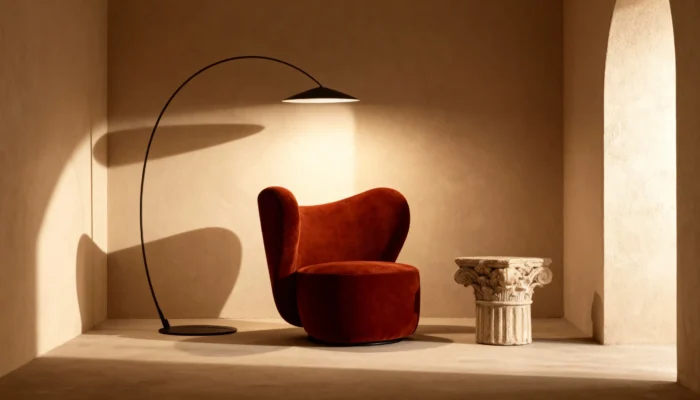
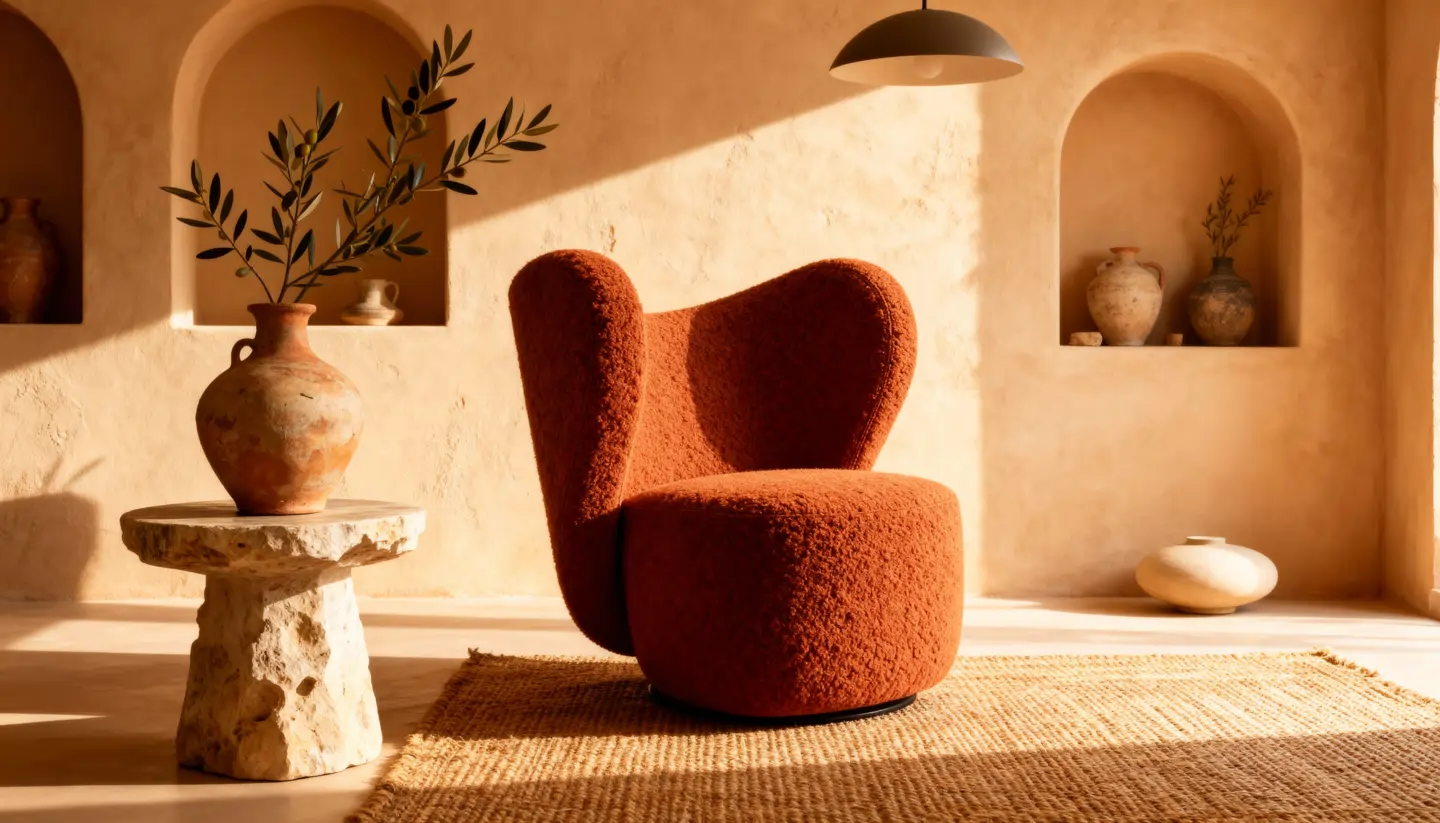
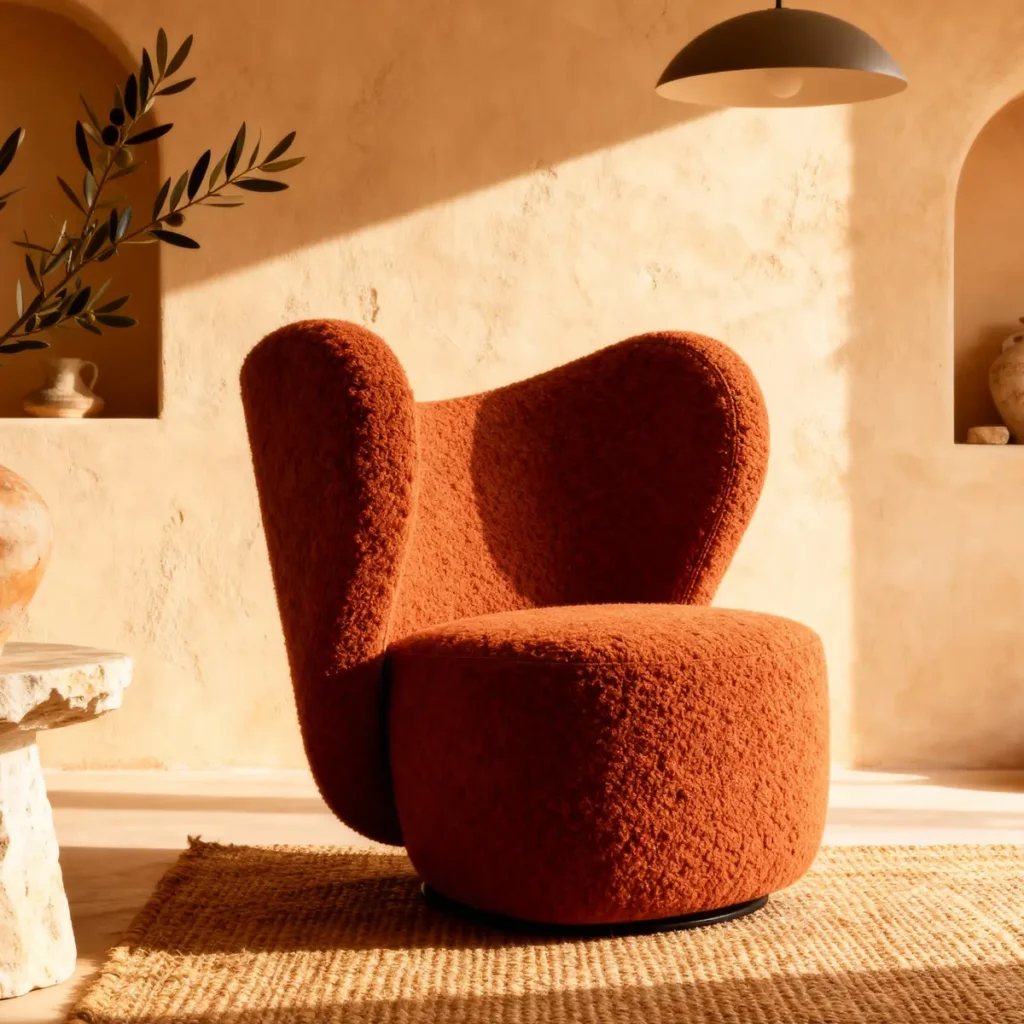
In a warm room, where the light falls on the textured wall in a large soft rectangle, there is a terracotta armchair. Nearby is a stone table, a vase with olive branches, arched niches, a woven rug, a quiet geometry of shadows. In such an interior, furniture does not simply perform a function. It becomes part of the atmosphere, almost the language of the space.
That’s how a designer chair works. It’s not limited to just being a place to sit. It can change the tone of a room, add depth, make a space warmer, softer, bolder, or more personal. Sometimes all it takes is one piece to take an interior from being simply beautiful to having character.
At KAIZEN, the chair is perceived as a separate form of life in the interior. It is a soft object, but at the same time a sculpture. It is a comfortable place to relax, but at the same time a visual accent. It is furniture for everyday use, but at the same time a personal sign: about the taste, mood, style and inner rhythm of a person.
What makes a chair designer?
A designer chair differs from an ordinary one not in price or a loud name. It is distinguished by its design. It has a logic of form, proportions, fabric, color, fit, and visual role. Each detail works not separately, but in a single composition.
A regular chair is often chosen based on the principle of “matching size and color.” A designer chair is chosen differently: it should match not only the dimensions, but also the character of the space. It can support the architecture of the room, soften strict lines, create a focal point, emphasize style, or vice versa — give the interior an unexpected lively impulse.
This is clearly visible in the chair in the photo. The shape does not try to be neutral. The backrest has a sculptural silhouette, similar to soft wings. The seat looks voluminous and stable. The terracotta color resonates with the warm walls, ceramics, natural stone texture and woven carpet. The object is not in the room by chance – it seems to be born from its materials, light and mood.
That’s why a designer chair cannot be evaluated only as “soft” or “beautiful.” It must be read as part of the interior.
The chair as the character of space
There are interiors that look right, but are not memorable. They may have quality flooring, beautiful walls, an expensive kitchen, thoughtful lighting, but there is no object that captures emotion. Everything is neat, everything is calm, everything is unmistakable – and that is why it is a little faceless.
A designer chair can change that without a major renovation. It works as a concentrated gesture. Not necessarily bright. Not necessarily contrasting. But precise.
In a warm Mediterranean interior, a terracotta armchair sounds like a continuation of the sun, clay, stone, ceramics and dry natural shades. In a minimalist space, such a shape could add softness and physicality. In a contemporary interior, it could become a sculptural accent. In a bright bedroom, it could create a private corner. In a living room, it could take on the role of the main object around which the composition is built.
In this sense, an interior chair is not just furniture for a room. It is an object that works with mood. It can say more about a space than the decor on the walls.
Interior character = architecture + light + materials + one strong object
Often, a chair becomes such an object.
Sculptural: when the form speaks for itself
Modern upholstered chairs increasingly resemble soft sculptures rather than furniture in the classical sense. They lack dry linearity, sharp angles, or excessive technicality. They work through radius, volume, fluidity, tactility, and a sense of invitation.
The chair in the photo has an expressive back that seems to hug the seat from two sides. Its shape is not just decorative. It creates a feeling of security, intimacy, soft privacy. You want to put such a chair not in the passage, but in a place where you can stop: at the table, in the reading area, next to the window, in the living room, in the bedroom or in a separate lounge area.
Sculpturality is also important because a chair lives in the interior even when no one uses it. A sofa is often perceived as a large functional surface. A table is the center of action. A wardrobe is an architectural volume. And a chair has the unique ability to be almost a portrait object. It has a “face.”
That’s why an art object chair doesn’t have to be extravagant. It can be calm, textured, warm, monochrome. The main thing is that it has expressive plasticity, not a random shape.
Fabric as the language of touch
A designer chair cannot be separated from its fabric. The shape gives the silhouette, but the fabric gives the feel. It is the fabric that determines whether the object will sound soft, deep, graphic, warm, restrained or bold.
The textured terracotta upholstery in the photo works very physically. It is not smooth and cold, but alive, voluminous, with a noticeable surface. Such a fabric enters into a dialogue with the textured wall, woven carpet, stone table and ceramics. All materials seem to speak the same language: warmth, earth, sun, hand-made texture, natural imperfection.
That is why the choice of fabric should not be reduced to the question “which is more practical?” Practicality is important, but for a designer chair it is not enough. The material should match the mood of the space.
Velour gives depth and a soft sheen. Bouclé – volume, coziness and a contemporary tactility. Chenille – density and calm comfort. Mat – structure and restraint. Printed fabric can add even more personality to an item.
If you need a chair for a calm interior, you can work with a texture without strong contrast. If the space lacks energy, you should look towards a rich color or an art print. If the interior already has a lot of details, the chair can be softer and simpler, but with an expressive shape.
Color: not decor, but emotion
The terracotta color in this chair is not accidental. It creates a feeling of warmth, earth, sun, clay, southern air. In a space with arches, ceramics and soft plaster, it looks natural, as if continuing the architecture.
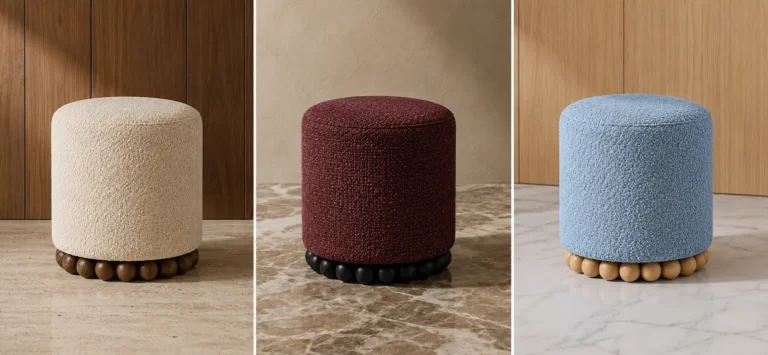
Color in a designer chair works not as decoration, but as an emotional code. Burgundy can add depth and intimacy. Cream – light and silence. Olive – naturalness. Graphite – collectedness. Blue – coolness and intelligence. Terracotta – warmth and lively energy.
The mistake of many interiors is that they choose the color of the furniture too carefully. Everything should be “neutral”, “so as not to get bored”, “so that it matches everything”. But when every object is neutral, the space often loses its individuality. It can be high-quality, but not have its own voice.
A designer chair allows you to add color in a spot. It’s not a wall that’s hard to repaint. It’s not a big sofa that takes up half the room. A chair is a more compact but very impactful piece. It allows you to introduce character without overloading.
Personality: a chair that reflects the person
In KAIZEN, it is important that furniture is not faceless. Modern interior design is less and less like a set of “right” things from a catalog. It should speak about a person, their rhythm, habits, taste, and inner state.
A designer chair is a great fit for this role. It’s bold enough to convey character, but not so big that it dictates everything. It can be made understated or bold. Solid or printed. Textured or smoother. Light or deep. Chambery or almost gallery-like.
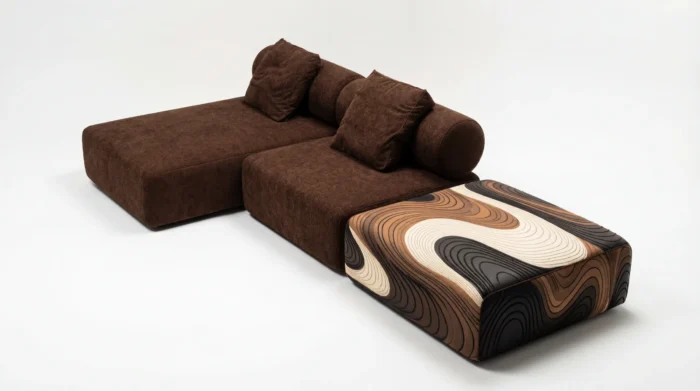
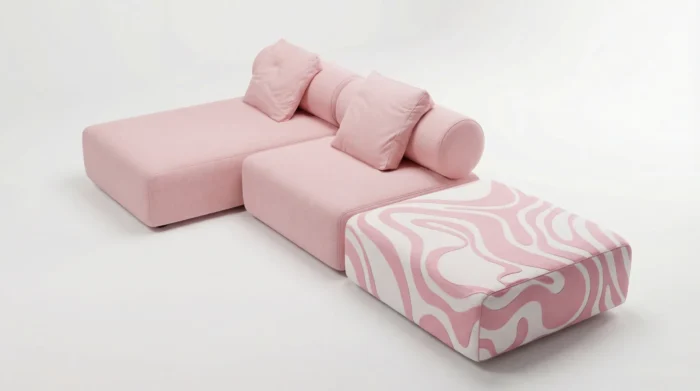
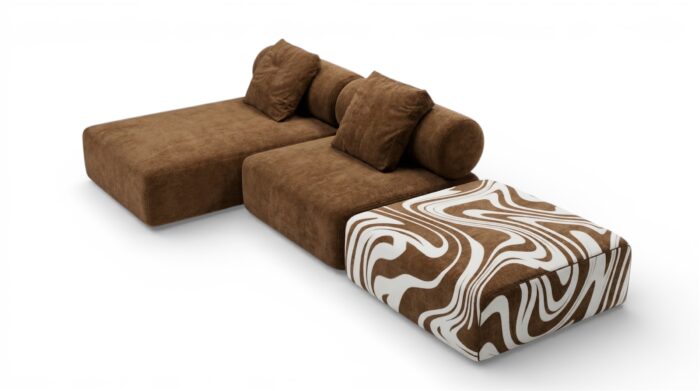
This is where the theme of personalization comes in. An armchair can be not just chosen, but customized to fit the space. Fabric, color, texture, art print, overall mood — all this allows you to make the object closer to the person or to the interior concept.
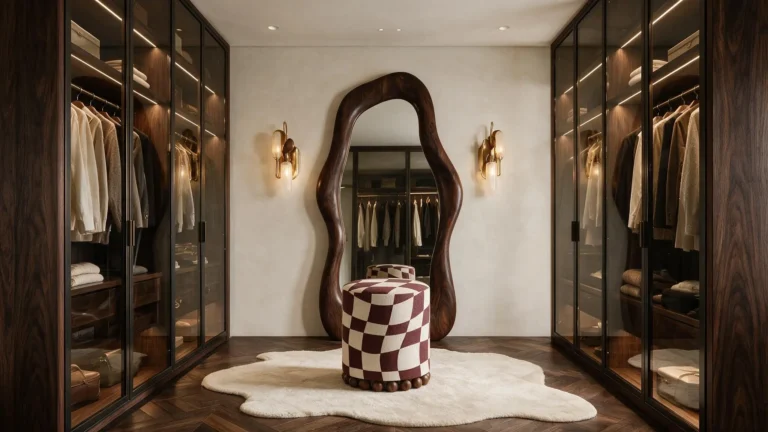
If you want a deeper personality, you can look towards a printed chair. The print can be graphic, natural, abstract, expressive or very delicate. It can reflect the owner’s character, support the palette of the room or become the emotional center of the design.
In this case, an art chair is not a strange thing “for the brave.” It is furniture that has its own language.
The chair as an art object: where is the line between furniture and art?
An art object chair does not cease to be functional. This is its strength. It should be comfortable, soft, and thoughtful for the body. But at the same time, it can carry an aesthetic idea: through shape, fabric, color, proportions, print, silhouette.
In a gallery, an object can simply be contemplated. In a home, an object must also live. A designer chair combines these two worlds. It is used every day, but at the same time it forms the impression of the room.
This chair is appropriate in various scenarios:
| Scenario | How a designer chair works |
|---|---|
| Living room | Creates a focal point and complements the sofa group |
| Bedroom | Forms a private corner for silence, reading or morning |
| Office | Adds softness to the workspace without the office dryness |
| Lounge area | Works as a subject of relaxation and visual impression |
| Showroom | Conveys the character of the brand through form and material |
| House near nature | Strengthens the interior’s connection to the landscape, light and textures |
It’s important not to overdo it here. An art object in a home interior shouldn’t constantly demand attention. It should be strong enough to be memorable, and natural enough to make you want to live with it.
How not to make a mistake with a designer chair
A designer chair should be beautiful, but that’s not enough. It should correspond to the real space, the scenario, and the person.
Error: choose a chair only as a “showpiece”.
Decision: evaluate fit, scale, fabric, light, and placement in the room.
Error: to be afraid of expressive form.
Decision: Remember that a sculptural form can be very soft and peaceful if the color is chosen correctly.
Error: take a neutral chair without character “so that it matches everything”.
Decision: Look for precision, not impersonality. A chair should not match everything, but your space.
Error: do not take into account the texture of the fabric.
Decision: to look at the material as part of the design, not as a technical upholstery.
Error: to place a chair randomly.
Decision: create a scene around it: a rug, a table, a light, a plant, a book, a blanket, or another object that supports the scenario.
How to choose a designer chair for your home
It’s worth starting not with a catalog, but with the question: what emotion should the space give?
If you want more peace, you should look at soft rounded shapes, light fabrics, boucle, chenille, natural shades. If you want depth, rich colors, velor, terracotta, burgundy, graphite, complex dark fabrics will suit you. If you need a visual accent, you can choose a chair with a print or a sculptural back. If the space should be very personal, you should think about customization.
For a practical choice, you can take a short route:
- Determine the location: living room, bedroom, office, window area, lounge area.
- Understand the scenario: reading, coffee, rest, conversation, waiting, pause.
- Assess the scale of the room and the visual weight of the chair.
- Choose a shape: discreet, rounded, sculptural, enveloping.
- Choose a fabric to suit your touch and mood.
- Decide if you need a print.
- Think about what will be nearby: a table, a floor lamp, a carpet, plants, decor.
- Check whether you want to return your gaze to this object.
The last point is especially important. A designer chair should appeal not only on the day of purchase. It should withstand everyday life: morning light, evening fatigue, changing seasons, new details in the interior, the habit of sitting right there.
How to combine a designer chair with other cluster items
If you are just starting to make a choice, it is worth taking a broader look at the topic first. soft chair for relaxation. It breaks down how a chair works in the home, what scenarios it can cover, and why softness is not just about fit, but also about atmosphere.
If you need a chair specifically for a book, coffee, a blanket, and silence, it makes sense to move on to the material about reading chair. It emphasizes comfort for the shoulders, back, arms, posture, and proper placement near the light.
If you want to look at the topic from a more commercial perspective, you can open the previous material “Designer armchair – an accent for a modern interior”. It complements this article well in terms of choice, purchase, and the role of the chair as a prominent object in a modern space.
And to view current models, you should go to the category KAIZEN armchair or follow new images in Instagram KAIZEN.
Conclusion
A designer chair is not just something to put in a free corner. It is an object that can transform a room without rebuilding the walls. It adds softness, shape, color, mood and personality to the interior. It can be calm or bold, plain or with a print, minimalist or almost art object.
The main thing is that it should not have random decorativeness, but character. The one that is born from shape, fabric, color, proportions, light, and the scenario of life.
At KAIZEN, a designer armchair can be chosen as a personal item for your home, living room, bedroom, reading area or lounge space. It can become a place to pause, a soft sculpture, a warm accent or a visual center of the interior. That’s when furniture ceases to be just a function – and begins to speak the language of space.