Зміст
Modern interiors are increasingly moving away from rigid geometry. Straight lines, sharp corners, cold symmetry and overly “correct” furniture no longer seem to be the only sign of current design. On the contrary, today’s space needs softness. Not decorative, not accidental, but thoughtful: in shape, fit, tactility, light and the overall feel of the room.
That’s why modern upholstered chairs with rounded silhouettes have become such a noticeable interior trend. They don’t just add another place to sit. They change the emotion of a space. Where rectilinear furniture creates order, a rounded chair adds peace. Where architecture seems cold, a soft form returns a human scale. Where the interior feels correct but a little distant, a chair becomes an object that you want to get closer to.
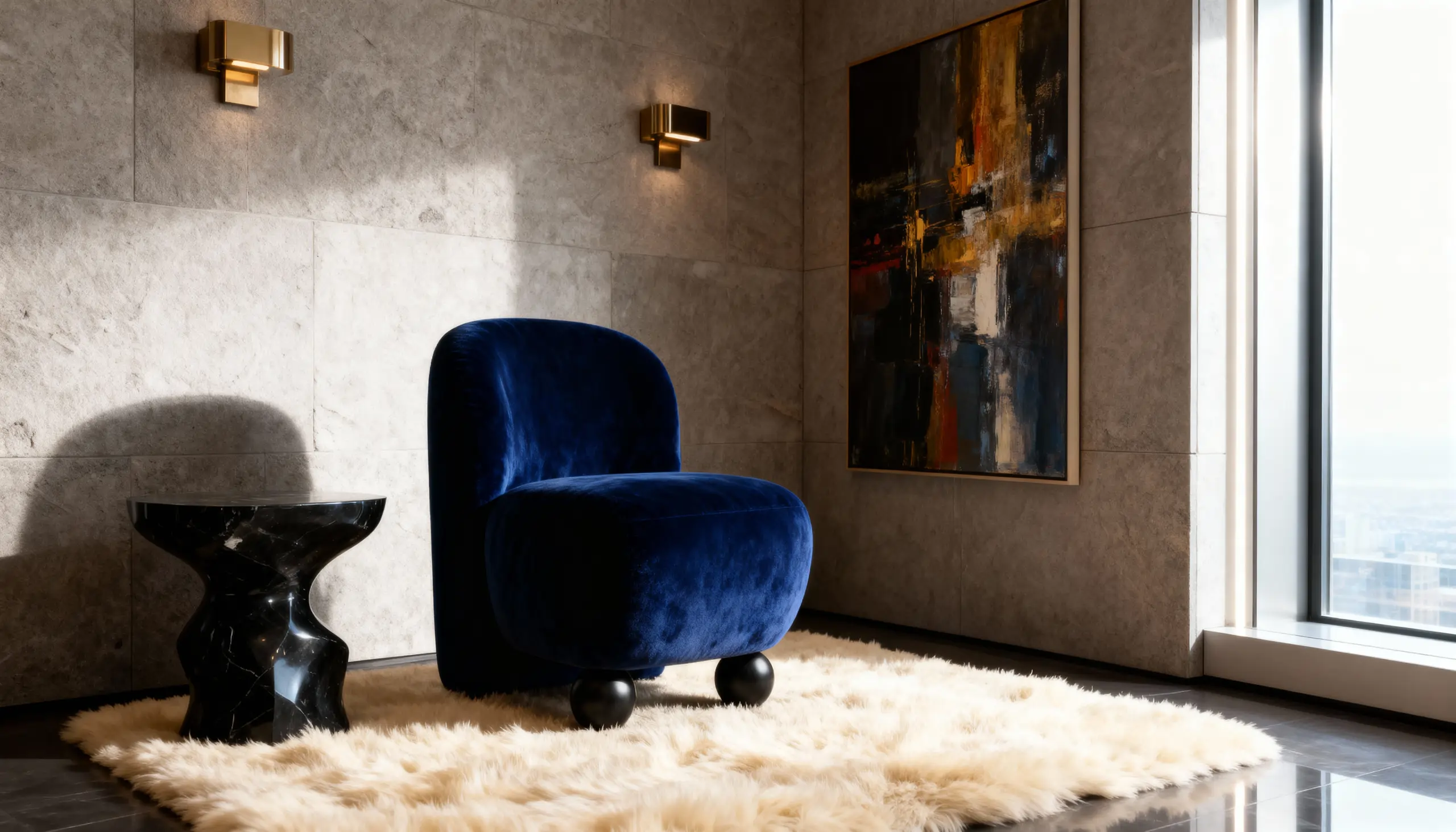
The photo shows the Oasis armchair: deep blue, rounded back, voluminous seat, spherical legs, and sculptural silhouette. It clearly shows the main idea of such furniture: the form does not have to be aggressive to be expressive. It can be soft, enveloping, almost silent — and that is why it is strong.
Why rounded shapes have become important in modern interiors
For a long time, modern design was associated with straight planes: flat facades, sharp corners, laconic sofas, graphic tables, a minimum of decor. This had its own logic – cleanliness, order, control. But when there were too many such solutions, interiors began to lose their lively feeling.
Rounded furniture became the answer to this fatigue. Radius shapes work differently. They do not cut the space, but flow around it. They do not create visual tension, but relieve it. They do not require perfect symmetry, but allow the interior to look more natural.
Soft chair with a rounded back can transform even a modest space. In a room with stone, glass, metal or large surfaces, it becomes an element of balance. The architecture remains strong, but ceases to be cold. An object appears that does not just stand in the composition, but brings warmth, pause and physicality to it.
This is especially important for modern apartments, flats, hotel rooms, lounges, salons and waiting areas. People today don’t want an interior that just looks “stylish”. They want a space where they can breathe.
An armchair as an alternative to rigid, rectilinear furniture
Straight furniture organizes space well. It creates structure, sets rhythm, and helps to pull together an interior. But if all the objects in a room are built only on straight lines, the space can become too strict.
This is where the role of the rounded chair comes into play. It works as a soft counterpoint. It doesn’t destroy the composition, but relaxes it. It doesn’t argue with the architecture, but adds a different intonation to it.
Imagine a room with a stone wall, a large window, a dark floor, a black table, and an abstract painting. Without a soft volume, such a space could look impressive, but a little detached. A blue armchair with rounded shapes changes this logic. It brings depth of color, the tactility of the fabric, visual weight, and a sense of security.
Yes interior chair ceases to be a secondary object. It becomes a point that gathers light, materials, and mood around itself.
Sculptural: When a Chair Works as an Object
One of the main features of modern upholstered chairs is sculpturality. This does not mean that the object has to be complex or strange. On the contrary: sculpturality is often born from simple but precisely found volumes.
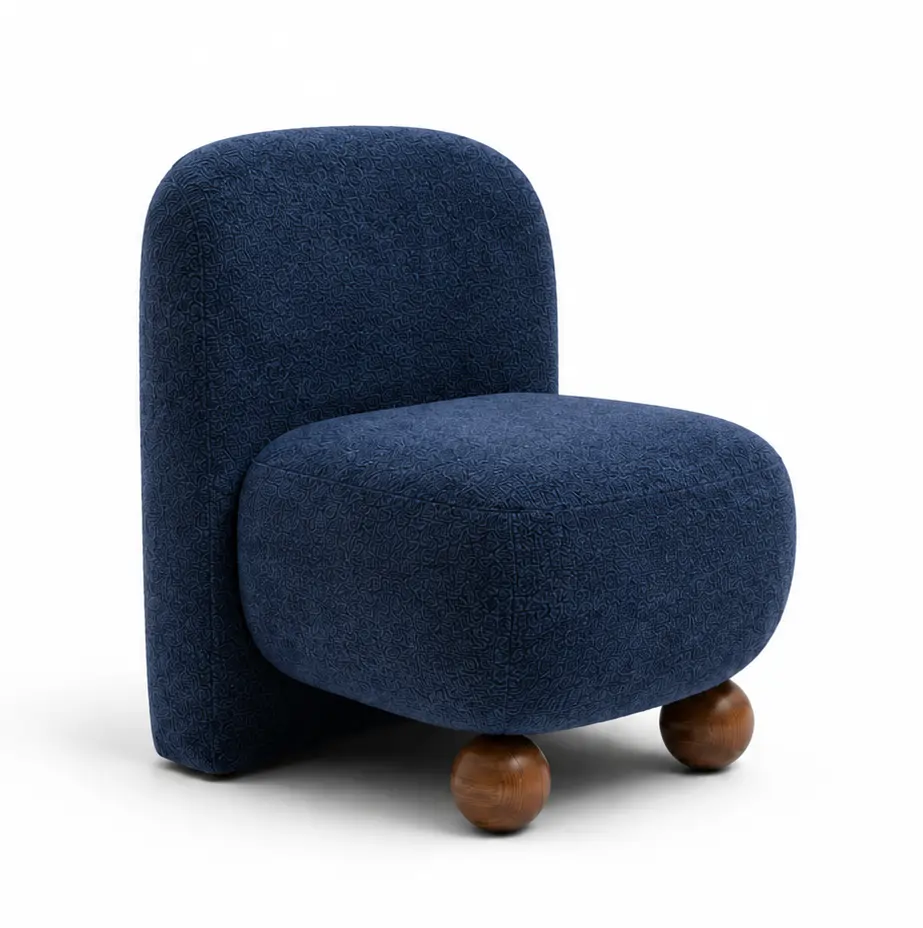
This is very clearly seen in the Oasis chair. The backrest has a soft radius and looks like a solid vertical shape. The seat is voluminous, rounded, visually dense. The ball-shaped legs add a bit of play to the object and make the silhouette more characteristic. As a result, the chair is perceived not as a set of parts, but as a completed object.
Sculptural chair works in an interior differently than usual. It doesn’t need a lot of decor nearby. It just needs air, the right fabric, and context. There can be a small table, a floor lamp, a rug, a painting, or a window next to it — and that’s enough to create a full-fledged zone.
That’s why these chairs work well not only in the living room. You can imagine them in the bedroom, by the panoramic window, in a private office, in a waiting area, in a showroom or in a hotel room. If you need a separate place for morning coffee, reading or an evening break, you should also check out the article about armchair in the bedroom. There, this topic is revealed through a more private, intimate scenario.
Envelope: Why a soft form feels calmer
A rounded chair affects not only the look, but also the body. A person reads the shape even before they sit down. A sharp angle gives a sense of structure. A radius – a sense of softness. A high rounded back – a sense of support. A voluminous seat – an expectation of comfort.
That is why modern upholstered chairs are often described as enveloping. They do not necessarily have to be too deep or large. Envelopment is created not only by size, but also by proportion: how the back supports the body, how the seat distributes weight, how the fabric contacts the body, how the shape visually “closes” the person from excessive tension of space.
This is important for the home, but even more so for commercial interiors. In a salon, hotel, office or waiting area, a person often spends little time, but it is the seating that creates the impression. If a chair looks beautiful but is uncomfortable, the brand loses some of its credibility. If an object is both expressive and comfortable, it works on the atmosphere of the space without words.
There is a similar logic in soft subjects of a different format – for example, in an article about modern Ritmo Jazz Soul banquette, where furniture is considered as an element of communication, pause and live interaction.
Visual tranquility: the power of a soft silhouette
The rounded shape has one important property: it calms the eye. It has no sharp end, no aggressive angle, no visual “impact.” The gaze glides along the line smoothly, without stopping. That is why radius furniture works well in spaces where tension needs to be relieved.
This doesn’t mean that such furniture is boring. On the contrary, a soft shape can be very expressive. Especially when it is combined with a deep color, textured fabric or unusual details.
The blue chair in the photo is a good example. The color is rich enough that the object doesn’t get lost. The shape is soft enough that it doesn’t look aggressive. The texture of the fabric adds depth. The ball-shaped legs make the look less formal. Together, this creates a balance: the chair is noticeable but not loud.
This is the value of the modern KAIZEN approach: furniture can have character without being overly showy. It doesn’t have to scream to be the main thing.
Designer chair: not only a beautiful shape
There is a common mistake: to perceive designer chair just as a spectacular photo object. But true design begins where beauty works together with function.
Comfort should not be inferior to design. A beautiful thing should withstand daily contact with the body. Fit, softness, support, tactility and construction are as much a part of design as form.
This is fundamental. A chair can look perfect in an interior, but if you don’t want to use it every day, it doesn’t fulfill its role. The object should not only be visually strong, but also honest in use.
Several things are important for an upholstered chair:
- correct landing height;
- sufficient seat depth;
- balance of softness and support;
- pleasant tactility of the fabric;
- stable construction;
- a backrest shape that not only looks beautiful but also supports the body;
- proportions that allow the chair to be noticeable but not overload the room.
Therefore, in KAIZEN, form never exists separately from the experience of use. The object must work in real life: in the living room, bedroom, office, waiting area, at the coffee table, by the window, next to the sofa or as an independent accent.
You can also read about the chair as an object with character in the article designer chair: interior character. It explores the idea of furniture as the emotional center of a space in more depth.
How a rounded chair changes the composition of a room
An armchair is one of the most convenient items for changing the mood of an interior. It is more compact than a sofa, but more noticeable than the decor. It can be placed alone, used in a pair, added to an already finished room or made the central accent of a small area.
A rounded upholstered chair works particularly well in several scenarios.
In the living room
In the living room, an armchair can break up the excessive straightness of the sofa, cabinets, coffee table or TV area. It adds a livelier line to the composition. If the sofa is restrained and geometric, a rounded armchair makes the space less formal.
More about such scenarios in the article living room chair.
In the bedroom
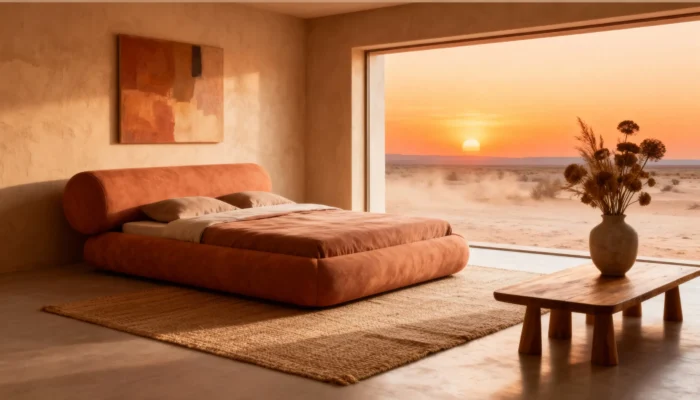
In the bedroom, a soft chair creates a separate private corner. This is a place not for guests or for demonstration, but for yourself: to sit down with a coffee, leave a blanket, read, take a break before bed.
In the office
In a workspace, a rounded chair can help to reduce the austerity. It can be placed next to a bookshelf, next to a low table, or in an informal conversation area.
In a commercial interior
In a salon, showroom, hotel or office, such a chair works on the first impression. It shows that the space is thought out not only functionally, but also emotionally.
In the area near the window
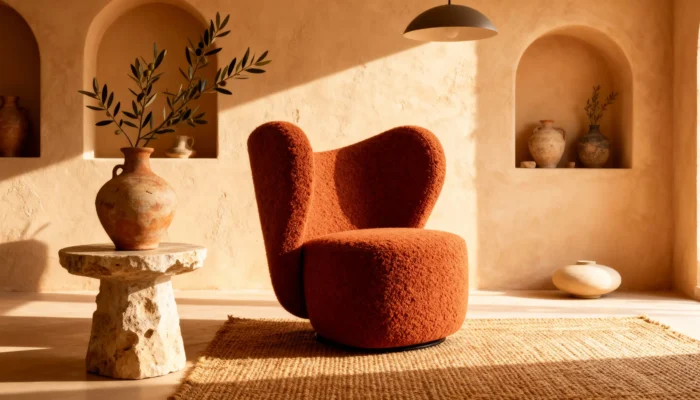
The rounded shape looks especially good in natural light. The light emphasizes the volume, fabric, depth of color and the smoothness of the silhouette.
Color and Fabric: Why a Blue Chair Looks Deep
The shape creates the silhouette, but the fabric and color set the mood. Deep blue is a complex, calm, almost architectural color. It is not as neutral as gray or beige, but it is not as overtly emotional as orange or red. It has depth, concentration, and silence.
In an upholstered chair, blue works particularly well because it emphasizes volume. On a rounded shape, the fabric catches the light in different ways: it becomes darker in some places, lighter in others, and has a texture. This makes the chair look lively, not flat.
For KAIZEN, it is important that furniture has freedom of choice. The same silhouette can change through fabric, color, texture, print and context. In a calmer fabric, the chair will become a soft background. In a deep color – an accent. In textured upholstery – a tactile center. In a bold print – almost an art object.
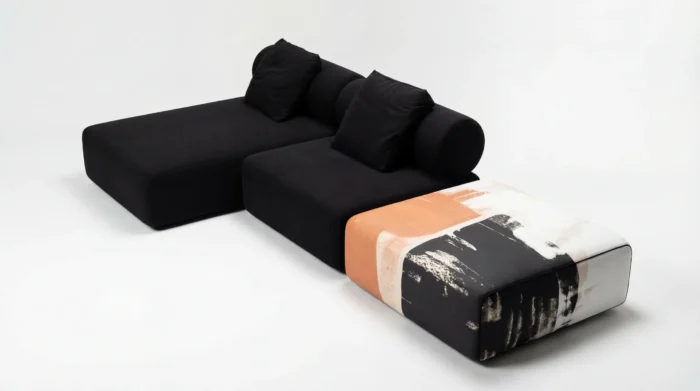
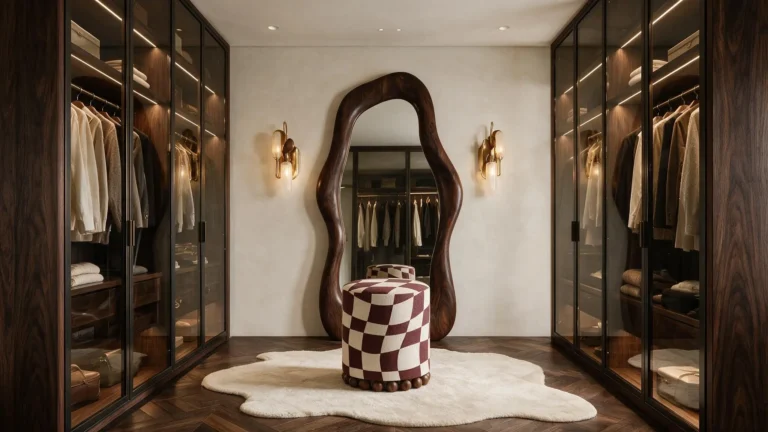
The same logic can be seen in other KAIZEN subjects: for example, in the article about Chess Illusion sofa, where graphics become part of the character of the furniture, or in material about Orange Stroke sofa, where color works as the energy of space.
Soft chair as a point of attraction
A good interior should have a focal point. It doesn’t have to be a large sofa, a fireplace, a painting, or a panoramic window. Sometimes, just one chair is enough.
An upholstered chair can become that very point of attraction because it combines several levels of perception:
Form — rounded, sculptural, voluminous.
Color — deep, accented or calm.
Tactility — a fabric that you want to touch.
Function — a real place to sit, pause, read, wait.
Emotion — a feeling of security, softness, and completeness of space.
It is the combination of these levels that makes the chair not a random object, but part of the scenario. It doesn’t just “add” to the room. It changes how the room feels.
How to choose a modern upholstered chair
To avoid modern upholstered chairs looking haphazard, it’s worth choosing them not only by color. It’s better to start with the feeling you want to create in the space.
You need peace of mind – you should look at rounded shapes, soft fabrics, and deep or natural shades.
You need an accent – you can choose a rich color, a distinctive texture, or unusual legs.
Sculpturality is needed – the integrity of the silhouette, the volume of the seat, and the shape of the backrest are important.
Versatility is needed – it’s best to look for a chair that has a strong shape but not overly active decor.
A commercial effect is needed – you should think not only about the appearance, but also about durability, fit, wear resistance of the fabric, and brand compliance.
The main thing is not to choose a chair as a random addition. If an object is to stand in an interior for years, it must be accurate: in scale, comfort, color, tactility, and character.
KAIZEN: furniture with character, comfort and freedom of choice
For KAIZEN, a chair is not just a piece of furniture. It is a way to transform a space without saying anything. To add softness to a rigid architecture. To give an interior a center. To show the character of the owner or brand. To create a place where you want to return.
KAIZEN is furniture with character, comfort and freedom of choice.
For those who don’t want to live among random things.
This is exactly how a modern soft chair works. It doesn’t shout about itself, but it changes the atmosphere. It doesn’t overload the space, but it makes it deeper. It doesn’t compete with architecture, but adds a human scale to it.
Rounded shapes are not just a trend. They are a response to the need for interiors where there is not only order, but also feeling. Not only style, but also physicality. Not only a picture, but also everyday comfort.