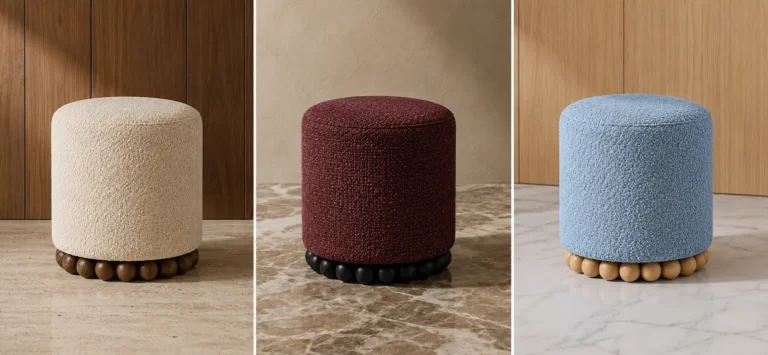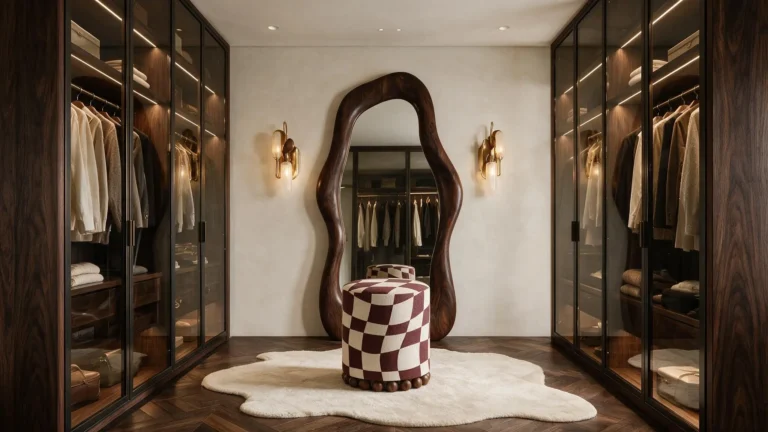
Fabric is the first thing the body senses in a chair. Even before a person appreciates the proportions, style or construction, they notice the surface: is it soft or dense, smooth or textured, warm or cool, calm or expressive. That is why the choice between velour, boucle, chenille and matting is not a technical detail after the design. It is part of the character of the chair.
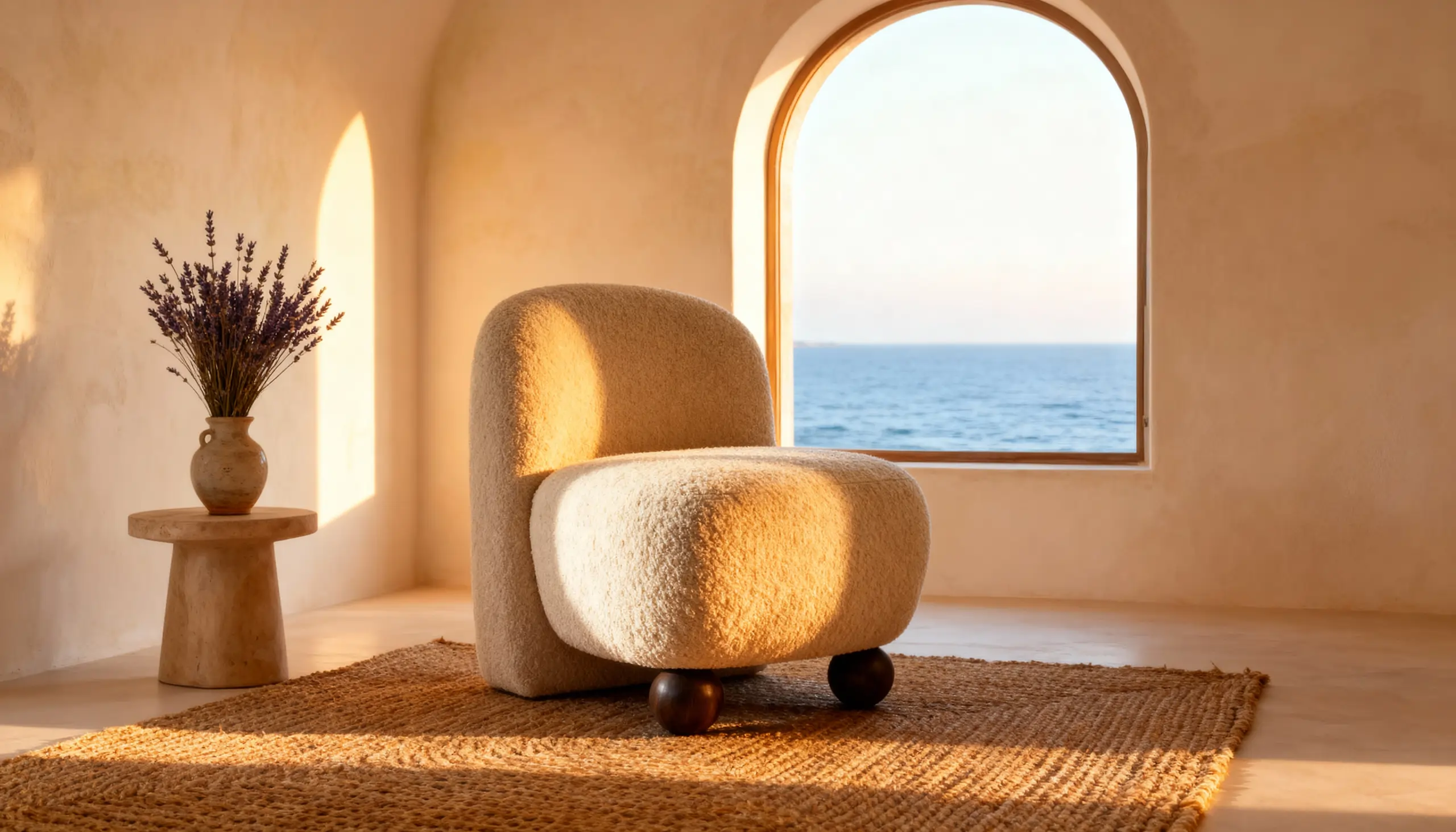
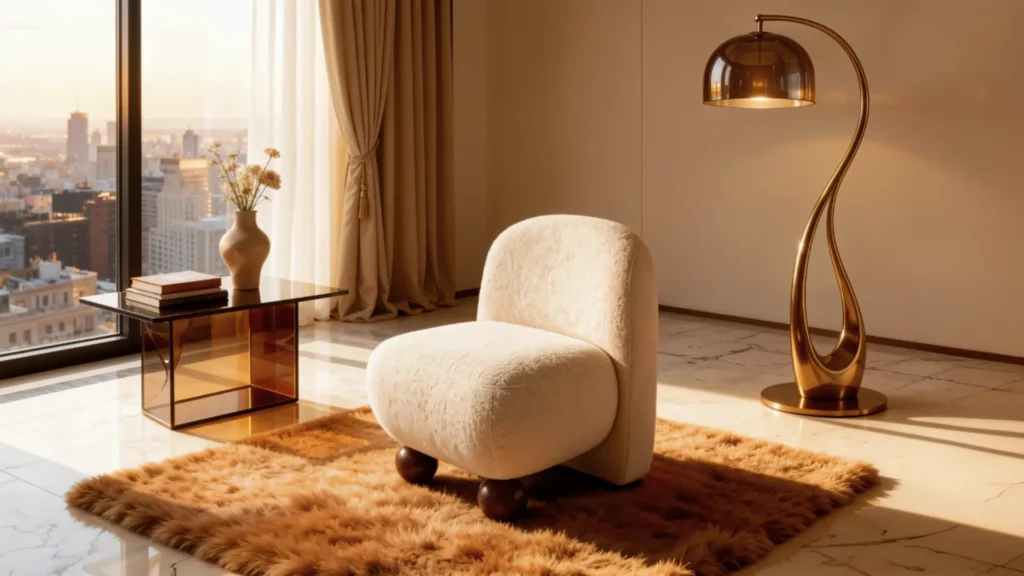
In the photo, the light-colored boucle armchair looks almost like a soft sculpture. The rounded back, the voluminous seat, the spherical wooden legs, the warm light, the carpet, the panoramic window, the arch overlooking the sea — everything works towards one feeling: silence, softness, air, pause. In such an interior, the fabric doesn’t just cover the form. It shapes the mood.
A velour armchair would sound different. It would add more depth, shadow, intimacy, and soft shine. A boucle armchair creates a sense of light and tactile comfort. Chenille gives a calm density. Mat – structure and restraint. That is why modern upholstered armchairs should be chosen not only by shape, but also by material that matches your space, rhythm of life, and sense of comfort.
Why fabric changes everything
An upholstered chair can have the same silhouette, but look like a completely different object in different fabrics. In velor, it becomes deeper and more evening. In boucle, it becomes lighter and cozier. In chenille, it becomes calm and homely. In matting, it becomes restrained, textured, architectural.
This is especially evident in the KAIZEN designer chairs, where the shape already has its own plasticity. The rounded back, voluminous seat, soft radius corners and wooden ball legs create a strong foundation. But it is the fabric that decides what the final look will be: minimalist, intimate, natural, premium, art object or more neutral.
Fabric affects four things:
| What changes the fabric | How does it feel? |
|---|---|
| Tactility | How pleasant it is to touch the chair with your hands, shoulders, back |
| Visual volume | Does the chair feel lighter, deeper, softer, or more structured? |
| Mood | Does the object create calm, warmth, drama, graphics, or comfort? |
| Practicality | How the fabric behaves in daily use |
At KAIZEN, this is an important part of the studio approach. We don’t consider fabric as “the last item in the order.” It is chosen together with the scenario: where the chair will stand, how it will be used, what kind of light is in the room, whether there will be a carpet, wood, stone, metal, sofa, curtains or a table nearby.
Velour armchair: depth, softness and intimacy
A velour armchair is a choice for those who want to add depth to their interior. Velour works well with colour: burgundy, terracotta, blue, graphite, olive, chocolate or caramel look more complex in velour than in smooth fabric. Light does not just fall on the surface, but glides over it, creating soft transitions of shades.
Velour is a good fit for a living room, bedroom, private office, lounge area, reading area. It is especially appropriate where the warm presence of an object is desired, rather than a cold minimalist purity.
A velour chair can be:
- a deep accent in a neutral interior;
- a soft object near the window;
- a chamber chair for reading;
- a distinctive element in the bedroom;
- a design accent in the lounge area;
- part of the living room with warm light and wood.
Velour has one important feature: it loves light. In daylight it can look softer and livelier, and in the evening it can look deeper and more saturated. Therefore, before choosing, it is worth looking not only at the fabric sample, but also at how it works in your room during the day.
Boucle armchair: light, texture and soft tranquility
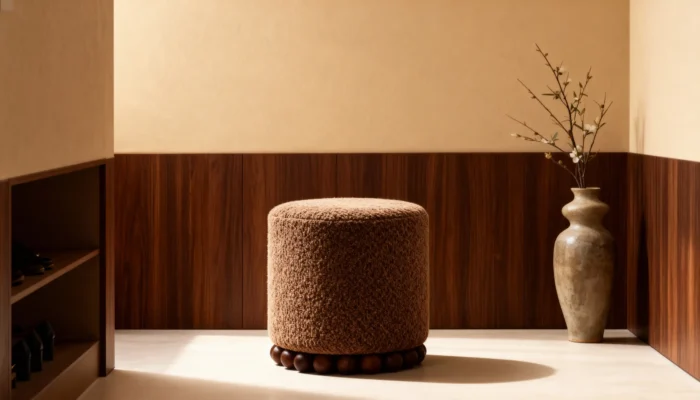
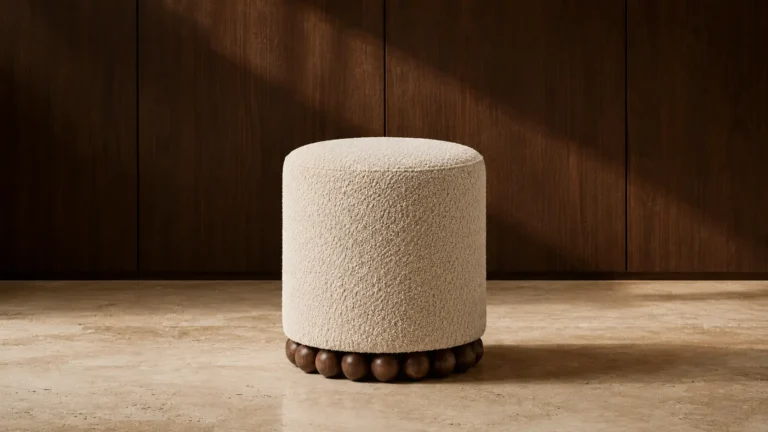
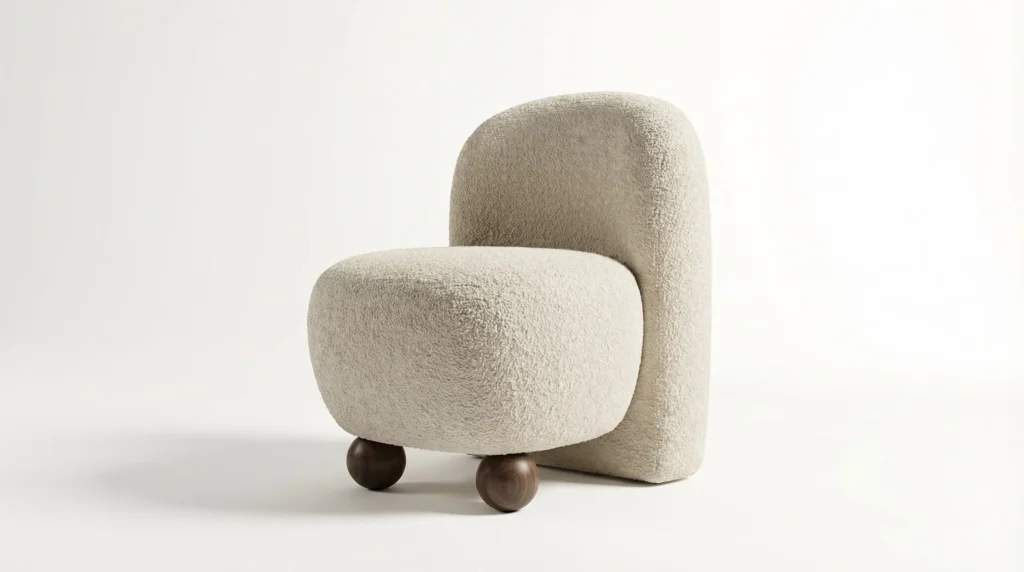
A boucle armchair has a different nature. If velor creates depth, then boucle creates volumetric softness. Its texture is not smooth, but embossed, lively, tactile. Visually, such a fabric makes the armchair warmer and more comfortable, even if the form is laconic.
In the photo, the light-colored boucle armchair works exactly like this. In an urban interior, it softens glass, marble, and metal. In a space by the sea, it continues the feeling of light, sand, stone, and warm air. On a white background, it is clear that boucle does not need a complex color: the texture itself already adds depth to the object.
A boucle chair is well suited for:
- bright living rooms;
- bedrooms;
- reading areas;
- Japanese-style interiors;
- contemporary spaces;
- minimalist interiors that lack softness;
- lounge areas with a warm, natural atmosphere;
- spaces with wood, stone, carpets, soft light.
Boucle is especially appropriate when you want the chair to look more substantial than decorative. Such a soft chair seems to invite you to sit down, wrap yourself in a blanket, drink coffee, read, or simply take a break.
Velour or boucle: the main difference
The choice between velor and boucle shouldn’t be reduced to the question of “which is more fashionable?” Both fabrics can look modern if they are correctly selected for the interior. The difference is in the mood they create.
| Criterion | Velour armchair | Boucle chair |
| Visual effect | Depth, overflow, chamberness | Volume, light, texture |
| Mood | Evening, soft, rich | Calm, natural, cozy |
| The best colors | Bordeaux, blue, graphite, terracotta, olive | Cream, milky, sand, beige, warm gray |
| Where it works well | Living room, bedroom, study, lounge | Bedroom, living room, reading corner, Japanese space |
| Feeling | Smoother softness | Embossed tactility |
| Role in the interior | Adds depth | Softens the space |
If the interior lacks warmth and light comfort, you should look towards boucle. If the space needs depth, rich color, and intimacy, velor will work better.
But the final choice depends not on the fabric alone, but on the entire space: the floor, walls, curtains, carpet, lighting, neighboring furniture, and how you plan to use the chair.
Chenille: a calm density for everyday life
Chenille is often chosen when balance is needed. It is not as deep and iridescent as velour, nor as textured as boucle. Instead, it provides a calm, dense, pleasant surface that works well in residential interiors.
For an upholstered chair, chenille can be a very good solution if you need:
- make the item warm but not too decorative;
- get a pleasant tactility;
- maintain a calm appearance;
- fit the chair into a modern living room or bedroom;
- avoid excessive shine;
- support the textile palette of the room.
Chenille works well in interiors with lots of wood, soft curtains, carpets, warm walls. It doesn’t always grab attention as quickly as velour or boucle, but that’s its strength. If the chair is to be a favorite everyday item, rather than a major art object, chenille can be a very accurate choice.
Mat: structure, restraint and architecturality
The mat has a more pronounced structure. It looks restrained, honest, a little architectural. If boucle gives three-dimensional softness, and velor – depth, then the mat adds order and textural simplicity.
This solution is well suited for interiors where conciseness is important:
- minimalism;
- soft modern;
- contemporary;
- modern living room;
- neutral bedroom;
- space with wood and stone;
- commercial lounge area without unnecessary decoration.
Mat works well where the chair needs to be soft but not too “fluffy.” It creates a sense of togetherness. This is a good option for those who want a designer chair without shine, without strong relief, and without visual drama.
Practicality: which fabric to choose for different scenarios
Practicality depends not only on the type of fabric, but also on the specific collection, color, density, method of use and space. But the general logic is this: the more actively the chair is used, the more careful you need to be with the fabric, care and color.
| Scenario | What fabrics to consider | Why |
| Living room chair | Velour, chenille, matting, boucle | Depends on whether you need accent, depth, or calm |
| Armchair in the bedroom | Boucle, chenille, velour | Softness, tactility and intimacy are important. |
| Reading chair | Chenille, boucle, velor | The fabric should be pleasant to the hands and shoulders. |
| Lounge area | Mat, chenille, velor | Needs durability and visual expressiveness |
| Showroom or salon | Velour, boucle, printed fabric | The chair works for both comfort and impression |
| Minimalist interior | Boucle, mat, chenille | Texture adds warmth without unnecessary decor |
For everyday use, it’s important not to choose a fabric based solely on a photo. At KAIZEN, you can work with samples, textures, and colors to see the material in person. This is especially important for bouclé and velour, as they change greatly depending on the light.
How fabric works with light
Light can make fabric look completely different. That’s why a chair in the salon, in a photo, and in a real interior can be perceived differently.
Velour reacts more actively to the direction of light. Its surface can give a soft shimmer, change the depth of color, look darker or lighter depending on the angle. This is beautiful, but it must be taken into account. If the room has a lot of direct sunlight, the color of velour will constantly “live”.
Boucle works differently. It catches the light in relief. Small shadows appear on the light fabric, which emphasize the texture. That is why a light boucle chair by the window does not look flat, but voluminous.
Chenille is usually more laid back. The mat shows the weave structure and looks good in natural light. This is important for a designer chair: the fabric should be beautiful not only in the perfect shot, but also in real life.
Fabric and shape: why the pair is important
Not every fabric works equally well with every shape. For rounded chairs like the KAIZEN, it is especially important that the material supports the plasticity of the silhouette.
Boucle emphasizes the roundness well. It makes the chair visually even softer, almost cloudy. Velour adds depth and shadow to the volume, especially in rich colors. Chenille works quietly, without taking attention away from the shape. Mat can make the silhouette more collected and structured.
In the Gelate Velvet model, presented in the KAIZEN armchair category, the sculptural form is built on smooth volumes, soft lines and spherical legs made of natural wood. That is why the fabric here should not be random. It should either enhance the softness, or add depth, or make the object more interior and restrained.
You can see the model on the page Gelate Velvet, and more broadly in the category KAIZEN armchair.
DNA KAIZEN: minimalism + comfort
At KAIZEN, minimalism does not mean coldness. It is not about empty space or furniture that is beautiful only in photos. For us, minimalism is about the precision of form, the purity of the silhouette, the absence of random details. And comfort is a body that does not strain, a fit that you want to return to, a fabric that is pleasant to touch.
That is why the KAIZEN soft chair always exists between two poles:
minimalism – so that the form is clean;
comfort — for the object to be alive.
Added to this is a studio approach. We work not just with a “model”, but with a specific task: what space, what fabric, what color, what scenario, what mood, who will use the chair. For interior designers, this gives more freedom: the chair can be adapted to the concept, moodboard, palette, style and function of the room.
Kaizen in fabric selection
There is a simple and powerful idea in the Kaizen philosophy: “Continuous improvement starts with small steps.” In furniture, this is a very practical idea. A good chair is not born from a single decision. It is assembled from many precise steps: shape, fit, fabric, texture, color, seam, legs, proportion, place in the interior.
Another formula close to KAIZEN: “Every detail can be improved.” For an upholstered chair, this means that the fabric is not secondary. It can be specified, compared, applied to a palette, viewed in daylight and evening light, tested by touch, and correlated with other materials in the room.
This is how the studio approach differs from a random purchase. Not “taking what is there,” but step by step finding what really works.
How to choose fabric: a short route
To make the choice more accurate, you should start not with a fabric catalog, but with space.
1. Identify the room
For the living room, the fabric can be more expressive. For the bedroom, it can be softer and calmer. For the lounge area, it can be more practical. For the reading area, it can be especially pleasant to the touch.
2. Look at the light
Is the room sunny or more intimate? Velour and boucle react differently to lighting. What looks calm in the shade may become more active in direct light.
3. Evaluate the materials around you
Wood, stone, metal, glass, carpet, curtains, sofa – all this affects the choice of fabric. The chair should not exist separately from the interior.
4. Decide if an accent is needed
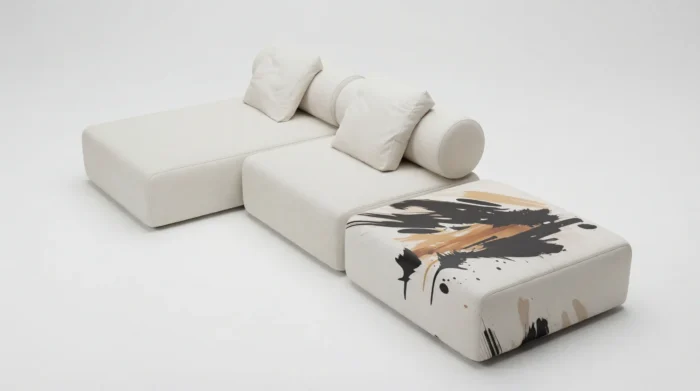
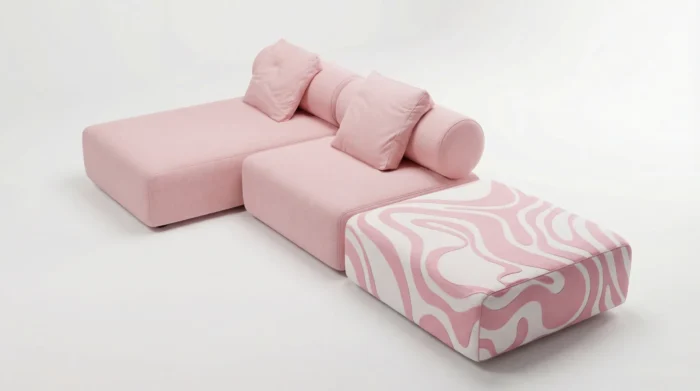
If you need an accent, you can choose velour in a deep color or a fabric with a print. If you need peace, choose boucle, chenille or matting in a natural palette.
5. Touch the fabric
This is a must for an upholstered chair. The fabric should be pleasing not only to the eyes, but also to the body.
How to connect fabric selection to other KAIZEN topics
If you are just starting to choose, you should first read the material about soft chair for relaxation. It breaks down how the chair works in the home, living room, bedroom, reading area, and personal break.
If you want to better understand how fabric is related to form, an article about designer chair as a character of the interior. And if you need individual adaptation – fabric, color, art print or size – you should go to the material about custom-made chair.
For a living room scenario, you can view the article about living room chair, and more broadly about the trend for soft rounded shapes — material “Modern upholstered chairs: why rounded shapes change the feeling of space”.
Conclusion
A velour chair and a boucle chair can have the same soft shape, but create a completely different mood. Velour adds depth, color, evening intimacy. Boucle – light, texture, bodily comfort. Chenille gives a calm density. Mat – structure and restraint.
That’s why fabric should be chosen not after the design, but together with it. It should match the space, the light, the scenario, the touch, the style, and the person who will use the chair.
At KAIZEN, modern upholstered chairs are created at the intersection of minimalism and comfort. A clean shape, a soft fit, precise fabric, a studio approach and collaboration with designers allow you to make a chair not a random object, but a part of the interior. This is what kaizen in furniture is: not a loud gesture, but a constant refinement of details, thanks to which the space becomes better.