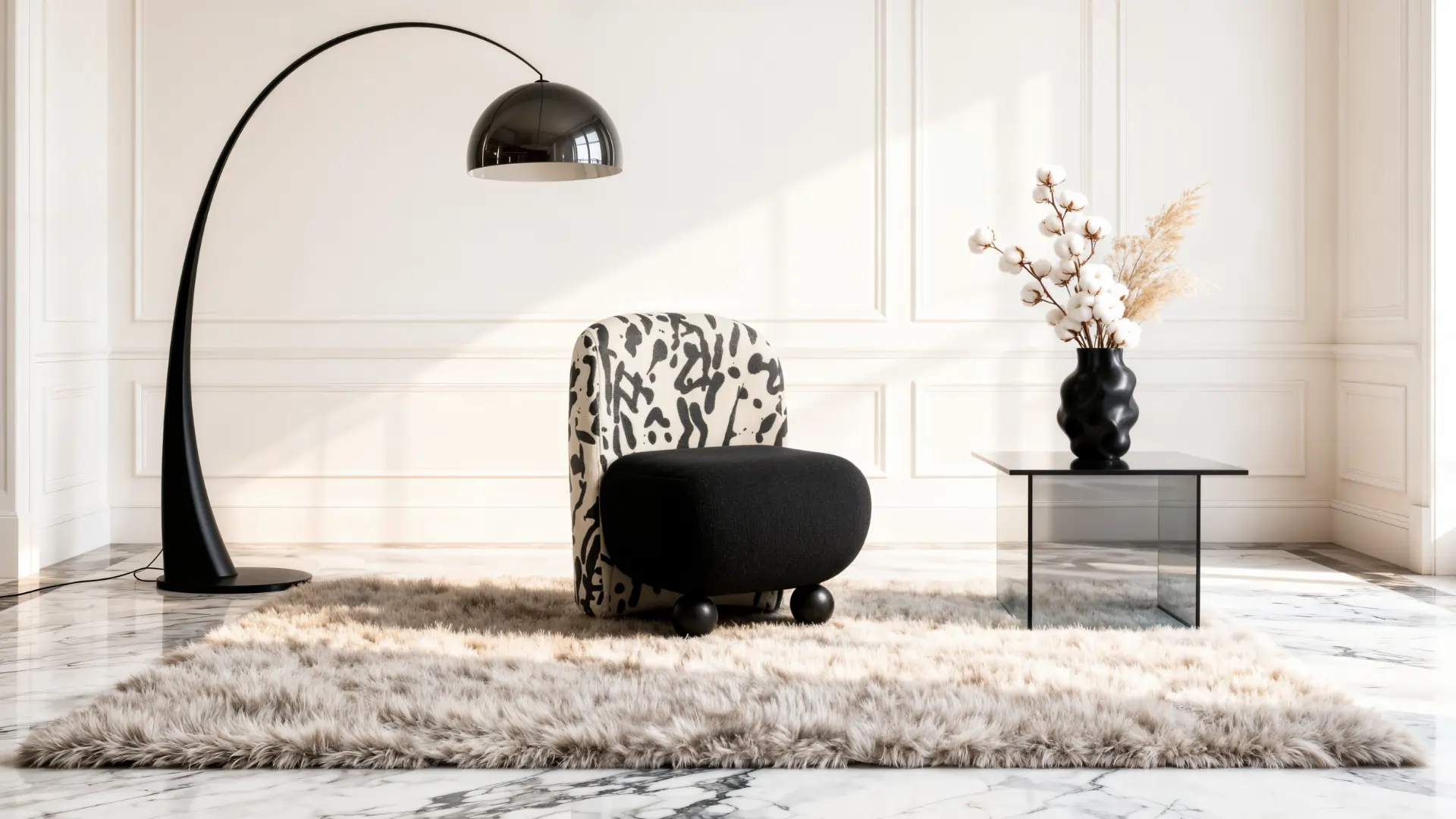
In a white space with a marble floor, a soft carpet, a black arched floor lamp and a glass table stands an armchair. Its shape is familiar to KAIZEN: a rounded back, a voluminous seat, a soft silhouette, spherical legs. But this time, not only the form takes on the main role. Graphics appear on the fabric – black abstract lines, spots, rhythm, an almost handwritten gesture. And the armchair immediately ceases to be just furniture.
This is how it is born printed chair — an object in which function meets art. You can sit on it, but you also want to look at it. It works for the body, but at the same time speaks to the space. It can be a soft place for coffee, a pause or a conversation, or it can become a focal point of the interior, a corporate symbol, an art object or a personal statement of the owner.
For KAIZEN, print is not decoration. It is language. Through it, a chair can convey the character of a person, the energy of a team, the ambitions of a business, the mood of a brand or the concept of a design project. That is why a printed chair is one of the most important themes in KAIZEN’s DNA: customization, collaboration with designers, corporate customers and furniture that can be created for a specific space.
A printed chair is not a decoration, but a character
Print is often mistaken for a decorative layer: something that “makes furniture more interesting.” But in the KAIZEN designer chair, print works deeper. It doesn’t just add a pattern to the fabric. It changes the perception of form.
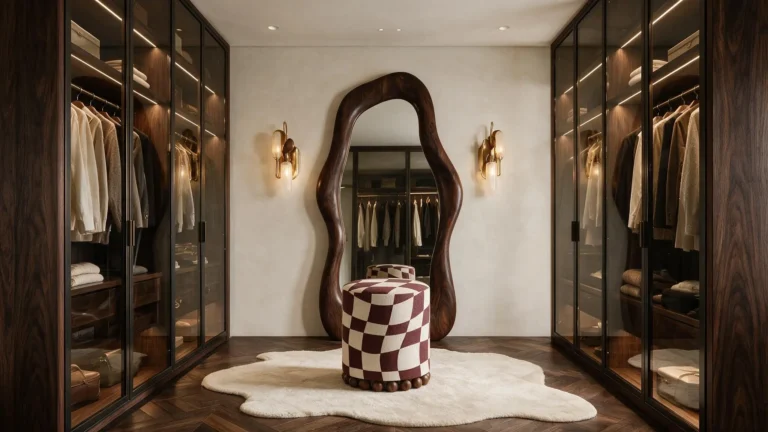
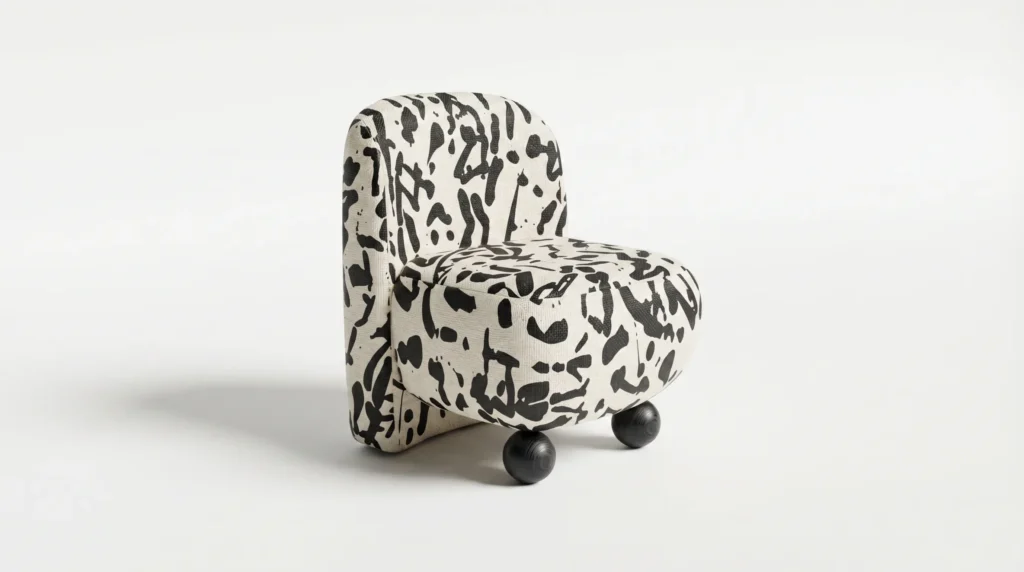
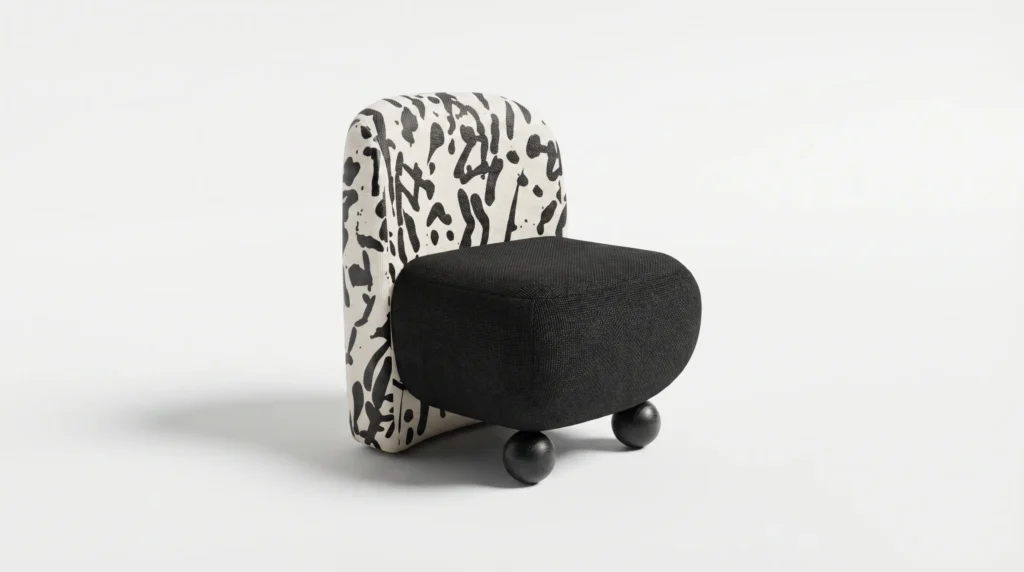
In the first photo, the print covers the entire chair: the back, the seat, the side planes. Because of this, the object looks holistic, almost like a three-dimensional graphic sculpture. In the second photo, the print is combined with a plain black seat. The effect is different: the chair becomes more architectural, collected, contrasting. In the third photo, this object already works in the interior – and becomes not just a furniture unit, but the main visual accent of the space.
This shows an important thing: the print can be customized. It can be active or discreet. Full or partial. Contrasting or delicate. Abstract, artistic, geometric, organic, corporate, author’s. It can cover the entire chair or work only on the back, seat, sides, a separate plane.
That’s why a printed chair is not a “ready-made bold option.” It’s a tool for creating character.
Furniture on the verge of art
An art chair should not be uncomfortable. And an art chair should not stand untouched like a museum exhibit. The most interesting thing begins where art enters everyday life.
A printed chair can work as a painting, but not hang on the wall. Like a sculpture, but remain a soft place to rest. Like a graphic work, but have volume, texture, fit, contact with the body. This is its strength: it does not separate art from everyday life, but makes it part of the space.
This is the layer that is often missing in modern interiors. A room can be high-quality, expensive, and thoughtful, but lack a personal touch. Everything is right in it, but nothing is memorable. A printed chair can change this situation with one item.
It adds:
- rhythm;
- graphics;
- emotion;
- personality;
- focal point;
- artistic presence;
- feeling of hand gesture;
- individuality without complete renovation.
At KAIZEN, furniture is not limited to function. It can be a carrier of a mood, a visual idea, a story, a team, a brand, or a person.
Print as a reflection of a person
In a home interior, a printed chair can be a very personal piece. Not everyone wants bright walls, a bold rug, or elaborate decor. But a single chair can take on the role of a personal statement.
A print can reflect a person’s inner state. Some prefer graphics – strong, contrasting, almost musical. Some prefer soft natural lines. Some prefer an abstract rhythm, similar to improvisation. Some prefer calm waves, colored spots, fragments of a landscape, their own artistic motif or a print created for a specific story.
Such a designer chair becomes more than just a “place in the room.” It begins to speak about the person:
- about her taste;
- about courage;
- about the love of art;
- about the desire to have a non-mass object;
- about inner freedom;
- about the ability to see furniture as part of one’s own identity.
In this sense, a printed chair is similar to clothing, music, or a painting. It not only performs a function, but also conveys a state.
Print as a brand language
For corporate customers, print opens up even wider opportunities. A business space has long ceased to be just an office with tables. Reception, lounge area, meeting room, showroom, salon, hotel room, coworking, waiting area — all these are points of contact with a person. And each such point forms an impression of the company.
A printed chair can be part of this experience. It doesn’t have to be a literal logo print. Often, a more subtle solution works better: a print that matches the brand’s rhythm, the colors of the identity, a graphic that conveys team dynamics, an abstraction related to the company’s values, or an artistic motif created specifically for the space.
This is important for business because strong companies think beyond functionality. They think about atmosphere, team energy, ambition, courage, customer experience, and the impression left after the meeting.
A printed chair can convey the following values:
| Company value | How a printed chair can convey it |
|---|---|
| Ambitions | Strong contrast, bold graphics, recognizable art object |
| Teamwork | A series of chairs with a single visual language |
| Innovation | Non-standard print, modern shape, customization |
| Openness | Soft lines, warm palette, comfortable lounge area |
| Premiumness | Discreet graphics, high-quality fabric, precise silhouette |
| Creativity | Author’s art print, unusual color combination |
| Confidence | Black and white graphics, expressive form, clean interior context |
This way, furniture becomes not just a part of the interior, but a part of corporate culture.
Customer print: when a chair is created for a specific idea
One of the key advantages of KAIZEN is the possibility of customization. The chair can be used not only with a ready-made art print, but also with a print from the customer. This is especially valuable for designers, brands, showrooms, salons, hotels and companies that want to create their own visual language of space.
The customer’s print can be:
- original graphics;
- abstract drawing;
- a fragment of the brand identity;
- artistic pattern;
- a motif from the project’s moodboard;
- a stylized company symbol;
- color composition for the interior;
- a series of prints for several armchairs;
- a soft interpretation of the logo without direct branding.
This opens up a very powerful opportunity: furniture can be created as part of a concept rather than being selected after the project is complete. A designer can incorporate a printed chair into a visual idea from the very beginning. A company can have a lounge area that cannot be replicated by chance. A private client can order an item that truly reflects their style.
This way, a custom-made chair becomes not a compromise between the catalog and reality, but an accurate design decision.
You can read more about fabric, color, art print, and space scenario customization in the article “Custom-made chair: how to create a personal item for your interior”.
Collaboration with designers: print as a project tool
For an interior designer, a printed chair is a powerful tool. It allows you to not just place upholstered furniture, but to create a point through which the entire concept is read.
In a project, a printed chair can play different roles:
- collect interior colors in one item;
- support art on the walls;
- create rhythm in a calm space;
- add emotion without overloading the room;
- become a personal accent for the client;
- divide the lounge area into visual scenarios;
- create a unique object for visualization;
- strengthen the brand in commercial interiors.
The combination of a print and a plain fabric works especially well, as in the second photo. The black seat makes the chair more collected, and the print on the back and sides retains artistic energy. This technique allows you to control the strength of the print: you don’t always need to cover the entire object with a pattern, sometimes just the right area is enough.
This is the KAIZEN studio approach: not just “choosing a fabric,” but finding the exact proportion between shape, color, print, interior, and usage scenario.
Printed armchair in a residential interior
At home, a printed armchair can be that detail that makes a space personal. It can be placed in the living room, bedroom, by the window, in a reading area, by the coffee table or in a separate corner for relaxation.
In the bedroom, the print can be more delicate, softer, and more intimate. If the topic of private space is relevant, you should check out the article about armchair in the bedroom, where the chair is seen as a place for morning coffee, evening silence, a book, and a pause.
In the living room, a printed chair can work more boldly. It can complement a sofa, create contrast to a neutral space, support art on the walls, or become the main object next to a floor lamp.
In a reading area, a print can be not only decorative, but also emotional. It sets the rhythm of a place where a person returns with a book, coffee, or blanket.
The main thing is not to be afraid of the print, but to work with it accurately. The print should not be an accidental “brightness”, but a part of the composition.
Printed chair in a corporate space
For corporate interiors, a printed chair can be an even stronger solution than for the home. Because in a business space, furniture often works on first impressions.
Imagine a reception area for a company that wants to communicate ambition and boldness. Standard neutral chairs will make the space look neat, but not necessarily memorable. A chair with a graphic print immediately creates a different signal: this company has a position, taste, visual culture, a willingness to be noticed.
In a coworking space, such chairs can form areas for informal communication. In a showroom, they can emphasize the brand’s DNA. In a salon, they can create a photogenic spot. In a hotel, they can add a personal touch to a room or lobby. In a lounge-format meeting room, they can make a meeting less dry and more human.
Teamwork can also be expressed through furniture. For example, a series of chairs with different but related prints can symbolize different roles in a team, united by a common visual system. One print as a general idea. Several variations as different voices within a strong company.
This is no longer just a furniture solution. It is the design of an environment that speaks about the brand without presentation.
Monochrome: Why Black and White Print Works So Well
Black and white print is one of the strongest formats for an art object chair. It does not depend on a complex palette, but has a powerful graphic energy. In a light interior, such a chair immediately becomes the center of attention. In a darker space, it can sound more dramatic. In a corporate area, it looks confident and modern.
In the photo, the black and white print works well with a black floor lamp, a black vase, and a glass table. The object doesn’t look random because the interior supports its graphics. This is what’s important: an active chair needs an environment that doesn’t argue with it, but lets it breathe.
Monochrome has several advantages:
- easily fits into different palettes;
- looks modern;
- works with space graphics;
- suitable for home and business;
- goes well with black, white, wood, metal, marble;
- allows you to make a strong accent without color overload.
Such a chair can be bold, but not colorful. Noticeable, but not chaotic. That is why the black and white print is well suited for the KAIZEN aesthetic: minimalism, comfort, art, precision.
Print and fabric: why the base is important
Print always works on fabric. Therefore, the choice of material cannot be separated from the pattern. Different textures convey color, line, contrast and small details differently.
For a printed chair, it is important to consider:
- how clear the graphics should be;
- is a soft textile texture needed;
- how the fabric behaves in light;
- Will the print be active in daily use?
- Is it necessary to combine a print with a plain fabric?
- What part of the chair should the drawing occupy?
If the topic of fabrics is relevant, it is worth reading the article “Velour chair or boucle chair: how to choose fabric for an upholstered chair”. It details how velour, boucle, chenille and matting affect tactility, mood, practicality and visual effect.
For a printed chair, the fabric is the canvas. And as in art, the canvas matters.
Shape: Why Print Works Better on a Sculptural Chair
A print can be beautiful on its own, but on furniture it has to work with volume. If the shape of the chair is flat or random, the print can look like simple upholstery. If the shape is sculptural, the pattern comes to life.
In KAIZEN chairs, soft rounded shapes create a good base for a print. Lines can move from the back to the seat, wrap around the sides, and change depending on the angle. A person sees not one plane, but an object in motion.
That’s why the printed chair in KAIZEN is perceived as a three-dimensional art object. It has a frontal view, a side view, a back view, an interior view. It works differently in the frame, in the room, near the light, next to other objects.
You can read more about the trend for soft radius shapes in the article “Modern upholstered chairs: why rounded shapes change the feeling of space”. And a separate article about the OASIS model — “OASIS chair: a design you want to feel” — helps to better understand the form in which the print can be revealed especially expressively.
DNA KAIZEN: customization, designers, corporate customers
At KAIZEN, the printed chair exists at the intersection of three directions.
1. Customization
You can work with fabric, color, print, combination of solid and graphic areas, mood, size and scenario of the space. The print can be from the KAIZEN collection or created/provided by the customer.
2. Collaboration with designers
The designer receives not just a ready-made model, but a tool for the project. The chair can support the moodboard, identity, palette, art concept, room style, or the client’s personality.
3. Focus on corporate customers
For business, a printed chair can work on recognition, atmosphere, first impression, brand culture, team energy and company values. This is especially important for showrooms, receptions, lounge areas, salons, co-working spaces, offices, hotels and spaces where design affects trust.
This logic distinguishes KAIZEN from the mass approach. The goal is not just to make a chair. The goal is to create an object that has a reason to look that way.
How to choose a printed chair
Before ordering, you should answer a few questions.
For home
- Should the chair be the main focus?
- Does the print need to be calm or bold?
- What colors are already in the interior?
- Will the chair be in the living room, bedroom, by the window, or in a reading area?
- Do you want the print to reflect your personal state or be simply aesthetic?
- Is it necessary to combine a print with a plain fabric?
For the designer
- What role does the chair play in the concept?
- Does the print support moodboard?
- Should I create one accent or a series of items?
- Will the print be repeated on other furniture or textiles?
- Should the chair function as an art object in visualization?
For business
- What first impression should the space create?
- What brand values need to be conveyed?
- Should the print be associated with the identity?
- Do you need a series of chairs for the team, clients or lounge area?
- Is the photogenicity of a space important?
- Should the chair be a bold sign of a company’s ambition?
These questions help make the print not random, but accurate.
A printed chair and the Instagram aesthetic of the space
In modern interiors, objects often work in the frame as well. This is especially important for brands: clients photograph the space, the team shoots content, and design becomes part of the communication. A printed chair has strong potential in this sense.
It reads well in photos, has a recognizable silhouette, creates a focal point, works with a floor lamp, carpet, table, vase, wall or window. In a salon, showroom, hotel or office, such a chair can become a point that people remember and photograph.
New images, interior solutions and the visual language of KAIZEN can be viewed in Instagram KAIZEN.
Conclusion
A printed chair is furniture that goes beyond function. It has a place for the body, but it also has a place for art, character, brand, team, ambition, inner state and design idea.
For a private interior, such a chair can become a personal art object. For a designer, it is a tool that collects a concept into one form. For a corporate customer, it is a way to show the company’s values without unnecessary words. For KAIZEN, it is a natural continuation of the philosophy of customization: furniture can be created not just “to size”, but to character.
The print can be of any mood: artistic, abstract, graphic, soft, bold, corporate, original or provided by the customer. The main thing is that it makes sense in the space.
Then a designer chair ceases to be just an object on the wall. It becomes a sign. A place. An art object. A part of the history of a person, a brand or a team that is not afraid to have its own voice.