Зміст
Not every space allows you to put an armchair. The balcony can be narrow. The kitchen can be compact. The niche by the window can be too small for a full-fledged lounge area. The dressing room can be walk-through. But this does not mean that such places should remain only functional.
This is where it works. small pouf. It doesn’t take up much space, is easy to move, adds seating, and creates a soft setting where a large object would be superfluous.
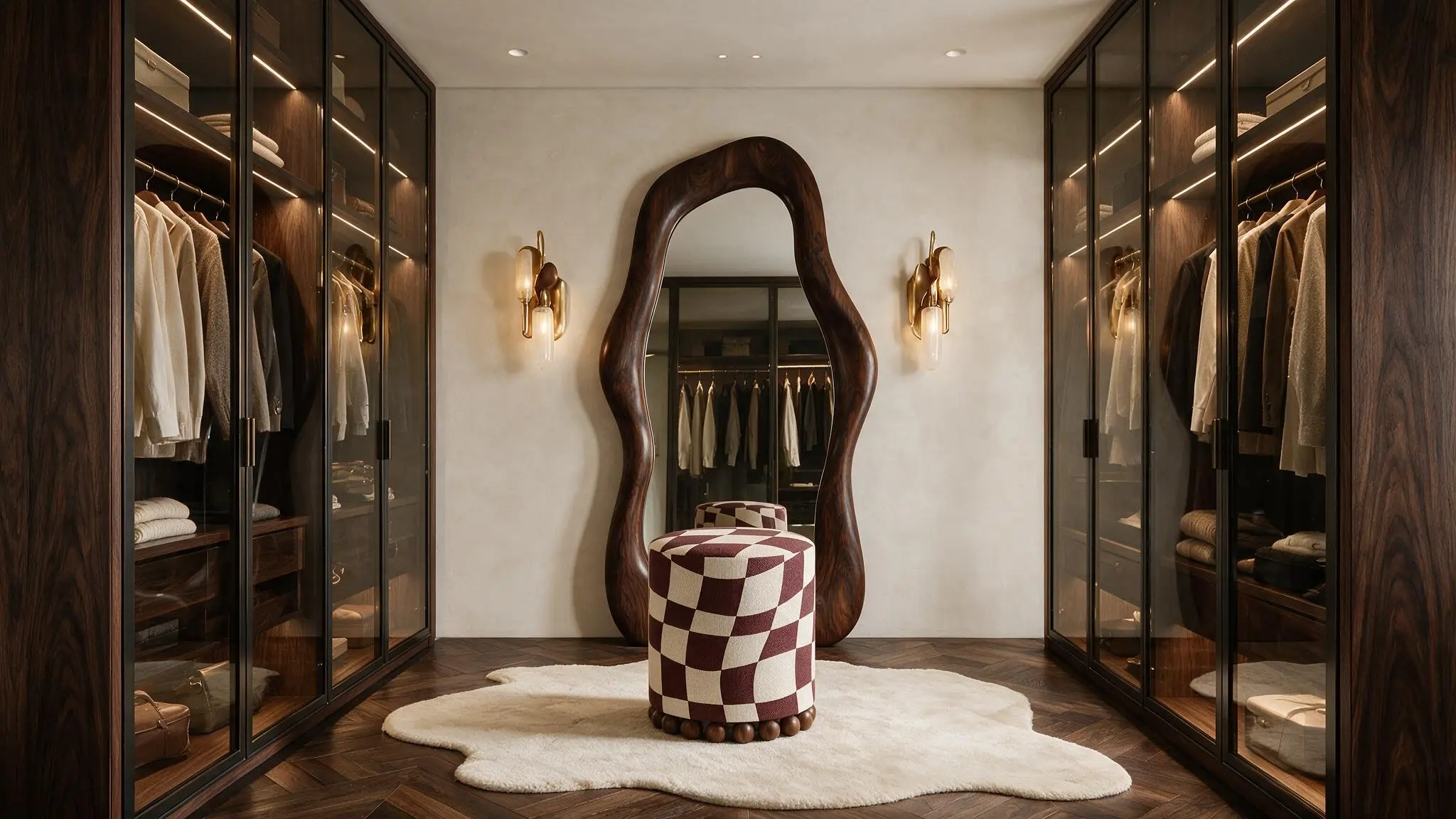
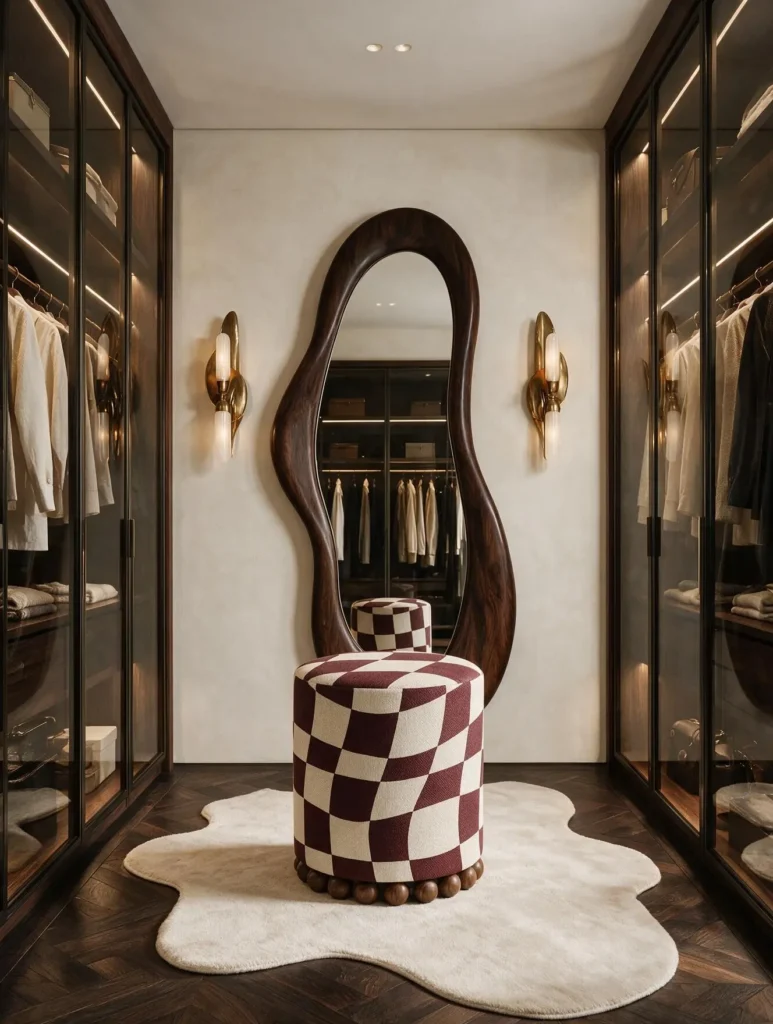
The photo shows neither a kitchen nor a balcony, but a compact dressing area. But the principle is the same: a narrow space, many verticals, cabinets, a mirror, a passage, a carpet and one soft object in the center. An armchair would look heavy here. A bench could take away the movement. And a round pouf with a burgundy and milk print works perfectly: it adds convenience, an accent and does not overload the area.
A small space doesn’t have to be rigid
Compact areas often look technical. The balcony is transformed into a storage space. A small kitchen into a work surface without pause. The niche by the window remains empty. The passage by the cabinets exists only for movement.
But even in a small space, you can create a soft scenario. Not a large lounge, not a full-fledged relaxation area with an armchair and a table, but a point of pause. A place where you can sit for a minute, put a cup on a tray, put down a book, leave a blanket, or simply change the feeling of space.
Compact soft zone formula:
SMALL POUF + LIGHT + TEXTILE + THE RIGHT PLACE = PAUSE WITHOUT OVERLOADING
In this sense pouf on the balcony, pouf for the kitchen or a pouf in a niche is not a utilitarian stool. It is a soft object that adds humanity to the space.
A pouf on the balcony: not a complicated lounge, but a soft spot near the light
A balcony often has limited width. It is difficult to place a deep armchair, a large table or a full-fledged sofa there. But the balcony itself can become a small area for coffee, reading or a short break near the light.
Pouf on the balcony works well if you need mobility. It can be placed by a window, next to a small table, in a corner or next to plants. If you need to free up space, the pouf is easy to move.
For a balcony, not only the shape is important, but also the fabric. If the balcony is glazed and used as part of the living space, you can work with soft textures: boucle, velor, chenille, matting or art print. If the area is used more actively every day, it is worth thinking about practicality and care.
They work well:
- light textured fabrics for a calm balcony;
- warm sand and terracotta shades for a southern mood;
- deep colors for a private evening area;
- graphic print if the balcony is too neutral;
- round shape if the space is narrow and you need to maintain movement.
More details on how a designer pouf can set the tone for an entire interior can be found in the article “Designer poufs: a small object that keeps the character of the interior”.
Pouf for the kitchen: not a stool, but a soft accent
The kitchen is a complex area for upholstered furniture. There are work surfaces, a table, chairs, appliances, movement and many practical actions. Therefore pouf for the kitchen It should not be seen as a replacement for a kitchen stool. Its role is different.
The pouf is appropriate not in the work area near the stove, but in soft kitchen scenarios:
- at a small round table;
- in a niche by the window;
- next to the kitchen sofa;
- in the breakfast area;
- near the bar or coffee area, if height allows;
- as an additional place for a guest;
- as a soft accent in the kitchen-living room.
In a small kitchen, an ottoman can fit in where a chair would look too stiff. It can be pushed under the table, pushed against the wall, or moved into the living room when guests arrive.
It is important not to reduce it to a “sit down and eat” function. A pouf in the kitchen works better as part of a compact soft zone: drink coffee, talk, wait, put down a bag, add a color accent.
| Kitchen scenario | How does a pouf work? | What to consider |
|---|---|---|
| Kitchen-living room | connects the kitchen and lounge area | the color should support the sofa or textiles |
| Small table by the window | adds a soft fit | need a compact form |
| Niche | creates a separate pause point | height and depth are important |
| Additional landing | easily moved | stability is needed |
| Accent | adds color or print | the background should be calm |
If the kitchen flows into the living room, an ottoman can work in both scenarios. Learn more about this flexibility in the article “Pouf by the sofa: the soft spot of the lounge area”.
Niche, aisle, window area: where a small pouf works best
The strongest point of a small pouf is that it can live where other furniture doesn’t fit in scale.
An armchair needs space for depth, a back, armrests and a walk-around. A bench needs a longer wall. A chair often looks too dry. And a small pouf can take up the center of a niche, stand by a window, stand by a mirror or be between cabinets.
The images show exactly this scenario: a dressing area with two rows of cabinets, a large mirror and a white carpet. The pouf stands in the center, but does not interfere with movement. It has no sharp corners, so the space remains easy to walk through. The round shape works softer than the rectangular one.
This principle can be transferred to other compact places:
- balcony with a narrow passage;
- kitchen niche;
- area near the panoramic window;
- a small corner near the shelf;
- space under the console;
- dressing room;
- narrow hallway;
- compact bedroom.
Small pouf does not ask for a large space. But it asks for a precise location.
Mobility: the main advantage of a small pouf
In compact areas, furniture needs to be flexible. If an item is difficult to move, it quickly becomes an obstacle. If it is too large, the space loses air. If it is too rigid, it does not add the necessary softness.
The pouf easily changes role throughout the day.
In the morning, it can stand by the kitchen window. In the afternoon, it can move to the work corner. In the evening, it can be next to the sofa as a footrest or an extra seat. On the balcony, it can be part of the coffee scenario, and then return to the room.
This is especially important for apartments where one area performs several functions. The kitchen can be a place for breakfast and communication. The balcony is a relaxation and reading area. A niche is a place for a pause or decoration. The pouf supports this variability.
Mobility formula:
ONE POOF = MULTIPLE SCENARIOS
That’s why you shouldn’t buy a small pouf as a “spare seat.” It’s better to think of it as a movable soft element that can be adjusted to suit the day.
Fabric for compact area
In a small space, fabric is read very closely. A person sees the weave, texture, print, seam, color. Therefore, the material is as important as the size.
For a balcony, kitchen or niche, the fabric must meet three things:
- Usage scenario.
For frequent seating, a more practical fabric is needed. For a decorative area, you can choose a more expressive texture or print. - Light.
Color looks different near the window than it does in the back of the room. Light fabrics become more airy, dark ones more graphic. - The mood of the space.
A balcony can be light and natural. A kitchen can be warmer and livelier. A niche can be intimate. A dressing room can be more expressive.
| Fabric/solution | Compact area effect |
|---|---|
| Boucle | adds comfort and a soft texture |
| Velour | gives depth of color and a more evening mood |
| Basket | looks structural and practical |
| Chenille | creates a warm, calm feeling |
| Art print | turns a small pouf into an accent |
| Graphic pattern | adds rhythm without a big subject |
You can read about choosing a texture in the material “Velour or boucle chair”. Although the article is about chairs, the logic of fabric transfers well to poufs: the material changes not only the look but also the feel of the object.
Color: How to Make a Small Pouf Noticeable but Not Overwhelming
In a compact area, color works very powerfully. One small item can change the entire mood. But it’s important not to cross the line between an accent and a random spot.
In the photo, the burgundy and milky checkered pouf works because it has support in the interior: dark wood, warm lighting, soft white rug, organic shape of the mirror. It is active, but not alien.
For a balcony, kitchen or alcove, you can use several strategies:
- tone on tone — the pouf supports the palette of the space and almost dissolves;
- soft contrast — the pouf stands out a little, but does not dominate;
- graphic accent — a print or check adds rhythm;
- deep color — burgundy, green, chocolate, dark blue for intimacy;
- light texture — milky, beige, sand for lightness.
If the space is very small, it is better not to overload it with several active objects. One expressive pouf can be enough.
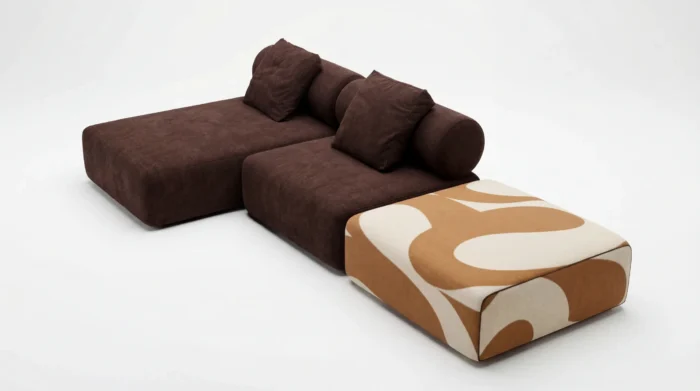
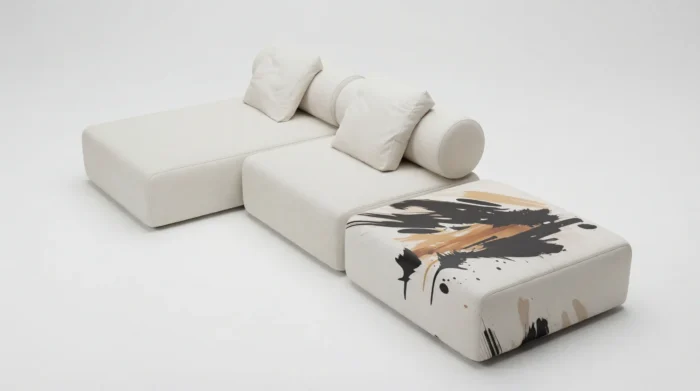
This idea is well revealed by Chess Illusion sofa — graphics and rhythm can become the main accent, but they need to be precisely dosed. In a small pouf, such graphics sound more compact and safer for the interior.
A small pouf as an alternative to a chair
A chair provides comfort, but it takes up space. A small ottoman provides a different kind of comfort: a short, flexible, informal fit. It’s not a replacement for a lounge chair, but a solution for places where a chair just doesn’t fit or looks too heavy.
A pouf is appropriate if:
- you need to add a landing, but keep the passage;
- the space cannot withstand a large silhouette;
- need an item without a back;
- mobility is important;
- I want to add textiles and color;
- The area should be soft but not congested.
In compact spaces, an ottoman often works better precisely because it doesn’t have a back. It doesn’t block the view, doesn’t create a high vertical, doesn’t block a mirror, window, or facade. It’s easy to get around and easy to move.
This is noticeable in the photo: if there were a chair in the center of the dressing room, it would break the symmetry and take up the passage. The pouf, on the contrary, creates a center, but leaves the space light.
Compact area as a small art scenario
KAIZEN is better to talk about compact zones not because of utilitarianism, but because of the scenario. A balcony is not just a place to “put something small”. A kitchen is not only a functional unit. A niche is not an empty remnant of planning.
Each such zone can get its own soft mood.
A small pouf can become:
- accent by the window;
- soft landing on the balcony;
- coffee point scenario in the kitchen;
- an item in the dressing room;
- an element near the mirror;
- part of a compact lounge area;
- a mobile object between the kitchen and the living room.
This approach is similar to how KAIZEN works with other soft items. For example, modern Ritmo Jazz Soul banquette creates a zone of interaction through form and textiles, and Ritmo Maverick beauty salon bench shows how upholstered furniture works not only for seating, but also for the atmosphere of a space.
In a small pouf, this logic becomes even more compact: less space, but the same impact on mood.
Where exactly to put a small pouf
For a pouf to look appropriate, it needs to find the right spot. This is especially important in a compact area.
| Place | How does a pouf work? |
|---|---|
| Balcony by the window | creates a gentle coffee or reading break |
| Small kitchen | adds flexible seating without a heavy chair |
| Kitchen-living room | connects the dining and lounge areas |
| Niche | turns an empty corner into a script |
| Wardrobe | gives a fit for choosing clothes |
| In front of the mirror | creates a beauty or dressing scenario |
| Near the console | completes the composition |
| Near the sofa | becomes an extra seat or footrest |
More about the pouf near the mirror and dressing table in the article “Pouf for dressing table”. This is one of the strongest compact scenarios, because the pouf should be beautiful from all sides and look good in reflection.
How to choose a small pouf: a short checklist
Before choosing a small pouf for a balcony, kitchen, or niche, you should answer a few questions.
- Where will he stand most of the time?
Balcony, kitchen, niche, dressing room, area near the window, near the mirror. - Does it need to be moved often?
If so, choose a compact shape and a design that is not too massive. - What is the main role?
Additional seating, accent, stand, soft spot, beauty zone, coffee break. - Are there any textiles nearby?
Curtains, carpet, blanket, sofa, pillows, chair upholstery. - What is the background?
If the background is calm, a print is fine. If the background is active, a textured or solid-colored fabric is better. - Is customization needed?
In small spaces, size, color, and fabric need to be especially precise. - Will the pouf be visible from all sides?
If so, the quality of the shape, base, seams, and print is important.
Conclusion: a small pouf creates softness where space is lacking
Compact space doesn’t mean rigid space. A balcony, a small kitchen, a niche, a window area, or a dressing room can have its own soft scenario—no armchair, no large sofa, no clutter.
A small pouf is all it takes. It adds seating, texture, color, tactility, and the ability to change the space throughout the day. It can be placed by the window, moved to the kitchen table, moved to the sofa, left by the mirror, or used as an accent in a niche.
In the photo, the pouf works exactly like this: in the narrow space between the cabinets, it creates a center, but does not take away the movement. The burgundy and milky print adds character, the wooden base maintains the warmth of the interior, and the round shape makes the object soft and mobile.
Ago pouf on the balcony, pouf for the kitchen or small pouf for a niche, it’s not about utilitarianism. It’s about a compact soft zone where the interior lacks pause.