Зміст
There are spaces where everything is just right: flat surfaces, clean lines, a calm palette, thoughtful lighting. But the eye glides over them too quickly. The room looks complete, but it lacks a focal point—an object that stops the eye and adds a sense of presence.
In such an interior modern pouf works very precisely. It doesn’t take up much space, doesn’t clash with large furniture, doesn’t overload the composition. But its shape, fabric, color or print can change the entire mood of the space.
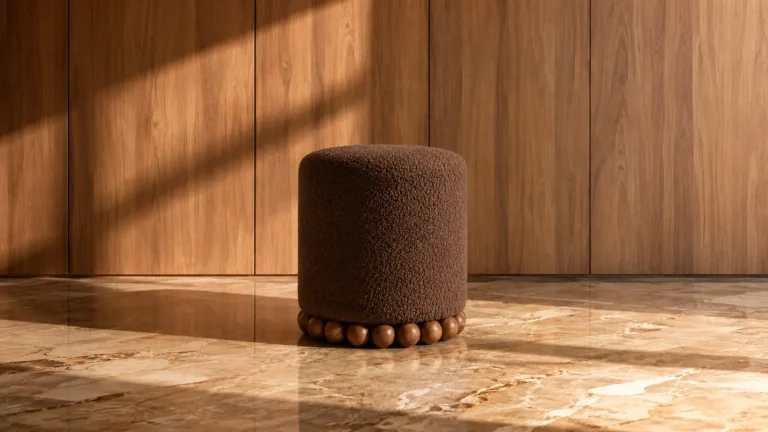
A burgundy and milky checkerboard print near a wooden console adds graphicity and warmth. A brown textured fabric against a background of wooden panels creates a quiet, deep accent. A blue art print under a black console works more boldly – like a small burst of energy in a restrained architectural scene.
That’s why stylish pouf Today, it’s not just a “place to sit.” It’s a way to make a space softer, more mobile, and more alive without major interior changes.
A modern pouf is not a decoration, but a scenario
Modern interiors are often built on clean planes: walls, panels, consoles, mirrors, cabinets, stone, wood. This creates order, but sometimes makes the space too static. The pouf adds what straight lines lack: roundness, softness, pause.
It can be a place for a short landing in the hallway, a spot near the dressing table, an accent in the bedroom, a mobile element in the living room or a soft detail for a showroom. In a commercial space, such a landing also works for the customer experience – more about this in the article “Pouf for office, shop and commercial spaces”.
The formula for a modern pouf:
MODERN POUF = SOFT SHAPE × MOBILITY × FABRIC × CHARACTER
It is important that the pouf does not need a separate “zone.” It can appear where the armchair would be too big, the bench too long, and the chair too hard.
The soft-shape trend: why roundness has become important
Hard, straight lines have long dominated modern interiors. They give a sense of order, but can also create tension. Rounded objects work differently: they reduce visual sharpness, soften movement paths, and make a room more tactile.
A round pouf fits into this logic particularly well. It has no sharp corners, is easy to read from different sides, does not block the space and looks natural next to a mirror, bed, console or armchair. That is why the topic of the round shape is separately discussed in the material. “Round pouf: soft geometry”.
In modern interiors, roundness is not just about aesthetics. It’s about a sense of calm. When a room has a lot of verticals, panels, doors, cabinets, and rectangular furniture, a round soft object balances the composition.

Stylish pouf as an accent: color, print and texture
Stylish pouf It doesn’t have to be bright. Its style can be based on very different things: deep color, fabric texture, graphic print, proportion, base, or interaction with other materials.
The burgundy and milky checkerboard motif creates dynamics. It adds space for movement, but does not look random, because it is supported by warm shades of wood, marble, and soft light.
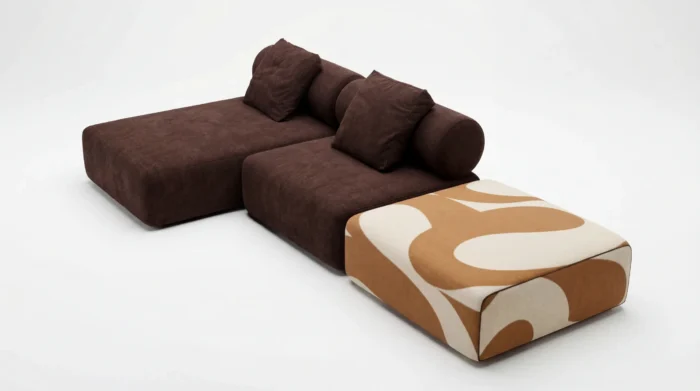
A brown textured pouf works more quietly. Its strength lies in the depth of the fabric, the warm tone, and the delicate spherical base. It is not a flashy accent, but an object that gathers space through tactility.
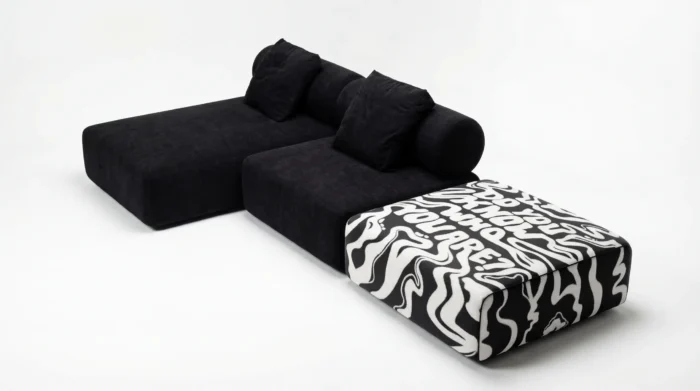
The blue art print is bolder. It adds graphics, energy, and a sense of authorial gesture. Such original pouf works well where the interior needs a living detail: in the hallway, showroom, salon, bedroom or lounge area.
| Decision | What character creates | Where it works best |
|---|---|---|
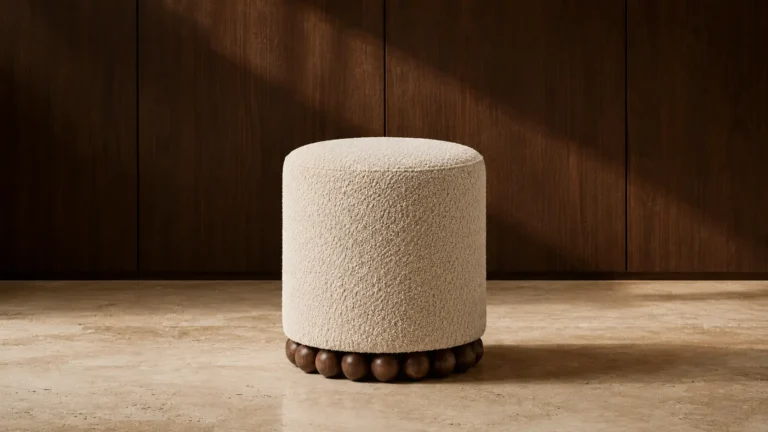
| Calm textured fabric | warmth, depth, tactility | bedroom, living room, hotel, lounge area |
| Graphic print | rhythm, energy, focus | hallway, showroom, near the console |
| Art print | individuality, courage, author’s accent | salon, studio, creative space |
| Dark base | contrast, graphics, modernity | interiors with black details |
| Natural wooden base | softness, warmth, naturalness | spaces with wood, stone, textiles |
Original pouf without visual noise
Originality does not mean excess. A pouf can be very expressive, but still remain collected. To do this, it is important that every detail makes sense: shape, fabric, print, color of the legs, proportion to the space.
One of the risks in modern interiors is to add an “accent for the sake of an accent.” Such an object quickly becomes annoying or looks alien. In KAIZEN, the logic is different: the pouf should support the space, not fall out of it.
Error → solution
Error: The interior is calm, but the pouf is chosen too randomly.
Decision: choose fabric and color to match existing materials — wood, stone, textiles, metal.
Error: I want an original pouf, but I’m afraid of overloading the room.
Decision: Keep the shape simple and add character through print or texture.
Error: The space has a lot of straight lines and looks rigid.
Decision: use a round pouf that softens the geometry.
Error: The pouf stands next to the console or mirror, but looks lower than the composition.
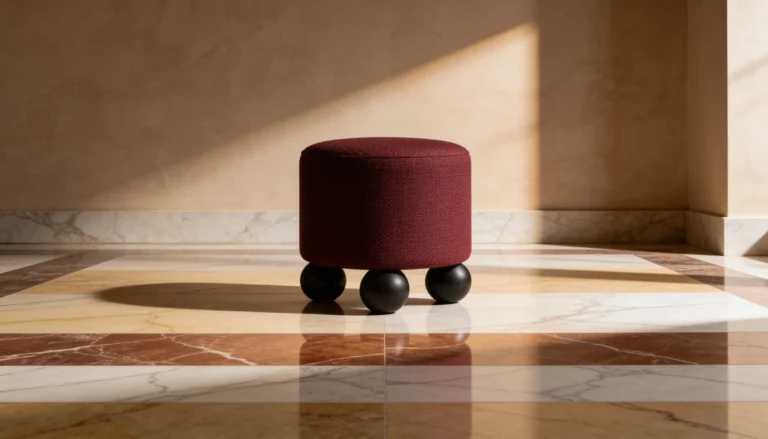
Decision: pay attention to the model with ball-shaped legs – such a base visually lifts the silhouette. More about this logic – in the article “Pouf on ball legs”.
Compactness and mobility: the main advantage of the pouf
A modern pouf is valuable because it doesn’t require much space. It can be placed where a full-fledged armchair would create overload, and a chair would destroy the soft atmosphere.
It works easily in various scenarios:
- Near the console or mirror — as a short landing and an accent point.
- In the bedroom — as a soft object next to the bed, wardrobe, or dressing table.
- In the hallway — as a place to pause at the entrance.
- In the living room — as an additional seating area or an element of a lounge composition.
- In the salon or showroom — as a photogenic detail and part of the client’s itinerary.
- In a compact area — like a soft object where there is no room for a chair.
It is mobility that makes the pouf modern not only in appearance, but also in its behavior in the interior. It does not fix the space forever, but allows for changing scenarios.
How to choose a modern pouf for your interior
Before choosing, it’s worth looking beyond the color or print. A modern pouf should work in a specific space.
Pay attention to several criteria:
- form: a round shape softens the interior, a square or rectangular one may work better in niches;
- height: the pouf should correspond to the seating scenario – near the console, bed, sofa or mirror;
- cloth: textured fabric adds depth, smoother fabric looks more restrained;
- color: a calm shade integrates the pouf into the space, a bright or contrasting one makes it an accent;
- print: art print is suitable where character and focus are needed;
- basis: spherical legs add rhythm, lightness, and architecturality to the object;
- scenario: The pouf should fit the real life of the space, not just look good on its own.
“Details are not details. They make the design.” — Charles Eames
This idea explains why a modern pouf cannot be judged solely as a small seat. It is the details – the fabric, the spherical base, the print, the height, the proportion – that create the feel of the object.

KAIZEN Customization: When the Pouf is Not Random
In a modern interior, an ottoman is rarely just “another soft object”. It is in such compact pieces of furniture that the character of a space is often concentrated: through shape, material, proportion, color, print and even the way the object stands on the floor. That is why at KAIZEN we look at the ottoman not as a standard item from a catalog, but as part of a holistic interior language.
When an object is chosen solely on the principle of “something small and convenient,” the result is often neutral but characterless. The pouf does not support the composition, does not reinforce the idea of space and remains simply a functional addition. Customization works differently. It allows you to create an object that does not accidentally end up in the room, but precisely fits its mood, rhythm and style.
For KAIZEN, this means that the pouf can be adapted to a specific usage scenario. If it is needed for the bedroom, it is important that it supports an atmosphere of silence, tactility and morning or evening rituals. If it is a pouf for the hallway, it should be compact, convenient for a short landing and at the same time expressive enough to work as an accent near a mirror or console. If the pouf is created for the living room, it already enters into a dialogue with a sofa, armchair, coffee table and can be a continuation of the lounge scenario. In the beauty zone or near the dressing table, landing height, softness and visual lightness come to the fore.
That’s why customization doesn’t start with fabric, but with the question: What role should an ottoman play in a particular space? After that, everything else is selected – shape, size, height, proportion, support, fabric, color, and decorative character.
What exactly can be adapted?
At KAIZEN, customization is not just about changing the color. In fact, a modern pouf can be configured much more precisely:
- form — more restrained, rounded, soft or graphic;
- height and proportion — for seating near a bed, mirror, console or in a lounge area;
- diameter and dimensions — for a compact room or a more spacious composition;
- cloth — from calm textured to expressive, tactilely active or smoother;
- color — in tone with the interior, in contrast to it or as an accent;
- art print — if the space needs individuality and visual focus;
- base and supports — in particular, options with spherical legs, which add architectural character and rhythm to the object;
- general character — calm, status, soft, playful, art object or more commercial.
It is in this approach that true design is manifested. Not in the formal word “designer”, but in the precision of decisions. The same pouf in a different fabric, color or proportion can look like a completely different object: warmer or more graphic, restrained or bold, homely or distinctly commercial.
Customization for private interiors
In private space, this is especially important, because successful interiors are not only based on large furniture. Often, it is small objects that create a sense of completeness. An ottoman can connect a bed, a blanket, curtain textiles and a wooden console. It can support the shade of the walls or, conversely, become the very point of contrast that “revives” the interior.
For example, for a bedroom, one client chooses a soft, calm shade and textured fabric so that the pouf looks almost like a part of the textile environment. Another wants an original accent and works with a burgundy and milky print or an unusual base. Both solutions are correct if they are based on space, not abstract fashion.
Customization is also useful when the interior already has strong materials – wood, stone, active textiles, mirrors, decorative lighting. A ready-made random pouf may simply “not fit” with this composition. And an individually selected one – on the contrary, will connect all the elements together.
Customization for interior designers
For designers, KAIZEN is an opportunity to work not with a compromising ready-made object, but with an element that adapts to the concept. In design work, this is very important: sometimes a space is already built on a certain plasticity of forms, a certain type of color or rhythm of materials, and an ordinary serial pouf looks alien in it.
In such cases, the designer needs not just a “pouf”, but a tool. An object that can support the author’s idea: repeat the roundness of other furniture, respond to the lines of a mirror, enhance the soft geometry of the room or, conversely, introduce graphic contrast through a print. Customization helps preserve the conceptual integrity of the interior – and this is especially valuable in author’s and premium projects.
Customization for B2B and commercial spaces
For commercial spaces, an individual approach has even greater weight. In a reception, beauty salon, showroom, boutique, hotel or waiting area, a pouf works not only as a place to sit. It becomes part of the brand and the customer experience. A person may not be able to put it into words, but it is through such objects that they read what a space is like: discreet, warm, status, bold, modern or creative.
Therefore, for B2B projects, the following are important:
- fabrics in brand colors;
- serial production of several identical or variant models;
- sustainable practical materials;
- shapes that work well in the flow of people;
- expressiveness without overload;
- the ability to integrate poufs into a holistic space concept.
In a beauty salon, it could be a soft seating area in the waiting area that supports the delicate aesthetic of the brand. In a showroom, it could be a more expressive object that becomes a photogenic point. In a boutique, it could be a compact pouf in the fitting room that works both functionally and emotionally. In an office or reception, it could be a soft element that removes visual rigidity and makes the space more welcoming.
Why is this important for the pouf?
The paradox is that the smaller the object, the more important the details are. A large sofa naturally becomes the center of the room simply because of its scale. And an ottoman should “work more subtly.” Its strength is not in size, but in its accuracy. If it is chosen correctly, it connects the interior, adds rhythm, softens geometry, maintains style and creates a sense of completion. If not, it looks random.
That’s why customization for a pouf is not a luxury “for beauty.” It’s a practical tool that allows you to make a small object strong and relevant.
The pouf as part of a whole, not a separate object
At KAIZEN, we consider the pouf as an extension of the entire space. It can harmoniously repeat the colors of the room or vice versa – set a new accent in it. It can be very calm or very expressive. It can become a soft pause among strict planes or a small art object in a laconic interior.
This is the point of customization: not just changing the fabric, but creating an item that looks as if it was conceived with the space in mind from the beginning.
Current models, trends and options for individual selection can be viewed in the category KAIZEN poufs.
Conclusion: a modern pouf makes a space livelier
A modern pouf is not a small decoration or a spare seat “just in case”. It is a compact soft object that changes the rhythm of the interior. It softens straight lines, adds tactility, creates a pause and can become a calm or bold accent.
A checkered burgundy and milky print adds graphicity to the space. A brown textured fabric creates depth and warmth. A blue art print makes the pouf energetic and original. All these solutions work differently, but have a common logic: the pouf does not just stand in the room, but affects its mood.
If needed modern pouf, which will not look random, it is worth starting with the space: where it will stand, what materials it will work with next to it, what emotion it should add. KAIZEN will help you choose the shape, fabric, color and print so that the stylish pouf becomes not an unnecessary detail, but a natural soft spot in the interior.