Зміст
Buying a sofa: why modular sofas are the smartest solution for a modern living room
Today, buying a sofa means more than just getting a “soft place to sit.” The sofa has become the center of the living room, a home hub where you work with your laptop, watch TV shows, entertain guests, and sometimes even sleep. That’s why more and more people are choosing sofas over classic models. modular sofas — flexible systems that adapt to life, not the other way around.
In this article, we will analyze what a modular sofa is, how it differs from a regular one, how to choose the configuration, size, materials and style. And also – when it makes sense order a custom-made modular sofa, rather than taking a ready-made version.
Let’s combine simple explanations for the buyer with the professional perspective of a designer — in the format of “selling SEO articles with benefits,” not a dry catalog.
What is a modular sofa and who is it suitable for?
Short:
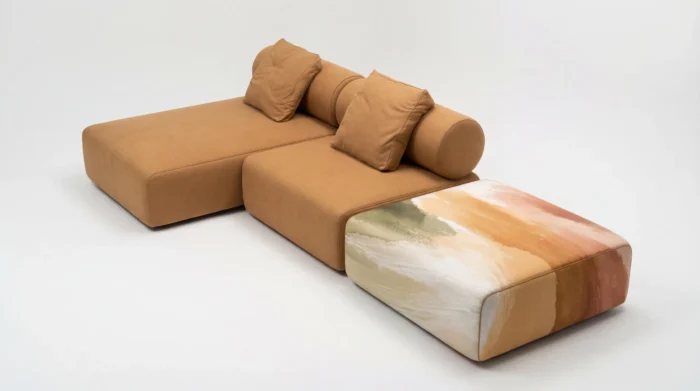
A modular sofa is a sofa that consists of separate blocks (modules) that can be combined, rearranged and supplemented. It is not just a “corner sofa”, but a designer where you create the desired shape: from a compact sofa for a studio to a large sectional sofa for a spacious living room.
Who are modular sofas suitable for:
- owners of apartments with complex layouts (non-standard niches, bay windows, studios);
- families where the sofa is the main point of attraction: children, guests, pets;
- for those who like to rearrange furniture and experiment with the interior;
- designers who work with open spaces and modern sofas for the living room.
Example:
Imagine a studio apartment of 35–40 m². In one space there is a kitchen, a recreation area and a work corner. A classic straight sofa will either block the passage or look like a random “bench”. Instead modular corner sofa You can assemble it so that one module separates the kitchen from the seating area, and the other creates a comfortable TV area. If your lifestyle changes or a child appears, the configuration can be reassembled.
Buy a sofa or choose a modular one right away: what is the difference in practice?
Short:
A classic sofa is a fixed form “as is”. A modular sofa is a flexible system that can be changed, expanded, simplified. If you like stability and know for sure that the layout will not change, a standard sofa will also work. If life is more dynamic, it is more logical to immediately look towards modular solutions.
Comparison table: classic sofa vs modular sofa
| Criterion | Classic sofa | Modular sofa |
|---|---|---|
| Planning flexibility | The shape is unchanged | You can rearrange, add, change configurations |
| Scaling | Do not expand without replacing the sofa | Easy to add new modules, ottomans, corner elements |
| Moving and repairs | Often “tied” to a specific wall | Rebuilding for new planning |
| Interior update | You often have to buy a new sofa | It is enough to change some of the modules, covers, prints |
| Sitting/sleeping area | Usually one format | Different depths are possible, sofa-transformer from modules |
| For whom | Static interiors | Dynamic families, young couples, creative interiors |
Example:
A family with two children first collects modular sofa in the “L” format with a chaise longue. A few years later, the chaise longue is moved to the window, creating a reading area. After a while, one module is added and the sofa is transformed into a U-shaped one for a large company. The basic “core” of the sofa remains the same – only the configuration changes.
How to choose a modular sofa: a step-by-step guide
Step 1. Analyze the space and life scenarios
Short:
Don’t start with color or upholstery. Start with planning and your scenarios.
Ask yourself the question:
- How many people use the sofa regularly?
- Do you sit more or do you like to “lay down”?
- Should the sofa serve as an extra bed?
- Do guests come often?
- Are there children/animals?
Example:
If you live alone but often gather friends, it makes sense to get a modular system where you can add an ottoman or a separate module that works as a temporary seating area if needed.
Additional key phrases that fit naturally:
“buy a modular sofa for the living room”, “modern modular sofa”, “modular sofa for a studio apartment”.
Step 2. Measure the space and consider the aisles
Short:
The ideal sofa is not one that fits snugly, but one that is comfortable to walk around.
- Leave at least 70–80 cm for passage.
- Do not block the lines of traffic to the kitchen, balcony, or bedroom.
- Think about where the TV will be, how the table and chairs will be placed.
Example:
In a narrow living room, instead of a deep sofa 110 cm wide, it is better to choose modular sofa with different seat depths: base part — 90 cm, one module — 110 cm as a place for relaxation.
Step 3. Determine the desired modular sofa configuration
Short:
Main options:
- Straight modular sofa with the option to add a corner.
- Corner modular sofa in “L” format.
- U-shaped sofa for large spaces.
- Sectional sofa with separate poufs, ottomans, and chaise lounges.
How to choose:
- Small living room: straight + one corner module or pouf.
- Medium apartment: “L” shape with ottoman.
- Private house / large living room: U-shaped sofa, possibly with a separate lounge module.
Step 4. Choose your comfort level: depth, firmness, back
Short:
Comfort is a combination of seat depth, backrest height, and type of filling.
What to pay attention to:
Seat depth
55–60 cm — for a more upright position (convenient for working with a laptop).
65–75 cm — for “lying” rest, movie nights, relaxation.
Backrest height
Low — a modern, lightweight silhouette, more about aesthetics.
Higher / with pillows – about comfort and back support.
Filler
The combination of PU foam + spring block or elastic belts is a balanced option.
The top layer of soft filling adds a “hugging” feeling.
Example:
If you want buy a sofa-transformer For daily relaxation, it is logical to choose models with a deeper seat and a softer top layer, but with reliable support inside.
Step 5. Upholstery: fabric that lives your rhythm
Short:
The upholstery material should match the intensity of use and lifestyle.
Popular solutions:
Wear-resistant furniture fabrics with a high Martindale score – for families with children and pets.
- Easy clean / stain resistant fabrics are for those who like to eat on the couch and don’t want to panic over every drop of coffee.
- Textured fabrics with a pronounced weave add depth and “texture” to the interior.
- For premium interiors – velvet, microvelour, a combination of textures: smooth modules + an accent module with a pronounced texture.
Futuristic KAIZEN approach:
At the KAIZEN studio, choosing upholstery is like creating visual map of space. First, a 3D concept of the sofa in your living room is modeled: how shadows, light, prints and texture will work with the floor, walls, lighting. Only then are fabrics and colors finalized.
Step 6. Design and style: how to fit a modular sofa into the interior
Short:
Modular sofas easily adapt to different styles – from minimalism to loft and modern.
Minimalism
Clean lines, low profile, neutral colors (white, beige, gray, cool graphite).
Laconic modules without unnecessary decorative seams.
Loft
More massive shapes, deeper seats.
Warm gray, terracotta, olive shades, combinations with brick and metal.
Modern / modern classic
Soft radii, rounded corners of modules.
A combination of a calm base and one or two accent modules — for example, with a different color or print.
Example:
In a neutral living room in the color “coffee with milk” modular sofa in light gray upholstery can have one accent module of a rich color (emerald, terracotta). This creates a light futuristic mood without aggressive contrasts.
Modular sofas and KAIZEN: when you need a “custom” level
Short:
Ready-made modular sofas are suitable for most interiors. But if you have a non-standard layout, special requirements for sizes, prints or functions, it makes sense to consider modular sofa made to order.
How the KAIZEN approach works:
Analysis of space and life scenarios
The designer doesn’t just ask “what color sofa do you want?” but studies your lifestyle: how you relax, how often you receive guests, and whether you have a home office in the living room.3D visualization of the concept
A visualization of your space with the sofa is created — even before production. You see how the modules work in plan, how they look from different angles, how the prints and textures behave.Customization of modules and prints
Non-standard sizes (for example, very wide modules for spacious houses).
Ability to add printing on furniture: your prints, graphics, patterns.
Different module depths within one sofa (one is a relaxation area, the other is a work area).
Materials and technologies
Materials are selected that can withstand your rhythm: from dense fabrics to high-tech upholstery that is easy to clean.
“A modular sofa is not just a piece of furniture, but the architecture of your relaxation.
“At KAIZEN, we design it so that it works for you today, tomorrow, and in 10 years.”
Common mistakes people make when buying a modular sofa
Short:
Most sofa disappointments arise not from the manufacturer, but from the wrong brief or choice.
Main errors:
Focus only on Pinterest photos
In the picture, the modular sofa is in a living room of 50–60 m², but in reality it is 18 m². The result: the sofa “eats up” the entire space.Unmeasured aisles and doorways
They forget about the width of doors, the turns of corridors, the height of the elevator. The modules may not fit or it will be difficult to insert them.Too soft sofa for everyday sitting
Falling beautifully into a sofa in a photo is one thing. Working in such a position every day is another. It’s important to find a balance between softness and support.Impractical upholstery
Light velvet in a family with two children and a dog is a decision that quickly disappoints. It is better to choose an easy-care fabric and add an accent in the form of decorative pillows or a single module.Lack of flexibility
People buy a minimum set of modules “to fit in”, but do not consider the possibility of buying additional modules later. It is important to immediately think about how the sofa can scale in a few years.
Modular sofa care: how to maintain a premium look for a long time
Short:
Caring for a modular sofa is not much different from caring for a regular one, but there are nuances.
Recommendations:
- Vacuum the sofa regularly with a soft nozzle – this extends the life of the fabric.
- If the upholstery has easy clean technology, react to stains immediately, don’t wait for them to soak in.
- Change the modules or pillows every few months – this will help avoid “favorite holes”.
- If the sofa is custom-made with a custom print, follow the manufacturer’s recommendations for cleaning products to avoid damaging the graphics.
Example:
At KAIZEN, customers often order modular sofa with individual print on one or two modules. In this case, the designer immediately offers fabrics that combine abrasion resistance and the ability to accurately convey color and graphics.
FAQ: short answers to popular questions about modular sofas
Does a modular sofa have to be large?
No. Modular sofa for a small living room can consist of 2–3 compact modules. It is important to choose the right dimensions and configuration. It’s like a designer: bigger is not always better, the main thing is logic.
Which is better: a modular sofa or a regular corner sofa?
If you need a one-time solution, “set it and forget it,” a regular corner sofa may be enough. If you plan to change the interior, expand the space, make rearrangements — modular sofas give much more freedom.
Can I buy additional modules over time?
In quality systems, yes. This is one of the key advantages of modular sofas: you can first buy a basic set, and after a year or two add another module, ottoman or corner element. When ordering, it is worth immediately clarifying the possibility additional module purchases and find out how long the manufacturer keeps the model in the line.
Is a modular sofa suitable for daily sleeping?
If we talk about modular sofa-transformer, which is specifically designed for this – yes, it is possible. But it is important:
choose models with reinforced filler and a high-quality mechanism;
clearly communicate with the manufacturer that the sofa will be used as the main sleeping place.
How much does a modular sofa cost compared to a regular one?
Starting price modular sofa often higher than that of a classic model. But in the long run it can be more profitable: you don’t buy a new sofa every few years, but adapt the existing one through modules, covers, and configurations.
Conclusion: How to make an informed decision when you want to buy a sofa
In short, the formula is this:
You value flexibility, love updating space, plan to live in this home for a long time and develop the interior — modular sofas give you freedom.
You want to put an end to the sofa issue once and for all – you can consider a high-quality classic sofa, but it’s still worth looking at modular systems as an investment in comfort.
KAIZEN’s futuristic approach to sofas is not about “the sofa as an object”, but about sofa as a life scenario: with concept visualization, customization options, printing of your prints, and working with non-standard layouts.
Before you buy a sofa, think not only about how it will look in a photo, but also about how it will change with you. This is where modular sofas really shine.