Зміст
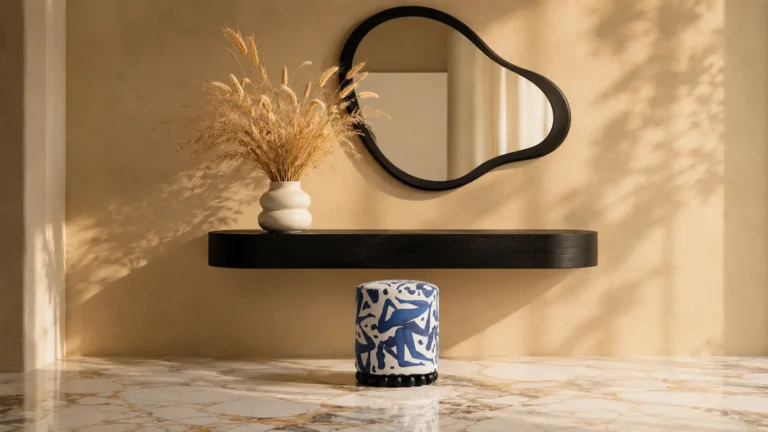
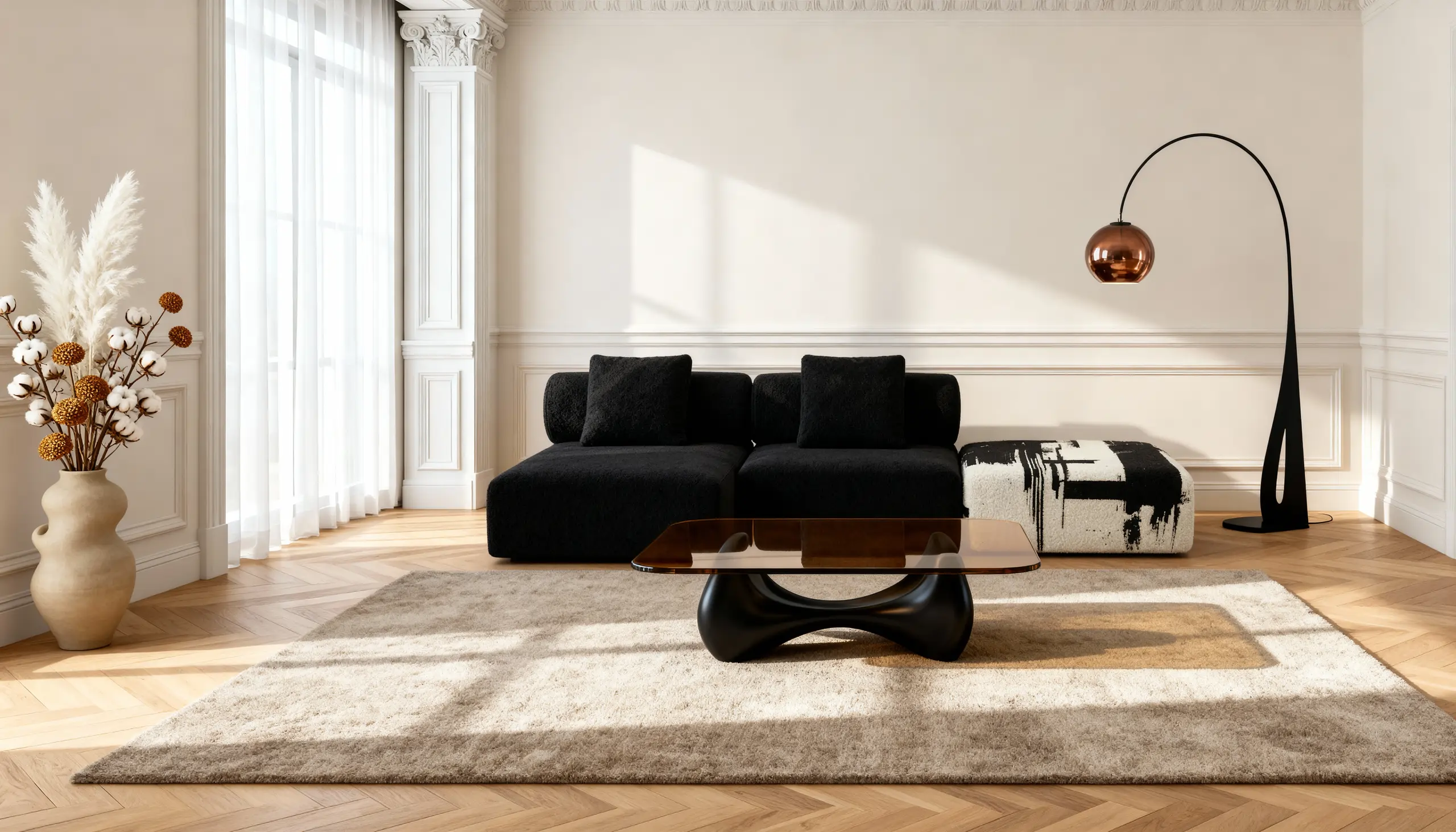
The light enters slowly, without asking permission. It slides along the light wall, breaks on the stucco, touches the wooden floor and stops on the black. Soft, deep, collected. Two modules stand side by side, as if they were an extension of the space, not a separate object. Nearby is a pouf with a graphic print, like a short remark in the silence. A metal lamp with a warm glow does not illuminate – it sets the mood. There is no need to explain here whose space this is. It speaks for itself.
This is how a sofa in a corporate style works. Not as a carrier of a logo, but as an element of a system in which identity, materials and space merge into one. In modern business interiors, such sofas almost never exist in isolation – they are part of a broader approach that shapes sofas with print as a tool for working with the brand through the environment, rather than through direct visual statements.
Corporate identity starts with a feeling, not with graphics
A sofa with a corporate style is not upholstery with corporate colors or a repetition of the logo in textiles. It is, first of all, the feeling that a person has when they sit down.
Corporate identity in space is read through:
level of calm;
accuracy of proportions;
restraint in decisions;
absence of random details.
In this interior, the black sofa does not dominate or disappear. It maintains balance. The light space enhances its depth, and the graphic print on the pouf adds character without aggression. This is how a sofa in a corporate style becomes part of the identity – not declaratively, but at the level of sensations.
Form as a carrier of brand character
“The real strength of a system is in its stability, not in the novelty effect.”
— Masaaki Imai
A branded sofa fits perfectly into the kaizen approach. It doesn’t need to be changed radically. It’s enough to adjust the details: modules, materials, accents. This is how a brand develops without sudden movements.
The first paragraph is to the point: the shape of the sofa conveys the character of the brand faster than any sign.
Sharp angles suggest rigidity. Excessive softness suggests a lack of structure. Here, the shape is collected but not dry. The low fit creates a sense of stability, and the modularity suggests flexibility.
This is critical in corporate spaces. A corporate-style sofa should:
do not change a person’s behavior abruptly;
not to break the space scenario;
maintain the overall logic of the interior.
That is why such sofas often overlap in approach with corporate style sofas, where design works quietly but systematically.
Mistake → solution: a brand that “screams”
Error: make the branded sofa too obvious.
Decision: let the brand be a backdrop, not a statement.
When identity appears everywhere—in color, graphics, shapes—the space quickly becomes tiring. A person feels pressure, even if they can’t articulate it.
In the correct solution:
the brand is read from intonation;
the colors are restrained;
point accents.
This is how signature sofas work, combining with other elements of the space as delicately as in the case of branded sofas, where the key is not brightness, but recognizability.
A sofa in a corporate style as part of a holistic corporate interior
In a holistic corporate interior, no element works in isolation. The space is perceived as a system where architecture, light, materials and furniture speak the same language. A sofa in a corporate style in such an environment is not an accent for the sake of accent – it stitches the space into a single whole. Its shape supports the architectural rhythm, the color does not conflict with the surroundings, and the material logically continues the overall tactile palette of the interior.
A corporate interior, built as a system, does not tolerate random solutions. If a sofa is out of context, it destroys the feeling of stability. That is why a sofa in a corporate style often has a restrained geometry and a basic color base, and the identity appears delicately – through proportions, rhythm, sometimes through a graphic accent in secondary elements. It does not compete with the walls, art or light, but works together with them.
In a holistic corporate space, the sofa becomes a point of balance. It combines a representative function with everyday use, without losing the character of the brand. A person may not realize why they are comfortable in this space, but it is such elements – such as a sofa in the corporate style – that shape this feeling. The interior ceases to look “made” and begins to be perceived as a natural environment for work, meetings and interaction.
Materials as part of identity
The material in the brand’s sofa is a language. In this space, the fabric is matte, tactile, without shine. It does not change dramatically in the light, does not create random reflections, does not “play” on the camera.
This is important for brands that:
work with clients directly;
build long-term trust;
value stability.
A contrasting printed pouf is not a decoration, but a tool. It supports the brand’s graphics without overloading the main volume. This is an approach often used in sofas with print, when identity is embedded in space, rather than superimposed on top of it.
A sofa in a corporate style as part of a space scenario
A branded sofa doesn’t exist without a script. It always answers the question: what’s going on here?
In such spaces it is usually:
short conversations;
waiting without tension;
informal meetings.
That is why a sofa in a corporate style often has a logic close to sofas for offices or waiting sofas, but with a greater emphasis on the character of the brand, rather than just function.
Table: branded sofa vs neutral sofa
| Criterion | Sofa in corporate style | Neutral sofa |
|---|---|---|
| Role | Identity bearer | Functional background |
| Form | Subordinate to the brand | Universal |
| Material | Part of the style | Practical |
| Accents | Dotted | Missing |
| Influence | Forms an impression | Does not affect |
Usage scenarios
Customer meeting
Waiting before talking
Pause between processes
In each of them, the sofa in the corporate style should remain stable and recognizable, without demanding attention to itself.
Final chord
The light becomes softer. The shadows from the lamp fall more smoothly. The black sofa remains in its place – confident, calm, unchanging. The space does not demonstrate the brand. It is it.
A sofa in a corporate style does not explain who you are. It allows you to feel it. And if you go back to the original scene, it becomes clear: the brand is not painted here. It is lived.
And it is in this lived brand that trust appears. Not declarative, not advertising, but quiet – the one that is formed from repetition day after day. When the sofa does not lose its appearance, does not get bored with its form, does not conflict with the space even after years. When it is equally appropriate during the first meeting and during an everyday work break. Such a sofa in the corporate style does not need updating, because it is already part of the culture. It is not about the impression at the entrance – it is about the feeling that remains after leaving.