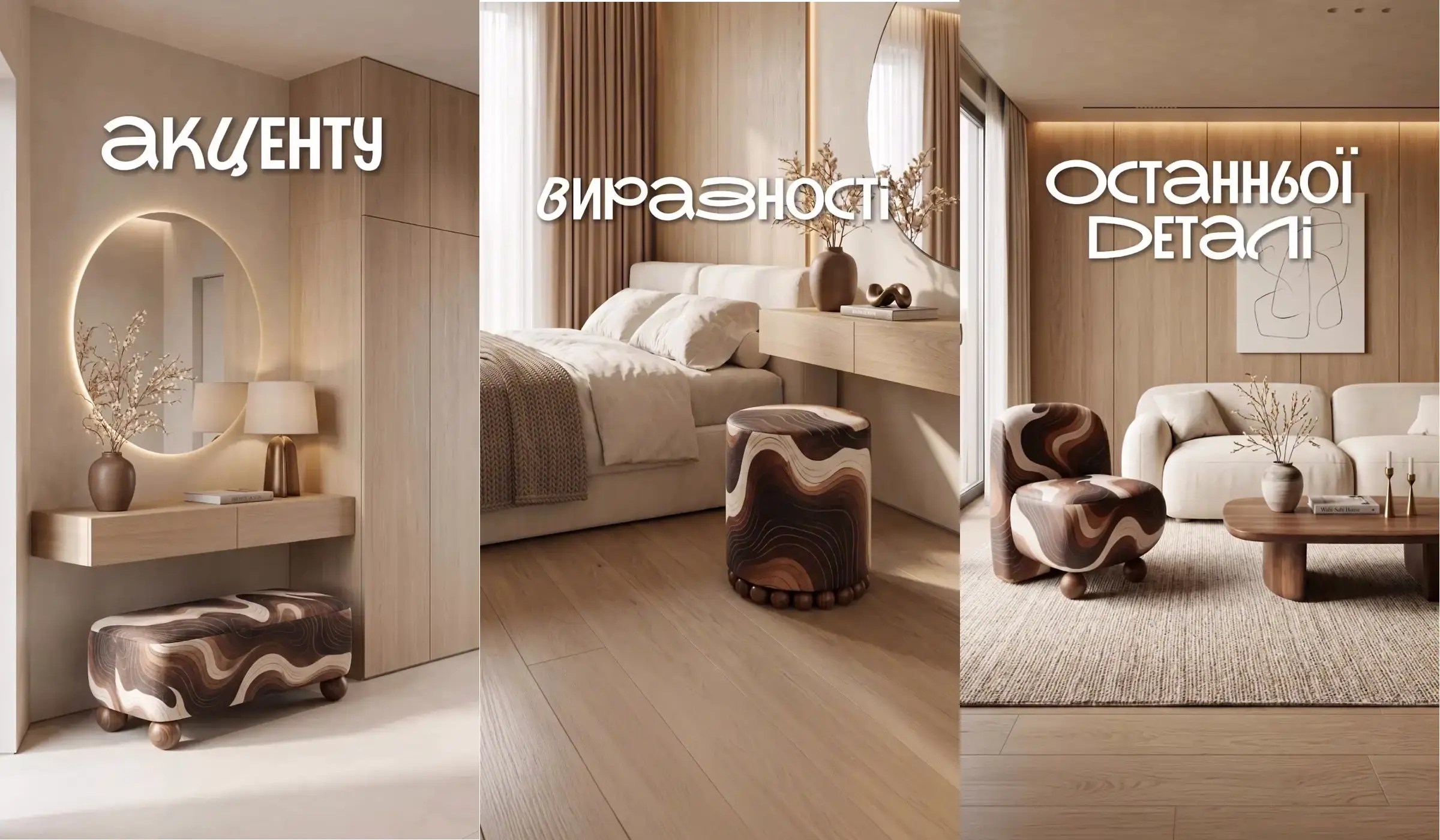
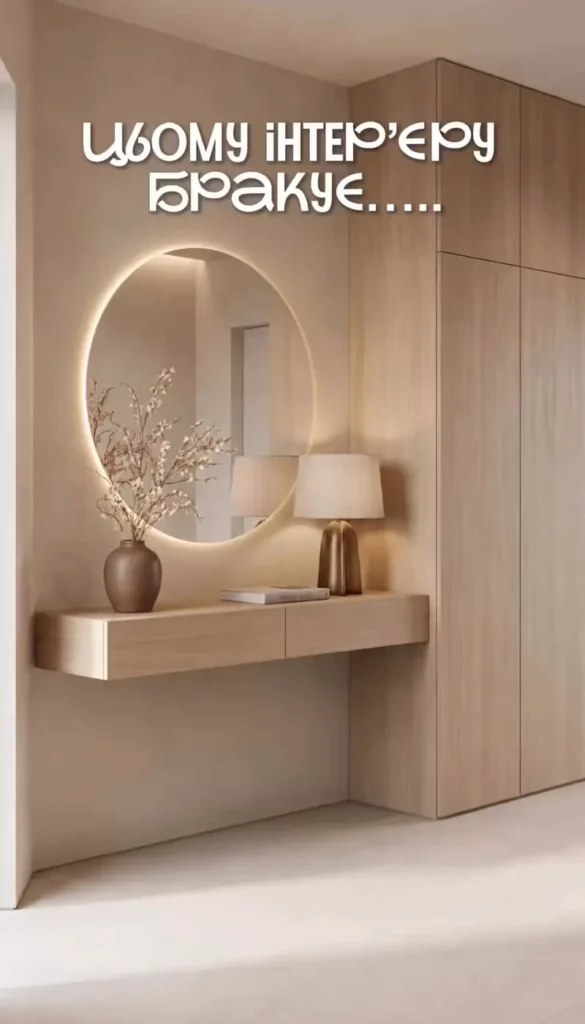
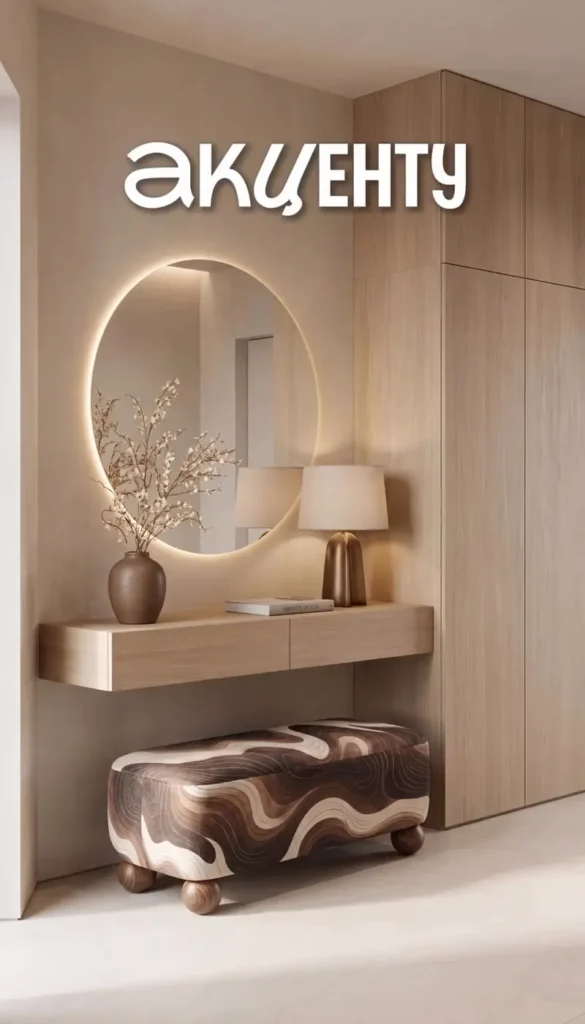
The light enters the hallway quietly, almost on tiptoe. It glides over the warm wood of the wardrobe, touches the round mirror, lights a soft circle of backlighting, and falls on the hanging console, where stands a vase of dry branches, a book, and a lamp with a copper glow. Everything is calm. Everything is clean. Everything is right.
But the gaze stops not because it has found the main thing, but because it is still searching for it.
There are rooms that seem to be made without mistakes. They have enough light, a pleasant palette, beautiful materials, modern furniture, the right proportions. They don’t annoy. They don’t argue. They don’t tire. But at some point, you get the feeling: the space is almost ready, but it lacks the final impulse. Not a renovation. Not a new wardrobe. Not another piece of decor. But one precise object that will take on the role of the heart.
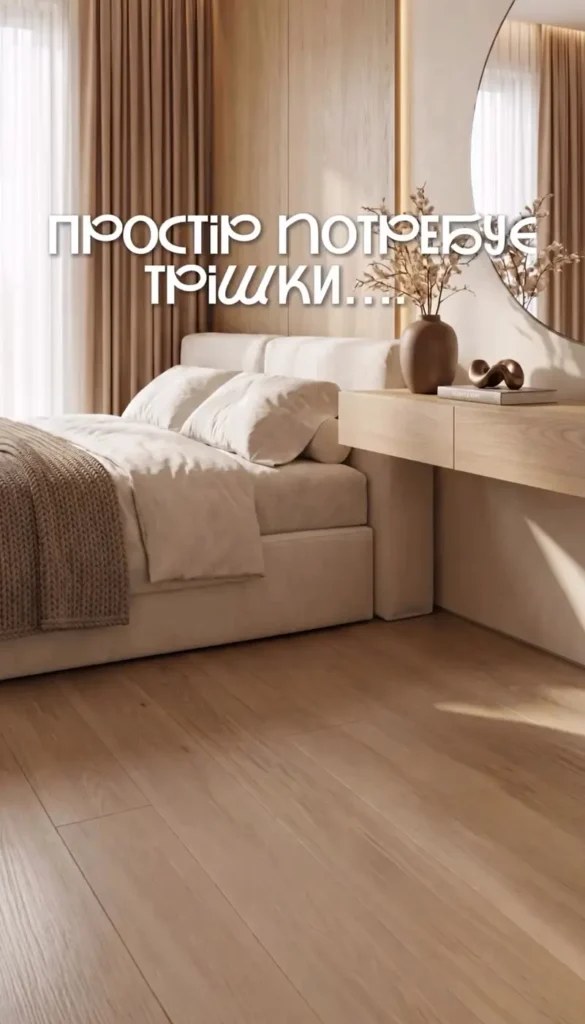
In the hallway, it could be a banquette with a wavy art print under the console. In the living room, an accent chair next to a neutral sofa. In the bedroom, a round designer ottoman next to the bed and mirror. The item is small, but it changes the temperature of the room. A space that was simply calm becomes expressive. An interior that was “right” gains character.
It is with this idea that it begins. Instagram post about an accent in the interior: the main tool that can change the character of a room without a global renovation is a correctly chosen accent. Not ten little things that argue with each other. Not a chaotic addition of colors. Not “something else for beauty”. But one main thing that first attracts the eye and sets the tone.
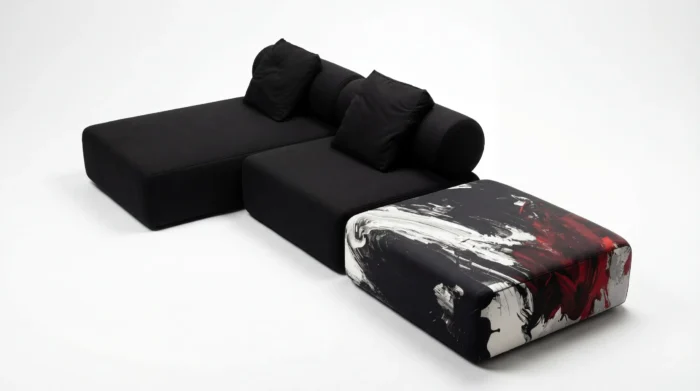
At KAIZEN, we often see this situation in interior design: the base is already there, but the space lacks emotional focus. And this is where an accent pouf, designer bench, or soft object with an art print works harder than it seems at first glance.
Why interiors often lack not furniture, but an accent
It’s very easy to make a modern interior calm. Wood, beige, milky, warm gray, minimalist facades, a rounded mirror, soft textiles, hidden light – all this has already become the language of the “right” space. Such solutions are comfortable for living, look good in the frame, are easy to perceive and almost do not risk getting bored quickly.
But this is where another problem arises: too many interiors start to sound the same.
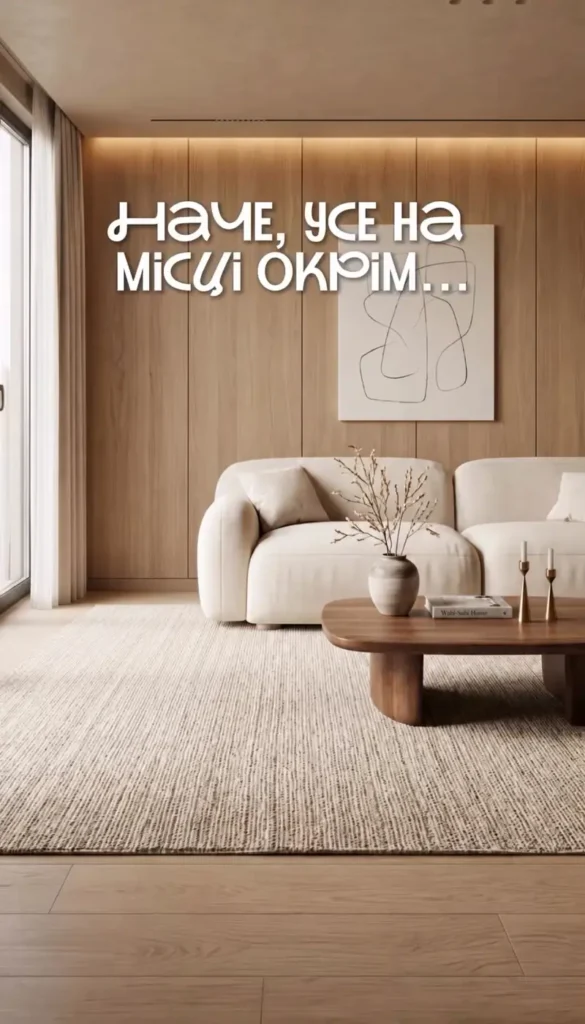
The hallway with its wooden wardrobe, console and round mirror has a great foundation. It is light, tactile, neat. But without an accent, it remains more of a backdrop than a stage. The living room with its white sofa, wooden wall panel, abstract painting and round table already has structure, but without a distinctive soft object the eye wanders. The bedroom with its bed, curtains, mirror and console creates peace, but needs a detail that makes this peace personal.
An accent is not just a “bright spot.” It is an object that explains a space. It suggests what is important here: silence or energy, minimalism or artistry, softness or graphics, privacy or openness.
Text formula for an expressive interior:
EXPRESSIVE INTERIOR = BASE + LIGHT + TEXTURE + ONE PRECISE ACCENT
The base gives peace. Light creates atmosphere. Texture makes the space come alive. But it is the accent that brings everything together into a single story.
The post suggests that instead of focusing on a lot of little things, it’s better to focus on one object that will become the heart of the room. This is very practical advice. Because when a person feels that the interior is “missing something,” they often start adding decor: another vase, another pillow, another painting, another shelf. As a result, the space doesn’t become stronger. It becomes noisier.
The right accent works differently. It doesn’t multiply details, but focuses attention.
In the hallway, a printed bench doesn’t just fill the empty space under the console. It adds function, rhythm, and visual depth. In the living room, an accent chair doesn’t compete with a white sofa, but creates a second centerpiece. In the bedroom, a round pouf doesn’t overwhelm the space, but adds softness, graphics, and completeness.
That’s why an accent pouf is not a “little thing.” It’s a design tool.
The rule of one main thing
In an expressive interior, not everything should be the main thing. It’s a simple idea, but it’s the one that’s most often violated. People see a beautiful color, an interesting painting, an unusual lamp, a textured rug, decorative pillows, printed textiles – and they want to add everything at once. But the space can’t stand it when every item demands attention.
The rule of one main thing works because the eye needs hierarchy. We perceive a room not as a list of objects, but as a composition. First we see the main center. Then the support. Then the details. If there is no center, the interior seems empty, even with furniture. If there are too many centers, it seems chaotic, even with expensive materials.
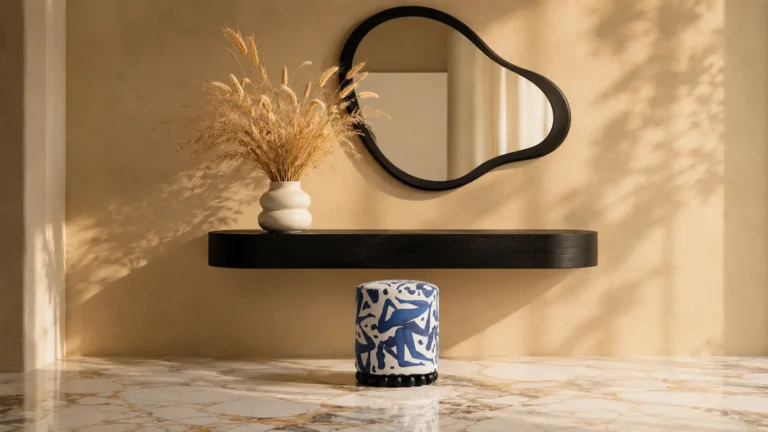
In the hallway, the main thing can be a bench with an art print. It is located low, does not cover the mirror, does not argue with the wooden cabinet, but immediately enlivens the entire vertical composition. The wavy pattern echoes the natural texture of the wood, and the rounded legs add softness to the image. Thanks to this, the bench does not look random. It seems like it was always meant to be there.
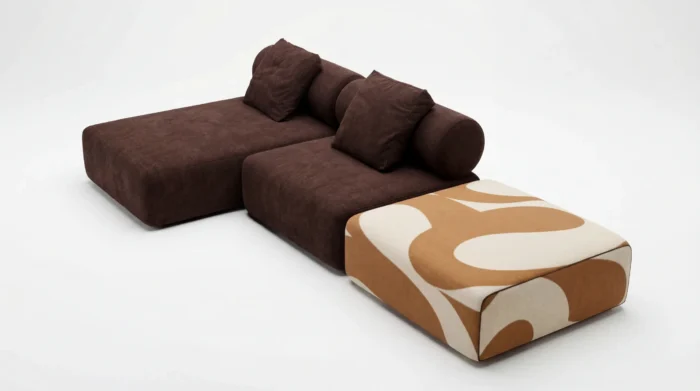
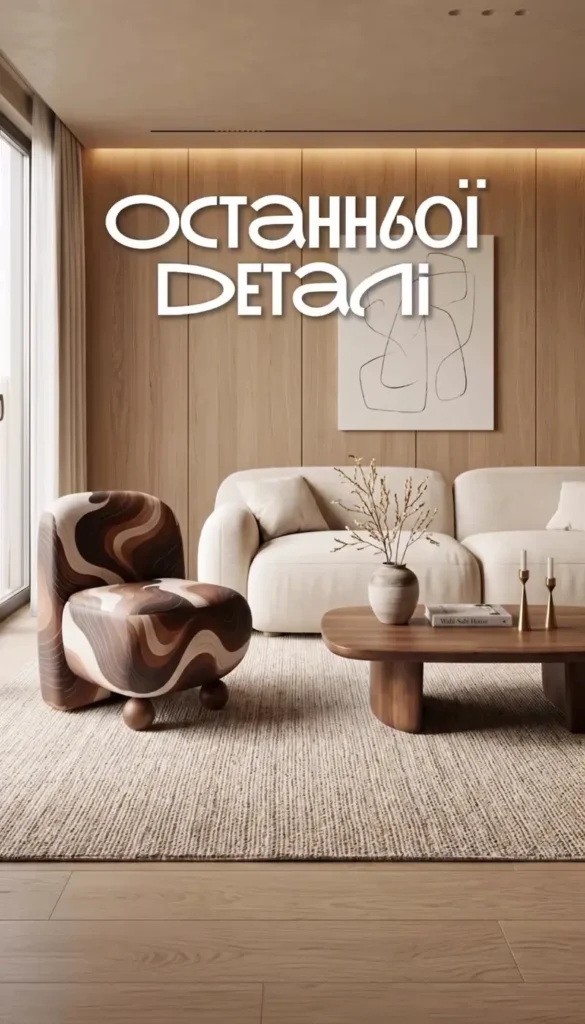
In the living room, the main accent can be an armchair. A neutral sofa, a wooden wall, abstract graphics, a rug and a round table create a calm foundation. But a printed armchair adds energy. It does not completely take over the room, because it works in the same natural palette: brown, cream, warm beige. But thanks to the wavy rhythm, it takes the interior out of predictability.
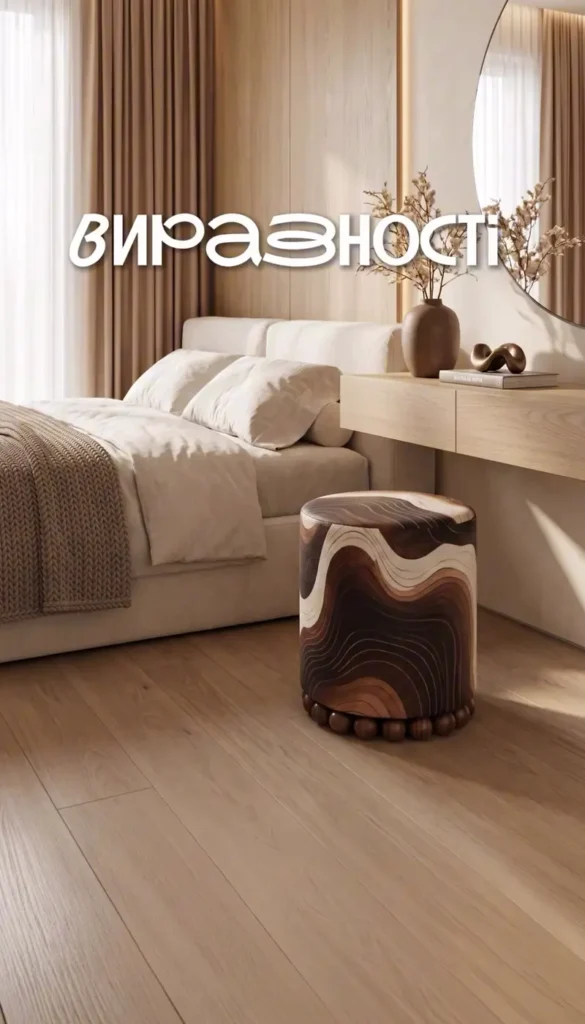
In the bedroom, the main accent can be an ottoman. It is compact but noticeable. Its rounded shape supports the softness of the bed and mirror, and the print adds graphic movement to a calm space. This is especially important for the bedroom, where the accent should be delicate. It should not destroy the feeling of relaxation, but should give the room character.
How the one main thing rule works
- Determine what should attract the eye first.
It can be a designer pouf, chair, banquette, large painting, accent wall or lamp. - Leave the other items to play a supporting role.
Decor, textiles, vases, books, and lighting should not argue with the main subject, but rather enhance it. - Check the contrast.
The accent should differ from the background in color, shape, texture or print. - Repeat his speech in small details.
If the pouf has a brown and cream print, wood textures, warm vases, ceramics, a plaid, or graphics in a similar palette can work well next to it. - Remove the excess.
If one item already serves as an accent, there’s no need to add five more competitors.
This is the principle of “less is more.” One thoughtful accent really looks more expensive than many bright details that have no common logic.
There’s something very similar to kaizen thinking in this approach. Masaaki Imai described kaizen as continuous improvement, born from attention to process and detail. In interior design, this means not necessarily changing everything at once. Sometimes, just one precise improvement is enough to make a room work differently.
Color, shape and print: how an accent changes a space without renovation
Global renovation changes architecture. Accent changes perception. And often the latter is more necessary.
When a room already has a quality base, it is not always necessary to repaint the walls, change the floor or order new built-in furniture. It is enough to add an object that will bring a new rhythm. In this sense, a designer pouf or a printed banquette is a very flexible tool: they do not take up much space, do not require complex installation, are easily integrated into different areas and immediately change the mood.
Color works first. In these interiors, the palette is restrained: wood, beige, milky, warm brown, soft daylight. Therefore, the accent does not have to be acidic or harsh. On the contrary, a wavy print in natural shades works more precisely: it remains within the general range, but adds movement. This is not an alien spot, but a visual extension of the space.
The form works as a second layer. The rounded legs of the bench, the soft volume of the chair, the cylindrical shape of the pouf – all this supports the trend for soft radius objects. Such forms do not break the interior with corners, but make it more tactile. They go well with a round mirror, smooth lines of textiles, a soft bed, a voluminous sofa and natural decorative branches.
The print works as the third layer — the most emotional. Wavy lines resemble the relief of the earth, the flow of a tree, the cut of a stone or the movement of sand. They add to the space not a literal pattern, but an organic rhythm. That is why such a print easily fits into warm minimalism: it is expressive enough to be an accent, but natural enough not to look random.
| Accent item | What changes in the room | Best Screenplay | What effect does it create? |
|---|---|---|---|
| Printed banquette | Fills the lower level of the composition, adds function and rhythm | Hallway, hall, console area | Completeness, hospitality, expressiveness |
| Designer chair | Creates a second center next to the sofa | Living room, lounge area, office | Depth, character, soft art object |
| Round accent pouf | Adds mobility and compact focus | Bedroom, dressing room, bedside area | Lightness, tactility, individuality |
| Custom-made pouf | Adapts to a specific space | Home, salon, office, showroom | Personalization, accuracy, brand language |
This table shows that an accent is not one universal item for all situations. In each zone, it has its own role. In the hallway, the function of seating and the first impression are important. In the living room, compositional balance. In the bedroom, softness and delicacy. In a commercial space, recognition and photogenicity.
That’s why at KAIZEN we don’t reduce accent furniture to “pretty upholstery.” We look at the bigger picture: how an item works with architecture, light, a person’s path, surrounding materials, and the mood of a brand or home.
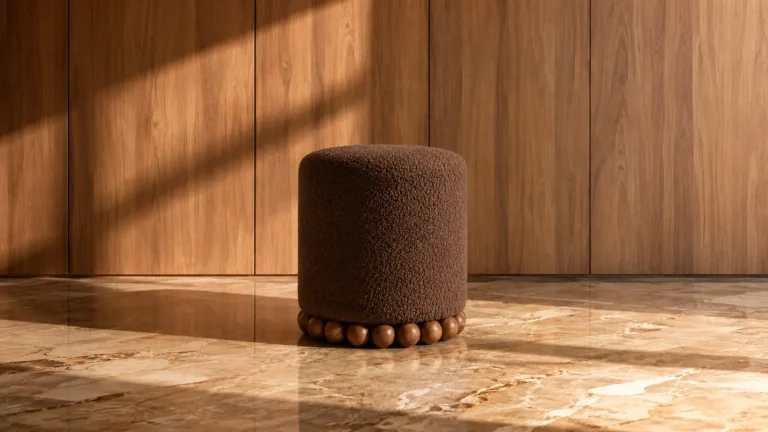
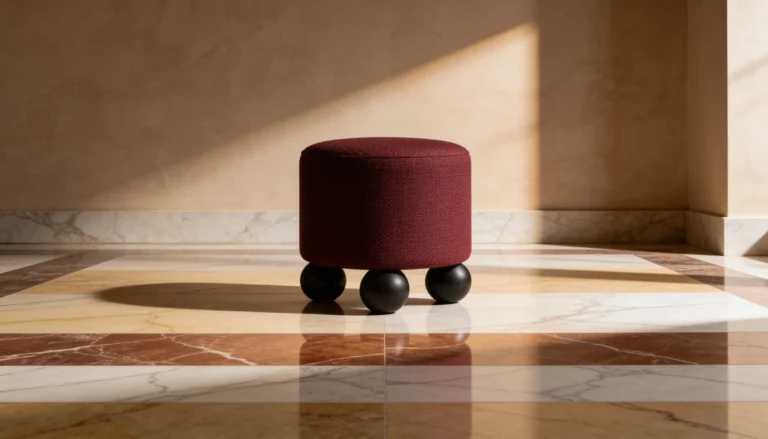
Accent pouf as a soft art object
The pouf is often underestimated. It is perceived as an auxiliary object: placed next to the bed, under the console, in a corner, next to an armchair. But a modern accent pouf can fulfill a much more complex role. It works simultaneously as furniture, decor, seating, compositional focus and soft art object.
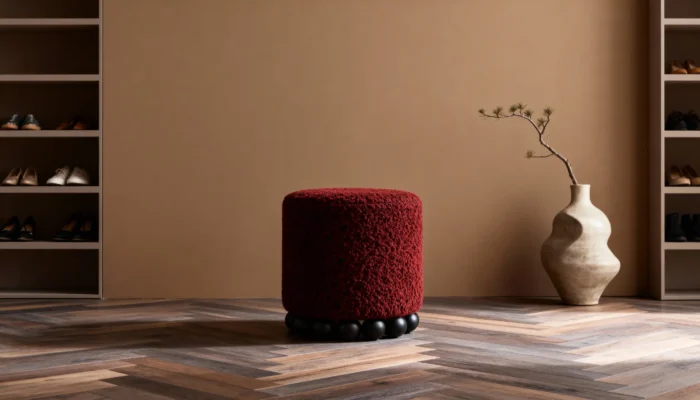
In the bedroom, a round pouf with a wavy print behaves exactly like this. It is not large, not massive, and does not change the entire function of the room. But thanks to its shape and fabric, it immediately makes the space livelier. Before its appearance, the bedroom was soft, warm, cozy, but very calm. After it, a rhythm appeared in it. Not aggressive, not flashy, but natural, as if the room had its own pulse.
In the hallway, a bench with the same mood does another job. It adds not only beauty, but also a scenario: sit down, put down your bag, put on your shoes comfortably, stop for a moment before leaving. This is important, because a good interior not only looks, but also behaves. It should support a person’s daily movements.
In the living room, the accent chair with a print already works stronger – as a full-fledged object of character. Next to the white sofa, it creates a lively asymmetry. The room ceases to be just a “resting area” and becomes a composition where there is a main soft volume, support, graphics, warm wood and a personal accent.
An accent pouf or bench works especially well when you need:
- add character to the interior without renovation;
- support a calm base with one expressive object;
- make the space more photogenic;
- add a landing or pause function;
- to link the colors of wood, textiles and decor;
- create an item that can be customized for a specific room.
It’s important not to confuse accent with random brightness. Brightness can quickly tire you. Accent should work longer: through proportion, quality of form, the right palette and material. That’s why a natural wavy print in brown and cream shades is so successful for these scenes. It’s expressive, but not alien. It’s modern, but not overly trendy. It adds movement, but doesn’t create chaos.
Error → solution
Error: add lots of small decor when the space lacks character.
Decision: Choose one item that will be the main focus.
Error: believe that the accent must be very bright.
Decision: work not only with color, but also with shape, texture, and print.
Error: buy a pouf “wherever it will fit”, without a script.
Decision: determine the role: landing, compositional center, console support, mobile object, soft art object.
Error: Be afraid of prints in a minimalist interior.
Decision: Choose a print that supports the palette and materials of the space.
Error: look for a universal item for any room.
Decision: create a custom-made pouf for a specific interior, size and mood.
This is the power of customization: the item doesn’t just “fit”, but is created for the task.
Hallway, living room, bedroom: three scenarios of the same principle
The same principle—the right accent—works differently in different rooms. That’s why it’s important to consider not only the subject, but also the scenario.
1. Hallway: The first impression starts on the ground floor
The hallway is often decorated functionally: a wardrobe, a mirror, a console, lighting, a place for keys, decor. But this is the area that first meets a person. It sets the tone for the entire house or commercial space.
A printed bench under the console makes the hallway not just more comfortable, but also warmer. It fills the space where there is often an empty niche. At the same time, it does not block the mirror, does not obstruct the passage, does not destroy the minimalist logic. Its rounded legs add lightness, and the print creates visual movement.
In a private interior, this solution speaks of attention to detail. In a salon, studio, hotel or showroom, it speaks of a brand that thinks not only in terms of function, but also in terms of atmosphere.
2. Living room: an accent helps to put together a composition
A living room with a white sofa and a wooden wall has a strong base. But without an additional soft accent, it can look too flat. A wavy-print armchair creates a second focal point. It doesn’t compete with the sofa in scale, but it adds character.
The principle of contrast of form and role works here. The sofa is large, calm, light. The armchair is more compact, expressive, graphic. Together they create a balance: comfort + individuality.
This is especially important for lounge areas, coworking spaces, offices, reception areas or salons. In commercial spaces, furniture often becomes part of the impression of a company. An accent chair or designer ottoman can make a waiting area not just a place to sit, but a space to remember.
3. Bedroom: The accent should be soft but noticeable
The bedroom needs to be delicate. It is not always appropriate to use too sharp colors or large visual gestures. But this does not mean that the bedroom should be faceless. On the contrary, a small accent pouf can be the perfect solution.
The round shape supports the softness of the bed. The print adds rhythm. The brown and cream palette ties together the wood, textiles, vase, mirror and floor. The item is compact but expressive enough to give the room a sense of completion.
Before/after as text infographics
Hallway to: warm base, mirror, console, but empty lower level.
Hallway after: A printed bench adds seating, rhythm, and completeness.
Living room to: white sofa, wood, carpet, table, but little character.
Living room after: An accent chair creates a focal point and deepens the composition.
Bedroom to: a soft neutral space, but without individual detail.
Bedroom after: A round pouf adds expression without disturbing the peace.
In all three cases, the accent works without renovation. There is no need to change the walls, floors, cabinets or main furniture. One precise item is enough.
KAIZEN customization: when the accent is created for the space
A ready-made accent can be beautiful. But it works best when it is created for a specific interior. That is why KAIZEN is developing a studio approach to upholstered furniture: shape, fabric, color, print and size should correspond not to an abstract “trend”, but to a real space.
For a private customer, this means the opportunity to get an item that doesn’t look random. For example, a bedroom pouf can be made in a palette of wood, textiles, and decor. A banquette for the hallway can be made to fit the size of the niche and the height of the console. A living room armchair can be made in a print that supports a painting, carpet, or decorative objects.
For designers, this means a more precise design tool. There is no need to look for a compromise between shape, size and fabric in a ready-made catalog. You can work directly with the manufacturer: coordinate dimensions, texture, print character, fit, proportions, usage scenario.
For corporate customers, customization opens up another level – branding. An accent pouf or printed banquette can become part of the identity of the space. This is important for salons, showrooms, hotels, offices, coworking spaces, reception areas, beauty spaces and studios, where the interior works not only for comfort, but also for impression.
In KAIZEN, you can work with the following parameters:
- object shape: round pouf, bench, armchair, soft module;
- fabric: textured, smooth, velor, boucle, matting, chenille;
- color: from neutral natural shades to deep accent tones;
- art print: organic, graphic, wavy, branded or author’s;
- size: for a niche, bedside area, hallway, lounge or commercial space;
- scenario: seating, decor, mobile object, soft art object.
If the space is almost ready but lacks that very last detail, the best solution is not to buy at random. It is worth writing in Direct KAIZEN, show the interior or references and together determine which accent will work: an ottoman, a banquette, an armchair, a color, a print or a texture.
This saves time, reduces the risk of error, and helps create an item that is not only pleasing on its own, but also works in the room.
How to choose an accent pouf or banquette
An accent piece should be bold, but not random. This is where the line between “stylish” and “superfluous” is drawn. To make an ottoman look natural in an interior, you need to evaluate not only the object itself, but the entire space.
7 steps to making the right choice
- Define the role of accent.
Should the pouf be a main piece, a support for the sofa, a seat, a bedside element or an accent under the console? - Look at the base palette.
If the room is neutral, the accent can be a deeper color or a more vibrant print. If the space is already saturated, it’s better to work more delicately. - Evaluate the shapes next to each other.
A round mirror, soft bed, rounded table, or smooth lines of decor well support a pouf with a radial shape. - Consider the print.
It should not only be pleasing to the eye, but also maintain the rhythm of the interior. Organic waves work well with wood, natural fabrics, and a warm palette. - Consider the scale.
A small pouf can get lost in a large room, and a too-large bench can overwhelm a hallway. The proportions need to be just right. - Check the function.
Will it be comfortable to sit on? Will it not obstruct the passage? Is mobility required? Will it have to withstand daily commercial traffic? - Support the accent with details.
The color or mood of the pouf can be repeated in a vase, book, decorative object, pillow, painting, or textile.
This approach is especially important for minimalist interiors. In them, every detail is noticeable. If the object is random, it is immediately visible. If it is precise, it elevates the entire space.
The right accent doesn’t scream. It attracts.
Less details, more character
The final principle of the post sounds simple: less is more. But in the interior, it’s not about emptiness. It’s about precision.
One accent ottoman can be more powerful than ten small decorative items. One printed bench can change a hallway more than another vase. One chair with a statement fabric can make a living room livelier than a set of random pillows. One round ottoman in a bedroom can add character without losing peace.
Everything returns to the first scene: light, wood, mirror, console, silence, the right base — and the feeling that the room is waiting for the final move. Then the accent appears. Not superfluous. Not accidental. Not loud for the sake of loudness. But one that gathers the space into a coherent image.
That’s why an accent pouf is not a small decoration or a secondary purchase. It’s a way to change the character of the interior without renovation, without overloading and without losing minimalism. The space gains focus, the person – comfort, and the room – its own voice.
This principle is further explained in Instagram posts about the right accent in the interior, where a short visual scenario shows the main thing: sometimes a room lacks not furniture, but one expressive detail.
If you feel that your hallway, living room, bedroom, salon, office or showroom space also needs such a detail, the next step is simple: write in Direct KAIZEN and discuss which accent will work best in your interior – a designer pouf, a printed banquette, an armchair, color, texture, or a custom art print.